The hantavirus cruise story is a contact-tracing calendar, not a general alarm
ECDC says the risk to the wider European public is very low. The useful lesson is how a rare cruise-ship outbreak becomes a weeks-long contact list.
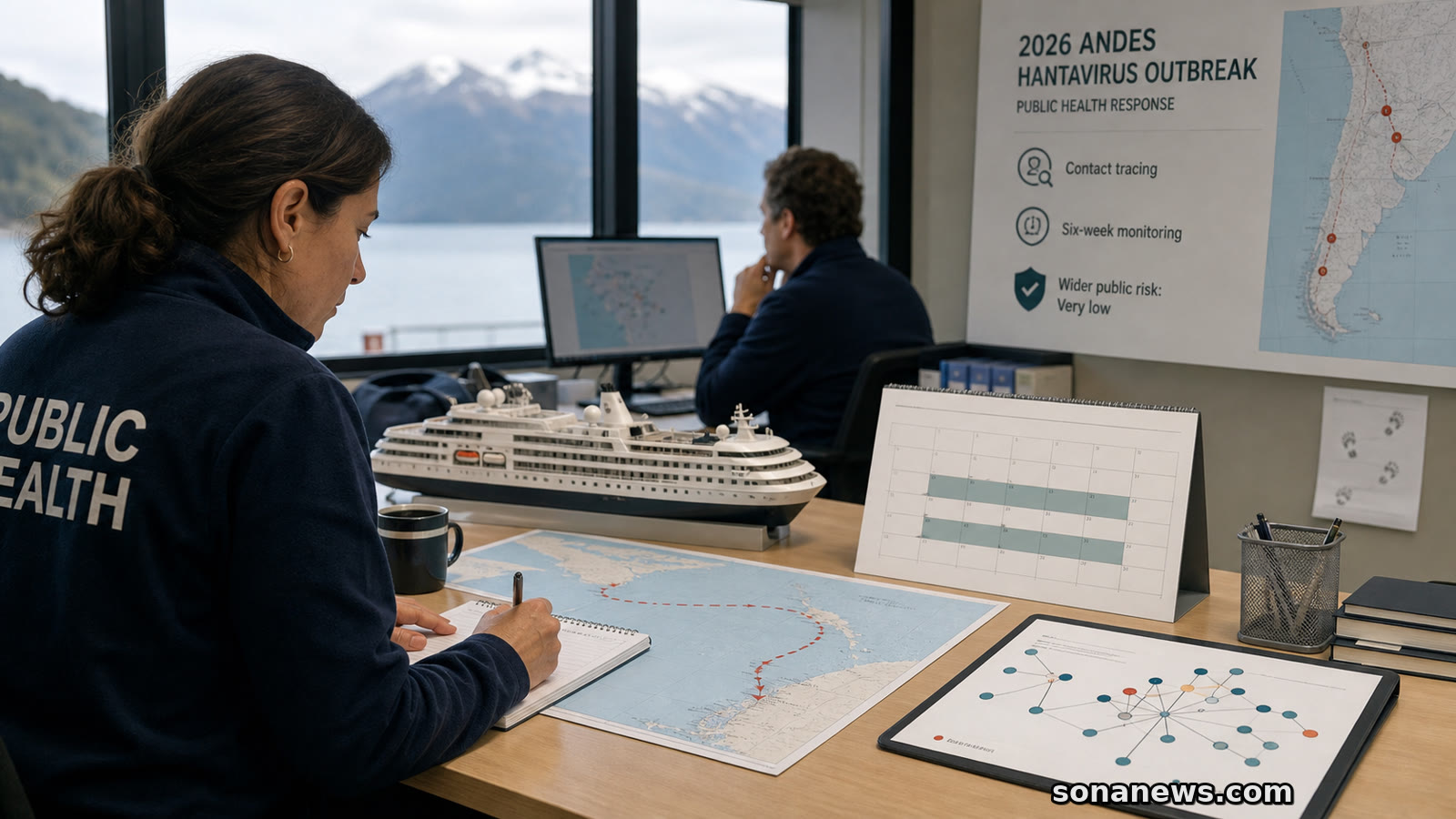

A rare outbreak on a cruise ship can sound larger than it is. The official picture from the European Centre for Disease Prevention and Control is more precise, and more useful: a defined group of people, a long incubation window, contact monitoring, and a public risk assessment that remains very low for the wider population.
ECDC says it was notified on 2 May 2026 of a cluster of severe respiratory illness on MV Hondius, a Dutch-flagged cruise ship carrying passengers and crew from 23 countries. The virus was identified as Andes hantavirus. As of ECDC’s 17 June update, 13 cases had been reported in total, including 12 confirmed cases and one probable case. Three deaths had been reported. Public health authorities were still monitoring identified contacts, while some contacts had already completed quarantine.
Those facts belong together. The case count is serious for the affected people and families. It is also not evidence of a fast-moving public threat. ECDC’s assessment says the likelihood of additional cases linked to the event is very low and the risk to the general population in the EU and EEA remains very low. Its Q&A is even plainer: this is not considered a pandemic threat.
The reason is transmission. Hantaviruses are usually linked to exposure to infected rodents or their urine, droppings or saliva. WHO’s hantavirus fact sheet says Andes virus, found in South America, is the currently known hantavirus for which limited human-to-human transmission among contacts has been documented. CDC says the same thing in slightly different terms: Andes virus is the only type of hantavirus known to spread person to person, and that spread is usually limited to people who have close contact with the ill person.
That distinction is why the cruise-ship story is best understood as a contact-tracing story, not a general travel scare. ECDC says Andes hantavirus does not spread easily between people and that transmission tends to require very specific close-contact situations. The agency also notes that the natural rodent reservoir for Andes virus is not present in Europe, which lowers the concern about ongoing community spread there.
The calendar matters because the illness does not always announce itself quickly. ECDC’s Q&A says there is often an incubation period of about two to four weeks, while longer incubation periods up to 42 days have been reported. That is why some public-health advice around this event has used a six-week quarantine or monitoring window for certain contacts. A person can leave the ship, go home, and still sit inside the relevant observation period.
This is where public health can look both strict and calm at the same time. Strict, because named contacts may be asked to follow specific instructions, limit contact with others, or stay in touch with health authorities for weeks. Calm, because those measures are targeted at people with a defined link to the outbreak, not at the general public. The line between those two messages is the difference between risk management and alarm. It also helps readers understand why a small group may receive detailed guidance while most people receive reassurance.
It is also a reminder that health risk is not only a property of a virus. It is shaped by setting. A ship is a bounded place with shared spaces, itineraries, cabins, passenger lists and crew records. That makes it possible to build a contact list, but it also means officials have to work across borders when passengers and crew come from many countries. ECDC’s role here has been coordination, guidance and updates, rather than telling every European traveller to change behaviour.
The language around care needs similar caution. WHO says there is no licensed specific antiviral medicine or vaccine for hantavirus infection, and that early supportive medical care is important for survival when severe disease occurs. That is not a basis for self-assessment from an article. It is a reason to rely on official contact advice and clinician assessment as the relevant channels for people connected to the event.
For everyone else, the durable lesson is less dramatic. A health story can be serious without being broadly threatening. The facts that matter are not only the case count, but also the route of transmission, the contacts identified, the incubation window, the public-risk assessment and whether authorities can still link new cases to the original event. In this outbreak, ECDC’s latest public message is that the wider risk remains very low. The public-health machinery behind that message is a calendar, a contact list and a careful refusal to turn a rare event into a general alarm.
Editorial note. This article is for general public-health information only and is not medical advice. It does not assess any individual exposure, symptom, contact status, travel decision or quarantine requirement. People linked to an outbreak, concerned about symptoms or contacted by public-health authorities should use current official public-health and qualified clinician guidance.
Sources
- Source: "Andes hantavirus outbreak in cruise ship", European Centre for Disease Prevention and Control, Extracted 2026-06-23. Verified: outbreak setting, MV Hondius, 23 countries, 13 total cases, 12 confirmed, one probable, three deaths, contact monitoring, and very-low risk assessment for additional cases and the general EU/EEA population
- Source: "Questions and answers on the hantavirus outbreak in a cruise ship", European Centre for Disease Prevention and Control, Extracted 2026-06-23. Verified: very-low public risk, Andes virus person-to-person context, close-contact framing, not a pandemic threat, incubation period and 42-day quarantine rationale
- Source: "Hantavirus", World Health Organization fact sheet, Extracted 2026-06-23. Verified: rodent exposure routes, Andes virus as the known hantavirus with documented limited human-to-human transmission, uncommon spread and supportive medical-care context
- Source: "About Hantavirus", Centers for Disease Control and Prevention, Extracted 2026-06-23. Verified: hantavirus overview, rodent transmission, Andes virus person-to-person exception and close-contact limitation
- Source: "Outbreak of Andes virus 2026 - Recommendations for self-quarantine", European Centre for Disease Prevention and Control, Extracted 2026-06-23. Verified: existence of ECDC self-quarantine guidance for asymptomatic contacts tied to the 2026 Andes virus outbreak
Help us improve
Was this article useful?
One anonymous tap helps Sona improve future reporting, headlines and source context.
Up next

Primary school sessions begin this week, with secondary pupils following later in autumn. For most families, the practical deadline comes from the local school immunisation team.
Continue readingMore in Health