The next health alert may start outside the clinic
WHO’s latest One Health update is a useful reminder that public-health signals now move through animals, water, food systems, climate and labs before they become a clinic story.
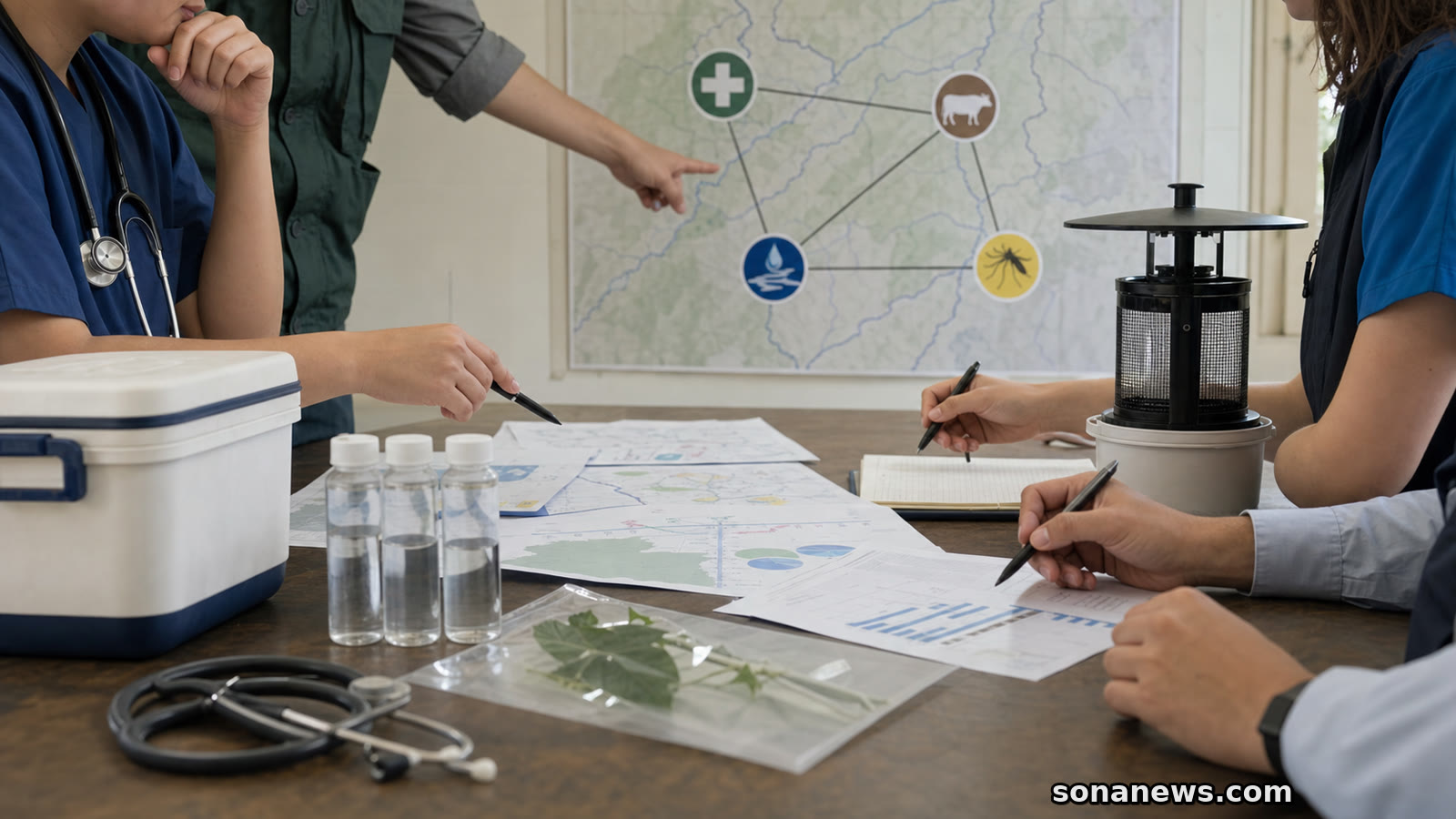

A public-health alert does not always begin with a patient in a waiting room. It may begin with a water sample, an unusual pattern in animals, a mosquito trap, a food-safety investigation, a farm report, or a lab result that only makes sense when several systems talk to each other.
That is the plain-language value of One Health, a phrase that can sound like conference wallpaper until a real alert arrives. In a 25 June update, the World Health Organization said experts meeting in Lyon had pushed for One Health work to move beyond awareness-raising and into practical, scalable implementation. The emphasis was not on inventing another slogan. It was on people, training, mentorship, communities of practice, cross-sector partnerships, governance, data sharing and systems that can act together.
The idea is simple, even if the machinery is not. WHO defines One Health as an integrated approach that aims to balance and optimise the health of people, animals and ecosystems. It is most often discussed when an infection can move between animals and humans, but the frame is wider than that. WHO links it to emerging infectious diseases, zoonotic diseases, antimicrobial resistance, food safety, ecosystem health and global health security.
CDC describes the same connection in more domestic terms: the health of people is closely connected to the health of animals and the shared environment. Its One Health material points to population growth, changing land use, climate pressure and the movement of people, animals and animal products as conditions that can create new routes for disease to spread. Animals can also be an early warning system. CDC gives the example of birds dying from West Nile virus before people in the same area become sick.
For readers, that matters because official health warnings increasingly sound less like a single medical bulletin and more like a chain of clues. A notice about poultry, ticks, wastewater, river quality, animal medicines, livestock movement or imported food is not a detour from human health. It can be the upstream part of the human-health story.
The Lyon update is careful about a familiar weakness in global health language: everyone can agree with coordination in principle, but coordination fails in practice when no one knows who owns the data, who calls the meeting, who pays for staff, or how a local signal reaches a national decision. WHO said the central challenge is turning One Health concepts into coordinated, measurable and operational action. That is dull phrasing, but it is the useful part.
The Quadripartite One Health Joint Plan of Action, developed by WHO, FAO, UNEP and the World Organisation for Animal Health, puts the same ambition into a 2022-2026 framework. Its aim is to help countries and partners prevent, predict, detect and respond to health threats at the human-animal-plant-environment interface. The plan talks about collaboration, communication, capacity building and coordination, not as public-relations extras but as the wiring needed before a crisis.
A useful public reading avoids two opposite mistakes. The first is reading every animal, climate or environmental signal as an immediate personal danger. That turns surveillance into anxiety. The second is dismissing those signals because they are not yet a hospital headline. That misses the point of early detection. One Health sits between those mistakes: notice patterns early, connect the right expertise, and avoid pretending that a human clinic can see every risk by itself.
There is also a fairness issue. If richer health systems build better links between laboratories, veterinary services, environmental monitoring and hospitals while poorer systems are left with paper reports and fragile staffing, the result is another surveillance gap. WHO’s Lyon update focused on capacity-building partly because a shared framework is only as strong as the people and institutions able to use it locally.
This is not advice for an individual symptom, pet, farm, pregnancy, food recall or travel decision. Those situations still need current local public-health information and qualified clinical or veterinary guidance. The broader point is civic rather than clinical. When a health agency talks about animal health, water, plants, climate or data systems, it is often describing the hidden part of prevention. That quiet plumbing is part of the story.
The next health alert may still arrive as a short notice on a government website. But behind it there may be a veterinarian, a water laboratory, an environmental team, a food inspector, a clinician and a data analyst trying to read the same pattern before it grows. One Health is the name for making that conversation less accidental.
Editorial note. This article is for general public-health information only. It is not medical, veterinary, food-safety, travel or legal advice, and it does not assess any individual symptom, exposure, animal, workplace, home, trip or product. For personal health concerns or urgent risks, use current local public-health information and qualified professional guidance.
Sources
- Source: "One Health experts in Lyon chart path from commitment to coordinated action on capacity-building", World Health Organization, Extracted 2026-06-27. Verified: the 25 June 2026 Lyon update, the push beyond awareness-raising, the focus on practical scalable implementation, people, training, mentorship, cross-sector partnerships, mapping, governance, data sharing and interoperability
- Source: "One health", World Health Organization, Extracted 2026-06-27. Verified: WHO’s definition of One Health as an integrated approach balancing the health of people, animals and ecosystems, and its relevance to emerging infectious diseases, zoonoses, antimicrobial resistance, food safety, ecosystem health and global health security
- Source: "About One Health", Centers for Disease Control and Prevention, Extracted 2026-06-27. Verified: CDC’s explanation of the connection between human, animal and environmental health, the role of population growth, land-use and climate changes, movement of people and animals, and the example of birds as West Nile early-warning indicators
- Source: "One health joint plan of action (2022-2026): working together for the health of humans, animals, plants and the environment", World Health Organization, Extracted 2026-06-27. Verified: the Quadripartite collaboration between FAO, UNEP, WOAH and WHO, and the plan’s purpose of supporting One Health implementation at global, regional and country level
- Source: "One Health Joint Plan of Action (2022 - 2026)", United Nations Environment Programme, Extracted 2026-06-27. Verified: the plan’s aim to help prevent, predict, detect and respond to health threats through collaboration, communication, capacity building and coordination across sectors
Help us improve
Was this article useful?
One anonymous tap helps Sona improve future reporting, headlines and source context.
Up next

Primary school sessions begin this week, with secondary pupils following later in autumn. For most families, the practical deadline comes from the local school immunisation team.
Continue readingMore in Health