IMAP's first public release has seven data streams, not a finished heliosphere map
NASA has opened measurements from seven of IMAP's ten instruments. The absent trio explains why this milestone is not yet the mission's defining map.
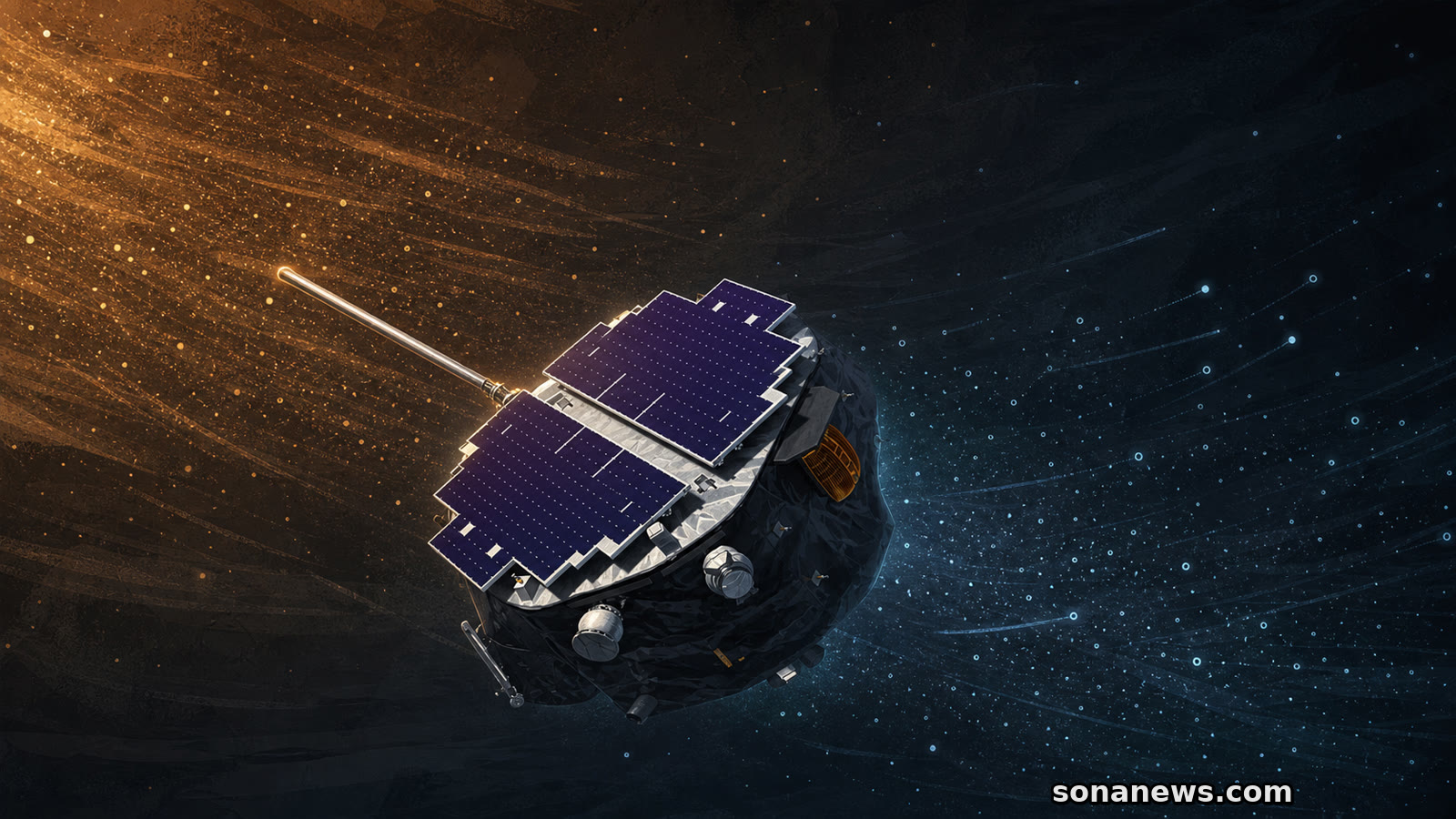

NASA has published the first broad set of science files from its Interstellar Mapping and Acceleration Probe, or IMAP. The release is substantial: measurements from seven instruments now cover the mission's opening months at its observing station between Earth and the Sun.
It is also narrower than the phrase "first data" can sound. [NASA's August 7 release](https://science.nasa.gov/blogs/imap/2026/08/07/nasas-imap-mission-releases-new-data-from-7-science-instruments/) says the files extend through April 30, 2026 and come from seven of the spacecraft's ten instruments. NASA says all ten are collecting data, while three datasets are not yet ready for release.
That distinction matters. This is an archive milestone, not an announcement of a new boundary around the solar system, a finished map of the heliosphere or a space-weather alert.
IMAP began its two-year primary science mission on February 1 after reaching the Sun-Earth L1 region, roughly one million miles from Earth toward the Sun. From there, the spinning spacecraft samples particles and fields moving through its neighbourhood while other instruments look outward for signals carried from much farther away.
The seven newly available streams do not all measure the same thing.
MAG records the interplanetary magnetic field. SWAPI counts solar-wind ions and ions that began as neutral particles from interstellar space before the solar wind picked them up. SWE measures solar-wind electrons. Together, those instruments describe parts of the plasma and magnetic environment passing the spacecraft.
HIT measures high-energy ions from the Sun and deep space, while CoDICE separates ions by properties including composition and charge across a broad energy range. GLOWS observes ultraviolet glow associated with the solar wind, giving researchers another way to study its large-scale structure. IDEX measures the composition of individual interstellar and interplanetary dust grains.
Putting those products in one public archive gives researchers complementary evidence rather than seven copies of one view. A change in energetic particles can be compared with the local magnetic field, solar-wind conditions and particle composition. Dust measurements answer a different question again: what solid material from between the stars is reaching the inner solar system?
The files are available through NASA's [Space Physics Data Facility](https://spdf.gsfc.nasa.gov/), the agency's long-term archive for heliophysics data. Public availability lets teams outside the instrument collaborations inspect the records, compare them with other missions and test their own analyses.
The release post lists the seven instruments but does not name the three absent datasets. Comparing that list with [NASA's ten-instrument roster](https://science.nasa.gov/mission/imap/) identifies IMAP-Lo, IMAP-Hi and IMAP-Ultra as the unreleased trio.
Those are the mission's energetic neutral atom imagers. Across different energy ranges, they are designed to detect uncharged particles arriving from the heliosphere's distant boundary. Because neutral atoms are not steered by magnetic fields in the way charged particles are, their arrival directions can be used to reconstruct where they came from. Accumulated over time, those detections can form maps of an otherwise invisible region billions of miles away.
That is why the first seven-stream release should not be described as IMAP's completed heliosphere map. The public files already cover valuable local and global measurements, including magnetic fields, solar-wind particles, ultraviolet glow and dust. But the three instruments most directly associated with the mission's neutral-atom maps are not part of this tranche.
NASA's post only says their data is not yet ready for release. It does not give a reason or a publication date. That wording supports neither a claim that the instruments have failed nor a promise that their files are imminent.
IMAP also has a near-real-time role. Its I-ALiRT system broadcasts selected measurements of the solar wind and energetic particles at high cadence. At L1, the spacecraft can provide roughly half an hour of notice before some conditions moving outward from the Sun reach near-Earth space.
That feed and the science archive serve different jobs. A forecasting stream prioritises speed and continuity. Archival science products need stable formats, documented processing and enough review for researchers to reuse them. The presence of near-real-time measurements therefore does not mean every instrument's full science product should appear immediately, and a later archive release does not make the fast feed redundant.
For readers, the useful check is the date range attached to each product. The August announcement was published months after IMAP's primary mission began, and the released records stop at April 30. Any analysis of a later solar event would need later data, whether from I-ALiRT or a subsequent archival delivery.
The next important step is not simply a larger file count. It is a documented analysis that joins measurements in a way that constrains a physical question.
Researchers could compare particle acceleration with changing magnetic-field and solar-wind conditions. Dust compositions could help distinguish material originating inside the solar system from grains arriving from interstellar space. GLOWS measurements can add broad context for how the solar wind varies across the sky.
For the mission's signature cartography, watch for calibrated releases from IMAP-Lo, IMAP-Hi and IMAP-Ultra, followed by maps or peer-reviewed analyses that explain how the teams handled background, viewing geometry and uncertainty. A first map would still be an early measurement, not a permanent outline: the heliosphere responds to changing solar and interstellar conditions.
The honest significance of this release is simpler. IMAP has moved from a spacecraft collecting measurements for its own teams to a public observatory with seven distinct datasets that other researchers can examine. The defining map remains work to be shown.
Sources
- NASA: IMAP Mission Releases New Data from 7 Science Instruments. Published 7 August 2026. Verified the release date, seven named instruments, data coverage through 30 April, all ten instruments collecting, three datasets not ready, public archive and I-ALiRT distinction
- NASA Science: Interstellar Mapping and Acceleration Probe mission overview. Accessed 9 August 2026. Verified L1 location, ten-instrument roster, mission objectives, energetic-neutral-atom mapping mechanism, I-ALiRT purpose, dust role and approximate warning time
- NASA: IMAP Begins Primary Science Mission. Published 2 February 2026. Verified primary-science start on 1 February, two-year primary mission and spacecraft arrival at L1
- Princeton University IMAP mission: Instruments. Accessed 9 August 2026. Verified that IMAP-Lo, IMAP-Hi and IMAP-Ultra collect and map energetic neutral atoms across complementary energy ranges
- NASA Space Physics Data Facility. Accessed 9 August 2026. Verified SPDF's role as NASA's active permanent archive for space-physics data and its support for cross-mission public access
Help us improve
Was this article useful?
One anonymous tap helps Sona improve future reporting, headlines and source context.
Up next
Hubble data trace a 10-sided atmospheric wave from faint 2023 hints to a clearer 2025 pattern. Its slow drift and 32-day wobble do not yet explain why it formed.
Continue readingMore in Space