The reading habit is becoming a stack of formats
A 2026 Pew survey, NEA arts data and audiobook industry figures suggest the real shift is not print losing to screens. It is readers moving between paper, phone, library app and headphones.
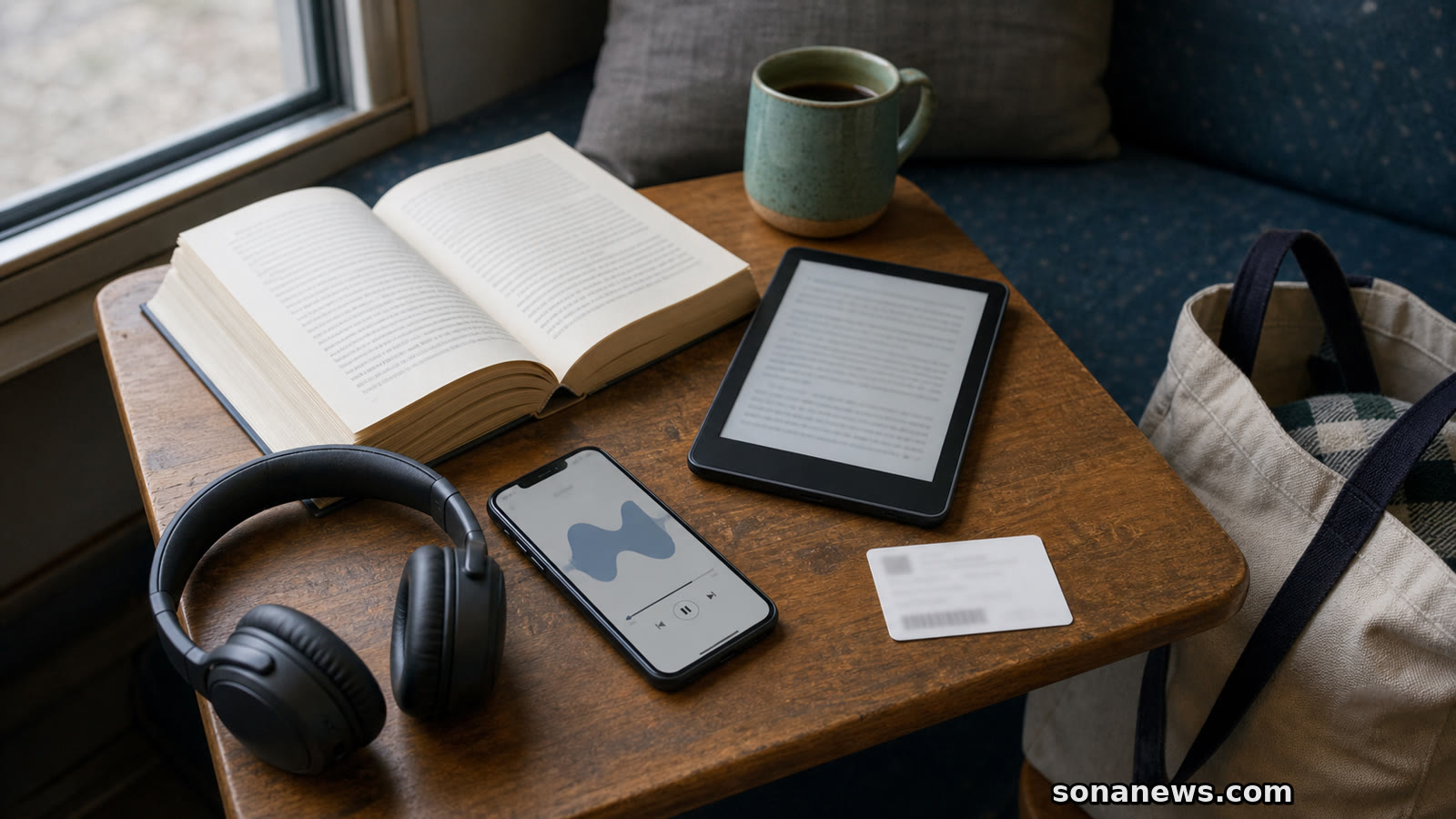

The argument about books often arrives in a theatrical form: print is dying, screens are flattening attention, audiobooks are cheating, algorithms are eating the bookshop. The data tell a less dramatic and more useful story. Reading has not become one habit. It has become a stack of formats, each fitted into different pieces of the day.
Pew Research Center's April 2026 analysis is a good antidote to the panic version. In a survey conducted in October 2025, 75% of U.S. adults said they had read all or part of at least one book in the previous 12 months. Print was still the only format used by a majority: 64% had read a physical book. E-books were at 31%, and audiobooks at 26%. Since Pew first asked the question in 2011, e-book reading has risen from 17% and audiobook listening from 11%, while print has slipped but remained the largest format.
That does not look like a clean replacement story. It looks like a household and lifestyle story. A paperback still works on a bedside table, in a bath, on a beach or as a gift. An e-book works when luggage is tight, the font needs changing or a library copy lands instantly. An audiobook works on a walk, during laundry, in a car or while cooking. The object changes because the available time changes.
The key phrase is not "people have stopped reading" or "print has won". It is context switching. The same reader might buy a hardback by a favourite author, borrow a digital thriller from the library, listen to a memoir at the gym and abandon an e-book sample after three pages. None of that fits neatly into the old culture-war shelf where serious reading sits on one side and digital convenience sits on the other.
Pew's demographic details also caution against turning the format stack into a universal lifestyle pose. College graduates were far more likely to have read a book in the past year, 88%, than adults with a high school education or less, 60%. Younger adults were more likely than older adults to use e-books and audiobooks. Book clubs, despite their social-media visibility, remained uncommon: only 7% of adults said they had participated in one in the past year.
So the public image of reading may now be louder than the private routine. A photographed stack of novels, a club night, a tote bag from an independent shop and a clipped audiobook recommendation can make books feel socially abundant. The survey suggests a quieter reality: most adults still touch books in some form, but the organised social version of reading is a minority activity, and access remains uneven.
The National Endowment for the Arts gives the necessary counterweight. Its 2024 review of federal data noted that the 2022 Survey of Public Participation in the Arts found 48.5% of U.S. adults had read at least one book for pleasure in the previous year, down from 54.6% in 2012. The share reading a novel or short story was 37.6% in 2022, also down from 2012. These figures are not the same as Pew's broader question about reading any part of a book, and they should not be treated as interchangeable. But the tension matters. A country can still have many adults who read something, while fewer people maintain pleasure reading as a steady cultural habit.
Audiobooks help explain why the boundary is getting fuzzier. The Audio Publishers Association's 2026 research facts say publisher receipts in 2025 totalled $2.43 billion, continuing 15 years of year-on-year growth. It also says 58% of Americans aged 18 and older have listened to an audiobook, and that listeners cite multitasking and listening on the go as leading benefits. In other words, audio is not simply a substitute for the printed page. It is a way of squeezing narrative, learning or company into time that used to be too awkward for a book.
That convenience has its own compromises. A book heard while unloading a dishwasher is not experienced in the same way as one read alone in a quiet room. Some listeners will absorb more, some less, and some will use audio for genres they would never sit down to read. The point is not to rank the formats by purity. It is to notice how modern reading is being bent around work, care, travel, screen fatigue and subscription habits.
Publishing revenue points to the same mixed picture. The Association of American Publishers reported that U.S. trade, or consumer book, revenues were down 0.5% year-to-date in 2025 at $9.8 billion. Hardback revenues were up 2.4%, paperbacks were down 3.4%, e-book revenues were down 0.3%, and digital audio was up 2.1%, with both e-books and digital audio around $1 billion. AAP also notes that its StatShot data are reported by participating publishers and can be restated. Still, the shape is clear enough: the market is not running in one direction.
For readers, the most practical implication is cultural rather than instructional. The book is now less a single object than a set of permissions. It can be owned, borrowed, streamed, downloaded, gifted, displayed, hidden on a phone, heard through headphones or left half-finished in three different places. That flexibility may keep more people attached to books. It may also make deep, private, unmeasured reading harder to protect.
The healthier story is the less triumphal one. Print did not vanish. Digital did not rescue reading on its own. Audio did not make attention effortless. The reading habit that survives in 2026 is messier: a paperback next to the bed, an app notification from the library, a pair of headphones in a bag and a reader trying to make a little space between everything else.
Editorial note. This article discusses reading habits, publishing formats and consumer behaviour. It is not educational, medical, financial, legal, accessibility or purchasing advice.
Sources
- Pew Research Center - "Americans still opt for print books over digital or audio versions; few are in book clubs" - - extracted 2026-06-27. Verified: April 9, 2026 publication, October 6 to 16, 2025 survey of 8,046 U.S. adults, 75% reading all or part of a book in the past 12 months, 64% print, 31% e-book, 26% audiobook, 88% of college graduates reading a book compared with 60% of adults with high school education or less, and 7% book club participation
- National Endowment for the Arts - "Federal Data on Reading for Pleasure: All Signs Show a Slump" - - extracted 2026-06-27. Verified: October 3, 2024 NEA research blog, 2022 Survey of Public Participation in the Arts figures showing 48.5% of adults read at least one book for pleasure, down from 54.6% in 2012, and 37.6% read a novel or short story in 2022
- Audio Publishers Association - "APA Research Facts" - - extracted 2026-06-27. Verified: publisher receipts of $2.43 billion in 2025, 58% of Americans aged 18 and older having listened to an audiobook, multitasking cited by 86%, listening on the go by 84%, digital audiobooks accounting for 99% of revenue, and survey timing in Spring 2026
- Association of American Publishers - "AAP December 2025 StatShot Report" - - extracted 2026-06-27. Verified: February 11, 2026 release, year-to-date trade revenues of $9.8 billion, hardback revenue up 2.4%, paperback down 3.4%, e-book revenue of $1 billion down 0.3%, digital audio revenue of $1 billion up 2.1%, and StatShot methodology caveats
Help us improve
Was this article useful?
One anonymous tap helps Sona improve future reporting, headlines and source context.
Up next
Across 11 experiments, people were more willing to give when invited to continue a run of donors. The effect offers a useful lesson about social signals, and a warning about how easily momentum can be staged.
Continue readingMore in Lifestyle