Accessibility is moving into the checkout sprint
The European Accessibility Act has turned e-commerce, banking, tickets and connected devices into ordinary release-work questions, not a last-minute compliance slide.
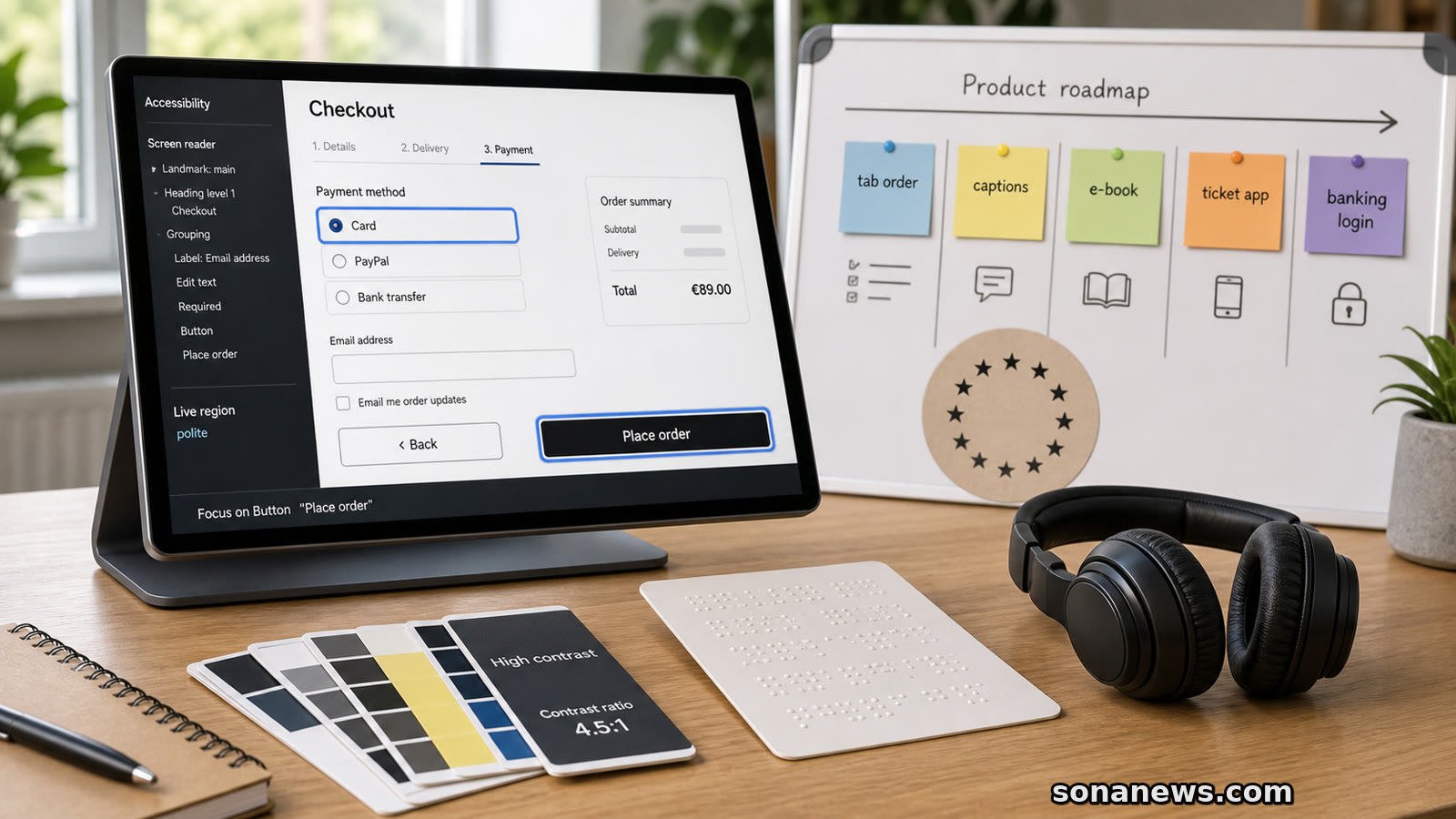

Accessibility on the web is often described as a moral principle, which it is. The more immediate technology change is more prosaic: it is becoming a release criterion.
The European Accessibility Act began to apply across the EU on 28 June 2025. It is not a new slogan about inclusive design. It is a 2019 directive that sets common accessibility requirements for a defined list of products and services, including computers and operating systems, smartphones, payment terminals, ATMs, ticketing and check-in machines, consumer banking, e-books, electronic communications, some transport information and ticketing services, and e-commerce.
That list matters because it pulls accessibility out of the specialist corner of a website audit and into ordinary product work. A checkout flow, a banking login, an e-book reader, a ticket app or a self-service terminal now sits closer to the same release conversation as security, payments and uptime. Can the service be reached without a mouse? Is the information about the service available in an accessible way? Are support channels able to answer accessibility questions? Are mobile services, electronic tickets and travel information usable by people who rely on assistive technology?
The Commission frames the law as a single-market measure as well as a disability-rights measure. Before the Act, companies faced a patchwork of national accessibility rules. The directive is meant to reduce those barriers by making requirements more consistent across EU countries. That is the dry policy language. The practical effect is that a product team serving EU users has less room to treat accessibility as optional polish added after launch.
This is not only about public-sector websites. The Commission's own list includes e-commerce, banking, e-books, phones and computers. EUR-Lex also lists services such as telephony, access to audiovisual media services and certain passenger-transport elements, including websites, mobile services, electronic tickets and travel information. AccessibleEU, an EU accessibility centre, describes the law as covering emergency number 112, banks, public transport and products such as smartphones, computers, digital books and e-commerce platforms.
For readers, the visible changes may be small but consequential. A payment button with adequate contrast is not glamorous. A keyboard focus ring is not a feature launch. A checkout page that works with a screen reader will not trend like a new phone. But these are the moments where a service either includes people or silently filters them out. The Act makes those small interface decisions harder to dismiss as edge cases.
There is also a useful correction to the usual platform story. Accessibility is not just a matter of adding a widget. The law points to information, instructions, interfaces, support services, policies and procedures. That wider scope is important because a technically neat page can still fail users if the contract, help desk, ticketing journey or cancellation route is unreadable. Digital accessibility lives in the whole service, not only in the front-end component library.
The deadline did not arrive without warning. The directive was adopted in 2019, and the June 2025 application date gave companies years to prepare. Even so, many organisations tend to discover accessibility when a redesign is already late, when a legal team asks for a statement, or when a user complaint exposes a basic failure. The better operational lesson is boring and valuable: build accessibility checks into design reviews, acceptance criteria, procurement, QA and customer support before launch day.
There are limits to the story. The Act does not mean every digital page in Europe is suddenly accessible. EUR-Lex notes exclusions, including microenterprises providing services and some older archived or time-based content. The detailed enforcement picture also depends on national implementation rather than one single EU pop-up. Some services will improve faster than others. Some companies will do the minimum. Others will use the harmonised rules as a reason to standardise better design across markets.
That unevenness is exactly why this belongs in the product roadmap, not only in a legal memo. Accessibility debt behaves like other technical debt. It compounds when teams ship inaccessible patterns repeatedly, then try to fix them in a rush across hundreds of screens. It is cheaper and kinder to make the default checkout component, account flow, document template and support script accessible from the start.
For technology companies outside the EU, the lesson is still visible even if the legal analysis is local. Large product stacks rarely stay neatly inside one jurisdiction. If an e-commerce flow, e-book platform, device interface or travel app is being built for multiple markets, a common accessibility baseline can be simpler than maintaining a separate version that works worse for disabled users.
The European Accessibility Act will not make digital life fair by itself. Laws do not write usable alt text, test a screen-reader path or train support staff to answer a practical question. But they do change what counts as normal work. Accessibility is moving from the kindness paragraph to the sprint ticket. The most telling sign may be a little blue focus outline on a checkout button, treated not as decoration, but as part of the product promise.
Editorial note. This article is general technology and regulation information. It is not legal advice, compliance advice or a recommendation about any product, service, accessibility standard or business strategy.
Sources
- Source: European Commission, "The EU becomes more accessible for all", Extracted 2026-06-30. Verified: the European Accessibility Act entered into application on 28 June 2025, covers key products and services such as phones, computers, e-books, banking services and electronic communications, and is framed around common accessibility requirements across the EU
- Source: European Commission, "European Accessibility Act (EAA)", Extracted 2026-06-30. Verified: the EAA is a directive intended to improve the internal market by removing barriers caused by divergent Member State rules, and covers computers and operating systems, ATMs, ticketing and check-in machines, smartphones, TV equipment, telephony, audiovisual media access, passenger transport services, banking, e-books and e-commerce
- Source: EUR-Lex, "Accessibility of products and services", Extracted 2026-06-30. Verified: Directive (EU) 2019/882 applies from 28 June 2025, lists covered products and services, notes requirements for websites, mobile services, support systems and service information, and records exclusions including microenterprises providing services and some older archived content
- Source: EUR-Lex, "Directive (EU) 2019/882 of the European Parliament and of the Council of 17 April 2019", Extracted 2026-06-30. Verified: directive identity, adoption date, Official Journal publication, in-force status and EEA relevance
- Source: AccessibleEU Centre, "A new era for inclusion begins: The EAA enters into force", Extracted 2026-06-30. Verified: examples including 112, banks, public transport, computers, smartphones, e-commerce platforms, televisions and digital books, plus the centre's statement that service providers must train around disability and accessibility
Help us improve
Was this article useful?
One anonymous tap helps Sona improve future reporting, headlines and source context.
Up next

The coming Android 16 feature lets Gemini save where you say you left keys or a passport. That can be useful, but it only knows the location you entered.
Continue readingMore in Tech