The party favour check starts with the battery door
A June CPSC recall of Honlyne LED party supplies shows why light-up glasses, clips and finger lights deserve a button-battery check before children handle them.

Glow sticks and light-up glasses usually enter a house as harmless background noise: a birthday bag, a school disco extra, a garden party box ordered in advance and forgotten until the guests arrive. The new U.S. recall of Honlyne LED party favours is a reminder that the smallest part of that box can be the part worth checking first.
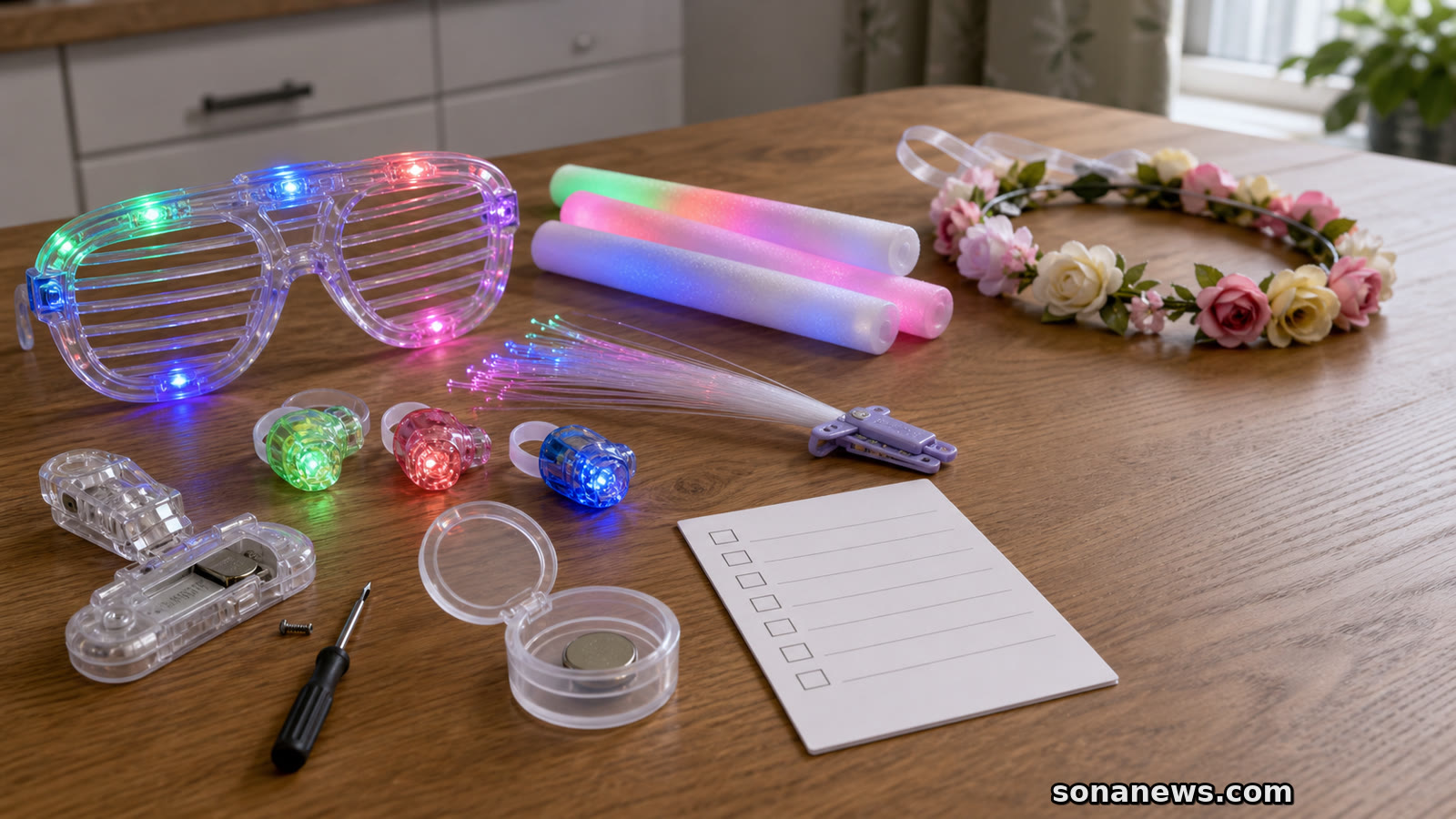
The Consumer Product Safety Commission announced the recall on 25 June 2026. It covers about 13,400 Honlyne LED Party Favors sets sold on Amazon from June 2024 through December 2025 for about $49. The set is not a single toy. CPSC describes a large party-supply pack with LED hair fibre-optic clips, LED glasses, foam glow sticks, light-up flower crowns, finger lights and glow sticks. The packaging can be identified by phrases including "Light Up Party Toy", "Brand: Honlyne", "Product Name: Glow in the Dark Party Supplies" and model number HON-302HE.
The hazard is specific and serious. CPSC says the light-up products contain button cell batteries that can be easily accessed by children, which violates the mandatory safety standard for consumer products with button cell batteries. The agency's recall notice says swallowed button cell or coin batteries can cause serious injuries, internal chemical burns and death. No incidents or injuries had been reported in the recall notice, but the absence of reported injuries is not the same as a product passing the household test.
That household test is deliberately unglamorous. Before a light-up favour is handed out, an adult can look for the battery door, the screw or locking mechanism, and any loose or cracked compartment. If a product is part of a named recall, the official recall route matters more than improvisation. In this case, CPSC tells consumers to stop using the recalled party favours immediately, dispose of the recalled products, take a clear photo of them in the trash, and email the seller for a refund. It also notes that button cell batteries are hazardous and should be disposed of or recycled according to local hazardous-waste procedures.
The wider reason this recall matters is Reese's Law, the U.S. law that pushed button and coin battery risks out of the fine print. CPSC's business guidance says Reese's Law set federal requirements for button cell or coin batteries and for consumer products that contain or can use them. The rule incorporates ANSI/UL 4200A-2023 for many covered products. In practical terms, replaceable button or coin battery compartments should require a tool, or at least two independent and simultaneous hand movements, to open. They should also remain secure during use and misuse testing.
The federal rule is not just paperwork for manufacturers. It gives parents, carers and hosts a plain visual clue. A light-up item with a battery door that opens with a fingernail, pops open after a drop, or has a missing screw deserves attention before it becomes party clutter. CPSC's 2023 announcement on the mandatory standard said the agency was aware of 27 deaths and an estimated 54,300 emergency-room-treated injuries from 2011 through 2021 associated with ingested or inserted button cell or coin batteries. The same announcement warned that a swallowed battery can burn through a child's throat or oesophagus in as little as two hours.
This is where the story moves from product recall to home routine. Button batteries hide in remote controls, key fobs, flameless candles, musical cards, bathroom scales, thermometers, small lights and toys. Party supplies are easy to overlook because they are cheap, seasonal and often bought in bulk. They are also passed around quickly, sometimes in low light, and then left under sofas, in party bags or on car seats after the event.
Poison Control's safety material is blunt about suspected ingestion: in the U.S., call the National Battery Ingestion Hotline or a poison centre immediately and do not wait for symptoms. For readers outside the U.S., the equivalent point is to use local emergency or poison-information services straight away. This article is not a medical guide, and it should not be used to manage a suspected ingestion at home. The important household distinction is prevention versus emergency. Prevention is checking the battery compartment before the party. Emergency response belongs with qualified services.
None of this means every glowing novelty item belongs in the bin. It does mean the lowest-cost object in a party pack can carry a high-consequence hazard if the battery is accessible. The calm approach is to check the exact product name and model against the recall, keep loose batteries and battery-powered favours away from young children, and treat disposal as part of the safety task rather than an afterthought.
The Honlyne recall is therefore less about one brand of party supplies than about a better reflex for homes full of small electronics. When a product lights up, flashes or sings, the first question is not only whether it works. It is whether the battery stays where it belongs.
Editorial note. This article is general household and product-safety information, not medical, legal, electrical or emergency advice. For recalled products, use the official recall notice and the seller's recall process. If a battery ingestion or insertion is suspected, contact local emergency services, a poison centre or another qualified urgent-care service immediately and do not rely on this article for diagnosis or treatment.
Sources
- Source: "Honlyne LED Party Favors Recalled Due to Risk of Serious Injury or Death from Battery Ingestion", U.S. Consumer Product Safety Commission, Extracted 2026-06-26. Verified: recall date and number 26-580; about 13,400 affected sets; product contents and packaging identifiers; Amazon sale period and price; accessible button cell battery hazard; no incidents or injuries reported; stop-use, disposal-photo and refund instructions; hazardous-waste note for batteries
- Source: "Button Cell and Coin Battery Business Guidance", U.S. Consumer Product Safety Commission, Extracted 2026-06-26. Verified: Reese's Law framework; 16 CFR Part 1263; ANSI/UL 4200A-2023 incorporation; requirement that replaceable button or coin battery compartments need a tool or two independent simultaneous movements; packaging and labelling context
- Source: "Making Families Safer from Button Cell or Coin Battery Dangers", U.S. Consumer Product Safety Commission, Extracted 2026-06-26. Verified: Reese's Law mandatory standard announcement; examples of consumer products; 27 deaths and estimated 54,300 emergency-room-treated injuries from 2011 through 2021; two-hour serious-injury warning; CPSC prevention framing
- Source: "16 CFR Part 1263", Electronic Code of Federal Regulations, Extracted 2026-06-26. Verified: scope and purpose of the safety standard; focus on preventing child access to batteries; children six years old and younger; effective dates and labelling requirements
- Source: "Safety tips for button batteries", National Capital Poison Center / Poison Control, Extracted 2026-06-26. Verified: emergency contact framing; do-not-wait-for-symptoms warning; examples of household items containing button batteries; safe storage and disposal emphasis
Help us improve
Was this article useful?
One anonymous tap helps Sona improve future reporting, headlines and source context.
Up next
A gold-coloured lamp has been recalled because its plug can overheat. With no model or serial identifier published, the order record matters more than a visual match.
Continue readingMore in Home & Living