The U.S. Galanz refrigerator recall starts with two lines on the back label
A U.S. recall covers five retro refrigerator models only when the model number and date code both match. Covered units should remain unplugged until a free in-home repair.
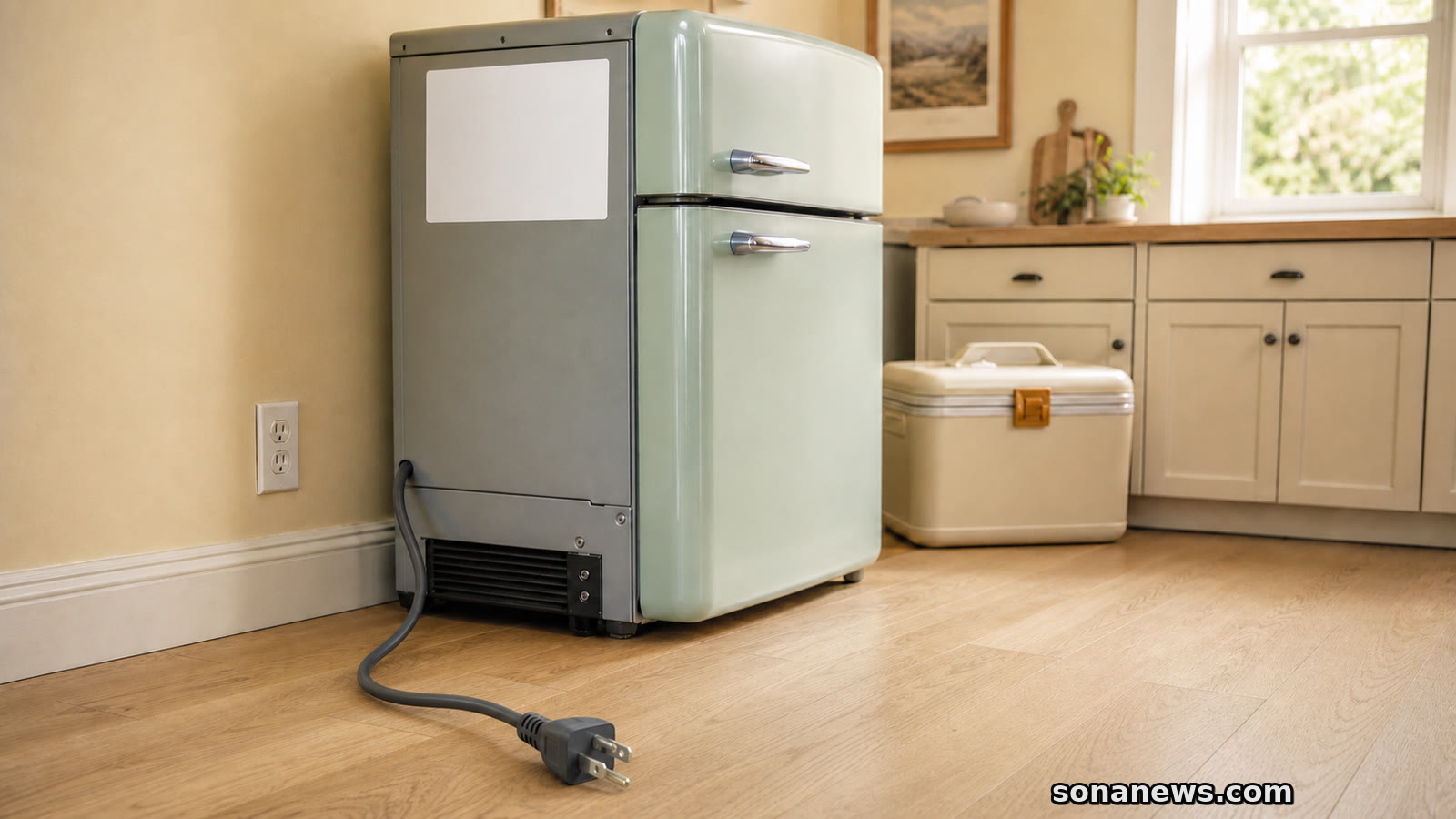

A curved handle and a pastel door can make a refrigerator memorable. Neither feature can tell an owner whether it is included in a new U.S. recall. That decision sits on a white label at the back, where the model number and date code have to be read together.
The U.S. Consumer Product Safety Commission announced the recall with Galanz Americas on 30 July. It covers about 121,680 Galanz 7.6 cubic foot retro-style top-freezer refrigerators. CPSC says internal electrical components in the covered units can short circuit and ignite, creating fire and burn hazards. The agency reports 34 fires involving the refrigerators, including one fatality according to a local fire department report.
This is a serious but tightly bounded product action. It is not a warning about every Galanz appliance, every compact refrigerator or every fridge with retro styling. The practical story is a paired identification check followed by a company repair, not a visual hunt for scorch marks.
The refrigerators were sold in black, blue, red and white. They have a separate top-freezer door, rounded styling and a capacity of 7.6 cubic feet. Those details help an owner recognise the product family, but they do not establish that a particular unit is covered.
CPSC lists five model numbers: BCD-215V-62H, GLR76TRDER, GLR76TBKER, GLR76TBEER and GLR76TWEER. A unit must also carry a date code from December 2018 through December 2020. The model and date code appear in YYYYMM format on a white label at the upper-left corner of the back of the refrigerator.
That pairing matters. A listed model with a date code outside the range is not included in the notice as written. A date within the range does not pull a different model into the recall. Home Depot's retail notice repeats the same five models, label location and date-code boundary, and directs customers to the official repair programme when both fields match.
The appliances were sold at Home Depot stores across the United States and online at Amazon from January 2019 to September 2022, according to CPSC. A purchase date or retailer record may help narrow the search, but the published identification rule still rests on the label. Colour, price and memory are not substitutes.
The label is on the back, an awkward place on a heavy appliance. The recall notice identifies that location but does not give household instructions for moving a refrigerator. This article does not imply that anyone should pull or tilt an appliance alone to reach it. If the label cannot be reached or read safely, the official Galanz recall contact is the appropriate place to ask how to identify a specific unit.
For a model-and-date match, CPSC's instruction is direct: unplug and stop using the refrigerator immediately until it has been repaired. Galanz is offering a free in-home repair by a qualified technician. The dedicated recall portal and contact details are linked from the CPSC page.
That route leaves no role for opening the rear panel, checking internal wiring or testing the appliance under power. The published hazard concerns internal components that can short circuit. The notice does not say that a refrigerator has to smell hot, make an unusual sound or show visible damage before the stop-use instruction applies.
The reverse is also important. A generated image, a social post or a photograph of a similar green refrigerator cannot confirm that a unit is covered. CPSC publishes real product photographs and an example of the actual label location. Those official images should be used alongside the model and date-code list.
Consumer Reports independently summarises the same scope and remedy, and notes that the five recalled models were not among the Galanz units it had tested or rated. Its article points owners back to the company portal for the model-and-date check and repair registration. The regulatory notice remains the primary source.
A refrigerator recall also creates an immediate practical problem: what happens to the food when the appliance is unplugged. That is separate from identifying the product and arranging the repair.
U.S. Food and Drug Administration guidance for a loss of refrigeration says an unopened refrigerator will keep food cold for about four hours. It advises keeping the refrigerator and freezer doors closed as much as possible. For a longer interruption, the FDA recommends coolers with ice or frozen gel packs to keep refrigerated food cold. It says perishable food that has been above 40°F for four hours or more should be discarded, and appearance or smell alone cannot establish safety.
Those general time and temperature rules do not change the recall instruction or predict how long a repair appointment will take. They provide a separate framework for food while the covered appliance remains out of use. A household's actual temperatures, elapsed time and available cold storage still matter, so the FDA page is a safer reference than improvising from the food's appearance.
The most useful version of this recall is therefore a short chain of evidence. First identify the product family. Then match both lines on the official back label. If both fields place the unit in scope, keep it unplugged, use the Galanz repair route and treat food storage as its own time-and-temperature problem. The retro door attracts the eye, but the unglamorous label decides what happens next.
Editorial note. This article provides general U.S. product and food-safety information, not electrical, repair, medical, legal or emergency advice. Identify a specific refrigerator only through the official CPSC and Galanz model-and-date-code process. Do not open or test an appliance based on this article. For smoke, fire, overheating or immediate danger, follow local emergency guidance. For food held without refrigeration, use current FDA or local public-health advice.
Sources
- **U.S. Consumer Product Safety Commission, recall 26-649, 30 July 2026:** Verified the U.S. scope, approximately 121,680 units, five model numbers, December 2018 through December 2020 date-code range, upper-left back-label location, sales period, internal short-circuit hazard, 34 fire reports, reported fatality, stop-use instruction and free qualified in-home repair
- **Home Depot retail safety-recall notice:** Cross-checked the five models, YYYYMM date-code boundary, back-label location, official portal and no-cost repair route. The article follows CPSC where its wording is more precise
- **Consumer Reports, 30 July 2026:** Independently cross-checked the paired model-and-date check, sales channels, stop-use instruction and free in-home repair, while keeping CPSC as the primary authority
- **U.S. Food and Drug Administration, Food and Water Safety During Power Outages and Floods:** Verified the separate general food-safety guidance for a loss of refrigeration, including the roughly four-hour closed-refrigerator window, 40°F threshold, cooler and ice planning, and the instruction not to rely on appearance or smell
Help us improve
Was this article useful?
One anonymous tap helps Sona improve future reporting, headlines and source context.
Up next
A gold-coloured lamp has been recalled because its plug can overheat. With no model or serial identifier published, the order record matters more than a visual match.
Continue readingMore in Home & Living