The reset routine is household labour in better lighting
New BLS time-use data, ONS unpaid-work figures and a 2026 cleaning survey suggest the online reset ritual is less a miracle habit than ordinary domestic work made visible.
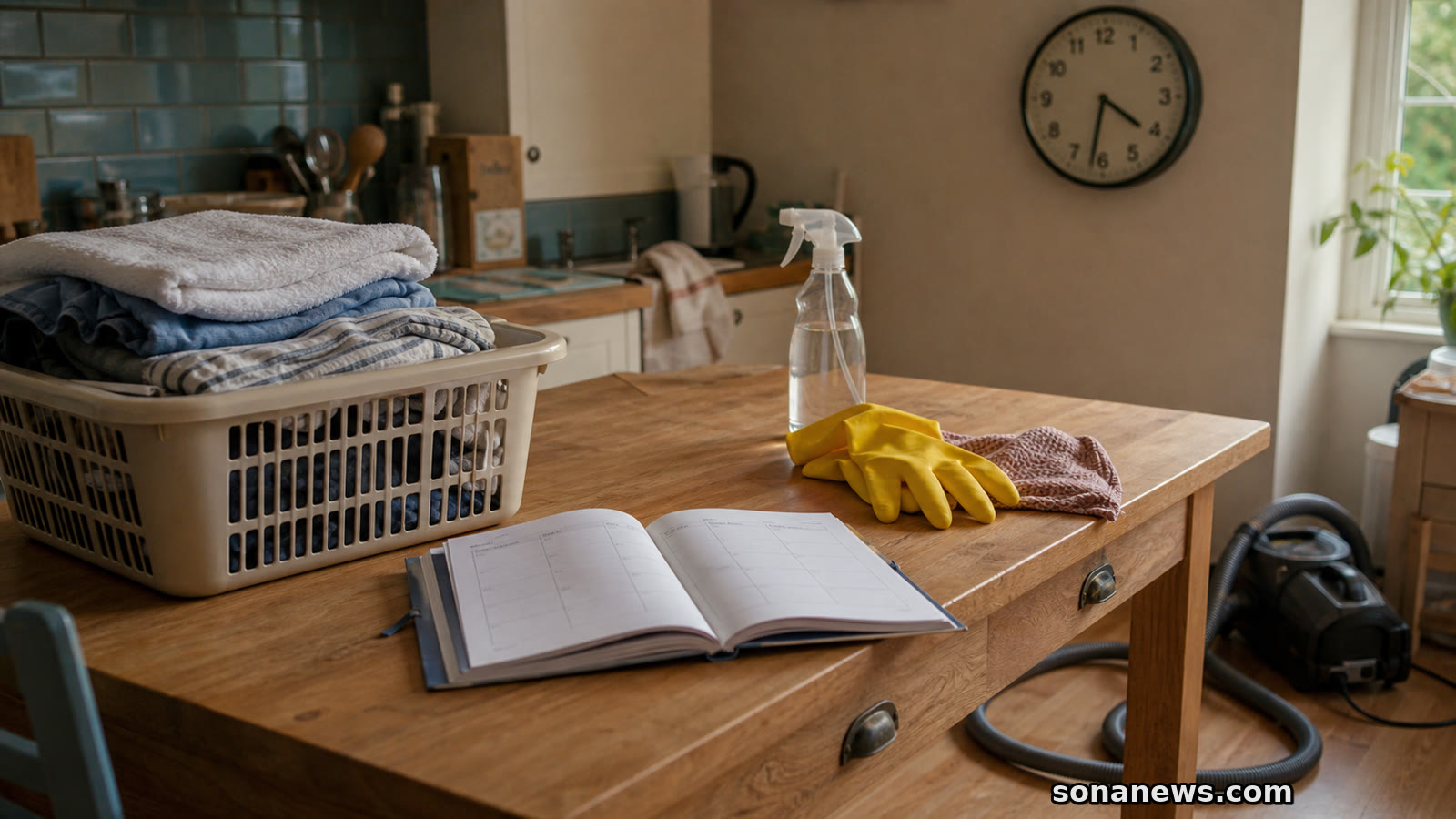

The "reset routine" has become one of the tidier stories the internet tells about domestic life. A person clears the kitchen, folds the laundry, changes the sheets, writes a list, lights a candle and begins the week again. In a short video it can look almost serene, as if the right playlist and a clean counter could turn household work into a private management system.
The evidence is less glossy, and more interesting. Domestic labour is not a little lifestyle flourish added to modern life. It is a large part of the day. The latest American Time Use Survey from the U.S. Bureau of Labor Statistics, released on 25 June, says 80.9% of people did household activities on an average day in 2025, spending two hours on them on average. The same release says 95.1% of people took part in leisure and sports, averaging 5.2 hours, with television still accounting for 2.6 hours a day.
Those numbers do not make chores more noble, or leisure more suspect. They do make the reset label easier to understand. A reset is often an attempt to gather scattered work into a visible block: washing, tidying, planning, shopping, cleaning, admin, food preparation and the small repairs that keep a home from slipping into friction. The social media version adds lighting and sequence. The time-use version shows the load was already there.
UK data points in the same direction. The Office for National Statistics time-use dataset for March 2024 measured unpaid work, including unpaid household work, DIY, gardening, unpaid childcare, unpaid adult care and volunteering. In the March 2024 table, women spent an average of 212.1 minutes a day on unpaid work, while men spent 155.2 minutes. That is not a moral verdict on every household, and the category is broader than cleaning. But it is a reminder that the pleasant language of a home reset can hide a persistent distribution problem: who notices the mess, who plans the fix, who remembers the sheet change, who knows what is running out.
The consumer industry has noticed the ritual too. The American Cleaning Institute's 2026 spring cleaning survey, conducted by Wakefield Research among 1,000 U.S. adults, found that 80% of Americans planned to spring clean. The same release said 57% named decluttering and organising as a motivation, 47% cited the fresh-start feeling of a new season, and 46% cited health and hygiene. It also found that 56% would be embarrassed to say when they last cleaned their refrigerator, 40% would feel that way about the toilet, and nearly one in three about washing sheets.
That source should be read with the usual caution. A trade association for cleaning products has an obvious interest in cleaning as a cultural event. Still, the survey catches a real tension: people want the feeling of order, and many also carry embarrassment about the maintenance work that never photographs well. The reset routine sits exactly there, between relief and guilt.
The better reading is not that everyone needs a stricter Sunday routine. That would turn one more piece of unpaid work into an achievement badge. A useful lifestyle story asks a different question: why does ordinary maintenance now need a mood board to feel manageable? Part of the answer is that domestic work has become more visible in feeds while remaining undervalued in real life. Another part is that homes are carrying more functions than they used to for many people: workplace, classroom, gym corner, delivery depot, care setting, entertainment room and storage unit.
The BLS release gives one clue to that overlap. In 2025, 34.5% of employed people did some or all of their work at home on days they worked, while 69.8% did some or all of it at their workplace. Those categories can overlap. A home that also hosts paid work can feel permanently half-reset, because the breakfast table, laptop, laundry pile and family calendar are competing for the same surface.
This is why the aesthetic version can be both comforting and misleading. Comforting, because a sequence can reduce the blur: collect the cups, clear the bag, change the bed, write the list. Misleading, because the video usually edits out the reason the routine is necessary again three days later. Domestic order is not a one-off transformation. It is a repeating negotiation with time, bodies, money, space and other people's habits.
There is a class signal here too. The most polished reset content often assumes spare storage, reliable appliances, enough cleaning supplies, controllable work hours and a home large enough to stage before-and-after order. Many households do not have that margin. For them, the reset is less about optimisation than avoiding small collapses: a uniform that is not dry, a bill that is missed, a lunchbox that has disappeared, a fridge shelf that needs dealing with before the next shop.
The calmer conclusion is to take the routine seriously without buying the fantasy. A reset is not proof of character, and a messy room is not a failed identity. It is domestic labour becoming visible in a culture that often prefers to sell the container, the spray bottle and the planner rather than name the work. The time diary is a useful corrective. It shows that the home reset was never magic. It was always labour, in better lighting.
Editorial note. This article discusses cleaning and household routines as culture and consumer behaviour. It is not health, hygiene, product-use, workplace, legal or safety advice. For cleaning products, appliances, rented homes, care settings or hazardous mess, follow relevant labels, contracts, local rules and professional guidance.
Sources
- U.S. Bureau of Labor Statistics - "American Time Use Survey - 2025 Results" - - extracted 2026-06-25. Verified: release time and date, 2025 annual averages, 80.9% participation in household activities, two hours average time spent on household activities, 95.1% participation in leisure and sports, 5.2 hours average leisure time, 2.6 hours watching TV, and 34.5% of employed people working at home on days worked
- Office for National Statistics - "Time use in the UK" dataset and March 2024 workbook - - extracted and workbook checked 2026-06-25. Verified: release date 7 May 2024, official-statistics-in-development status, dataset scope covering paid work, unpaid household work, unpaid care, travel and entertainment, and sheet 25 figures for March 2024 unpaid work: men 155.2 minutes a day and women 212.1 minutes a day
- Business Wire / American Cleaning Institute - "Cleaning Secrets Revealed: 40% of Americans Embarrassed to Admit Last Time They Cleaned Their Toilet" - - extracted 2026-06-25. Verified: ACI annual spring cleaning survey conducted by Wakefield Research among 1,000 nationally representative U.S. adults from Feb. 4 to 12, 2026; 80% planned to spring clean; 57% cited decluttering and organising, 47% a fresh start, 46% health and hygiene; 56% were embarrassed about refrigerator cleaning, 40% about toilet cleaning and nearly one in three about sheets
Help us improve
Was this article useful?
One anonymous tap helps Sona improve future reporting, headlines and source context.
Up next

Across 11 experiments, people were more willing to give when invited to continue a run of donors. The effect offers a useful lesson about social signals, and a warning about how easily momentum can be staged.
Continue readingMore in Lifestyle