The wardrobe repair habit now starts before checkout
EU and WRAP data point to a plain shift in clothing culture: repair, resale and longer use are becoming part of the shopping decision, not only a clean-up after overbuying.
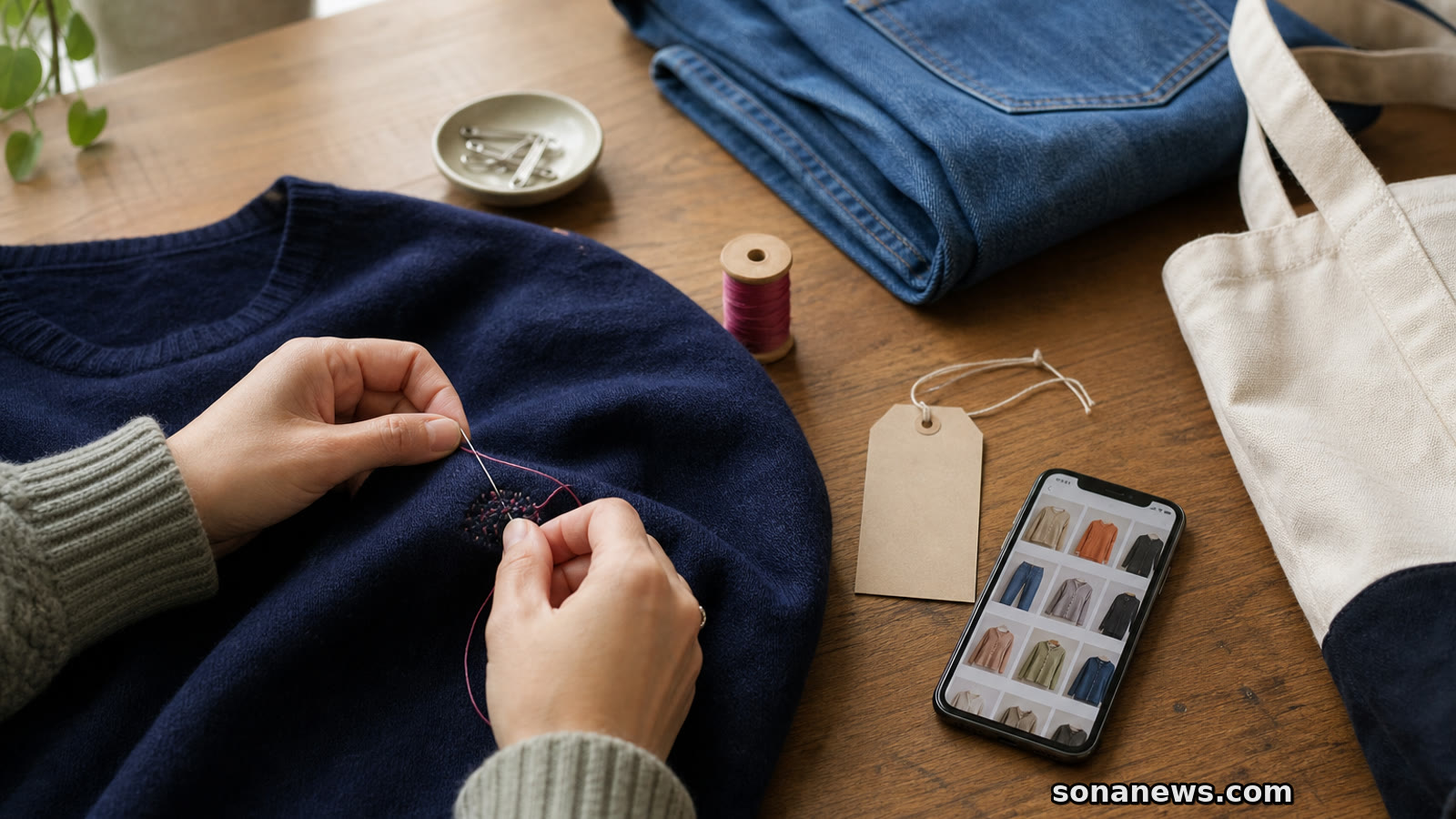

A small repair used to sit at the sad end of a garment's life. The missing button went into a kitchen drawer, the tired jumper moved to the chair, and the cheap black T-shirt became cleaning cloth material if it was lucky. That order is changing. Repair and resale are no longer only what happens after people buy too much. They are starting to affect the buying decision itself.
The pressure behind that shift is not subtle. The European Commission says EU textile consumption has the fourth highest impact on the environment and climate change after food, housing and mobility. Its textiles strategy says about 5 million tonnes of clothing are discarded each year in the EU, roughly 12kg per person, and that only 1% of the material in clothing is recycled into new clothing. The Commission's 2030 aim is blunt enough: textiles placed on the EU market should be durable, repairable and recyclable, with reuse and repair services widely available.
The European Environment Agency gives the everyday version of the same problem. Its textiles topic page, updated in April 2026, says EU citizens consumed an average 19kg of clothing, footwear and household textiles in 2022, up from 17kg in 2019. It also says that in 2020, each person in the EU consumed 16kg of textiles, while 11.6kg ended up in mixed household waste. Starting in 2025, EU member states must have separate collection systems for textiles. That sounds like a waste policy detail. In practice, it moves the wardrobe closer to the recycling bin, the repair bench and the resale listing.
This is where the lifestyle story becomes more interesting than the slogan. A circular wardrobe is often sold as a neat moral upgrade: buy better, mend more, sell what is left. Real clothes are messier. Some garments are too poorly made to repair well. Some repairs cost more than the original item. Some resale platforms make it easy to move clothes around while still encouraging a constant scroll for something else. A secondhand purchase can be frugal and sensible, but it can also become another form of over-shopping.
WRAP's 2025 Displacement Rates Untangled report is useful because it asks a harder question: does a circular choice actually replace buying new? WRAP found a repair displacement rate of 82.2%, meaning four out of every five repaired textile items displaced a new purchase in its tested methodology. For resale, it found a 64.6% displacement rate, or roughly three out of every five preloved purchases displacing a new item. Those are strong numbers, but they are not magic. The missing fifth repair and the other two resale purchases are the caution in the story.
WRAP's UK Textiles Pact update for 2024-25 adds another brake on easy optimism. Signatories cut carbon impact per tonne by 6% and water impact per tonne by 9% against a 2019 baseline. At the same time, they placed 17% more textiles on the market in 2024 than in 2019. The result was awkward: the overall carbon footprint rose 10%, and the water footprint rose 7%. The products improved, but the pile grew faster.
That is why the repair habit matters before checkout, not only after. The most useful question around a new piece of clothing is no longer just whether it looks good today. It is whether the fabric will survive ordinary washing, whether a seam can be fixed, whether the colour and cut will still make sense after the first rush has gone, whether someone else might want it later, and whether it replaces something or simply joins the churn.
There is a cultural change hidden in that sequence. The old fast-fashion rhythm made clothing feel temporary by default. The new repair-and-resale rhythm asks shoppers to think of clothes as objects with an afterlife. A jumper can be mended. Jeans can be listed, altered or handed on. A coat can be bought with its next owner faintly in mind. None of this is glamorous, and that is the point. Maintenance is quieter than a haul video, but it is a more honest test of whether a wardrobe is working.
Retailers will try to package this as a service. Expect more take-back schemes, resale corners, repair partnerships, durability claims and digital product information. Some will be genuinely useful. Some will be marketing around the same old volume problem. The EEA's figures are a useful guardrail here: if consumption keeps rising, better sorting and smarter labels will not carry the whole burden.
For readers, the shift is more modest than a full wardrobe revolution. It is the return of a slightly older idea: clothes are not disposable just because replacing them is easy. The repair kit, the alteration receipt, the secondhand search and the fabric label are becoming part of the same decision. The shopping moment now has a longer tail. What happens after checkout is beginning to matter before the card is tapped.
Sources
- European Commission - "Textiles Strategy" - - extracted 2026-06-09. Verified: EU textile consumption ranks fourth for environmental and climate impact after food, housing and mobility; 5 million tonnes of clothing discarded each year in the EU, around 12kg per person; 1% of clothing material recycled into new clothing; 2030 vision for durable, repairable and recyclable textiles with reuse and repair services
- European Environment Agency - "Textiles" - - extracted 2026-06-09. Verified: page modified 10 April 2026; EU textile consumption rose from 17kg per person in 2019 to 19kg in 2022; 2020 consumption and mixed-waste figures; separate textile collection systems from 2025; fast fashion context and low recycling rates
- WRAP - "Displacement Rates Untangled" - - extracted 2026-06-09. Verified: 27 February 2025 publication date; standardised methodology for clothing circular business models; 82.2% repair displacement rate; 64.6% resale displacement rate; tested with resale and repair businesses
- WRAP - "UK Textiles Pact Annual Progress Update 2024-25" - - extracted 2026-06-09. Verified: 28 October 2025 publication date; 6% lower carbon impact per tonne and 9% lower water impact per tonne versus 2019; 17% more textiles placed on the market; total carbon footprint up 10% and water footprint up 7%
- Google Search Central - "Get on Discover" - - extracted 2026-06-09. Verified: Discover eligibility depends on indexing and policy compliance; Google recommends accurate non-clickbait titles and large relevant images at least 1200px wide with max-image-preview:large eligibility
Help us improve
Was this article useful?
One anonymous tap helps Sona improve future reporting, headlines and source context.
Up next

Across 11 experiments, people were more willing to give when invited to continue a run of donors. The effect offers a useful lesson about social signals, and a warning about how easily momentum can be staged.
Continue readingMore in Lifestyle