The work-from-home day is now a household routine, not a perk
Hybrid work data from the UK and U.S. suggests remote days have moved out of office policy and into lunch, errands, childcare, rest and the quiet politics of who gets flexibility.
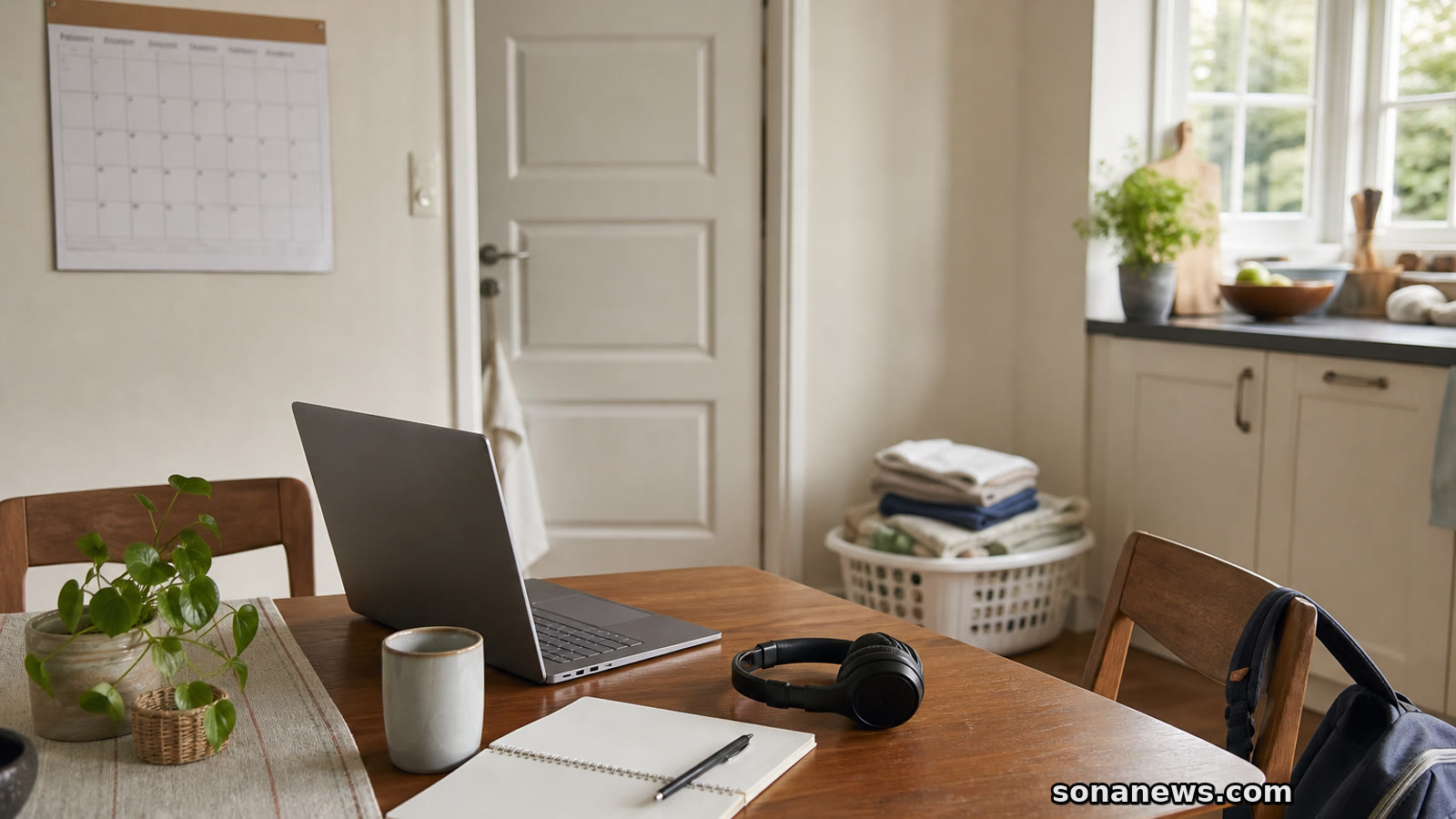

The work-from-home day is still often described as if it were a special treat: slippers, a quiet laptop, perhaps a better coffee than the one near the station. That version is too thin. For millions of people, the remote day has become a recurring household routine, with its own rhythms, frictions and small negotiations.
It is the day the washing machine goes on between calls. The day lunch is made from whatever is already in the fridge. The day a school bag sits by the chair, a parcel arrives during a meeting, a neighbour hears more typing than traffic, and the kitchen table has to become a desk by 8.55am. None of this is glamorous. That is the point. Hybrid work has stopped being only a workplace argument and has become part of ordinary domestic life.
The data supports that shift without turning it into a universal story. In Great Britain, the Office for National Statistics reported that 28% of working adults were hybrid working in autumn 2024. The ONS said the pattern, part travelling to work and part working at home, had become the "new normal" for around a quarter of workers, even as fully home-based work declined from earlier pandemic levels.
The time-use detail is more revealing than the headline rate. The ONS found that people working from home on a given day saved an average of 56 minutes by not commuting. On those days, they spent an average of 24 minutes more on sleep and rest, and 15 minutes more on exercise, sports and well-being. That does not mean the remote day is automatically healthier, calmer or better. It means the commute has become time that households can rearrange, and sometimes fight over.
A saved hour is not a blank hour. It may become a longer school run, a dog walk, a load of laundry, a proper lunch, a later bedtime, a second job of domestic admin, or simply more work. The cultural change sits in that reallocation. The office used to organise the day by default: departure, commute, lunch queue, journey home. A home-working day asks the household to do more of that organising itself.
The U.S. picture tells a similar story at a larger scale. WFH Research's May 2026 time series put work from home at 25.74% of full paid working days among U.S. workers in its main survey series. Its 2019 benchmark was 7.15%. The level is far below the emergency peak of 2020, but it is not a blip. It is a weekly pattern large enough to change where people buy lunch, when they run errands and how homes are expected to function during office hours.
Gallup's hybrid work tracker adds another useful boundary. Among U.S. employees in remote-capable jobs, Gallup reports 52% working hybrid, 26% exclusively remote and 22% on-site. It also says five in 10 full-time U.S. employees have remote-capable jobs, a reminder that the argument covers a large share of white-collar working life but not the whole labour market.
That caveat matters. Hybrid work is not evenly distributed, and lifestyle writing can be lazy when it treats flexibility as a matter of taste. The ONS found workers with a degree or equivalent qualification were 10 times more likely to hybrid work than workers with no qualifications, 42% compared with 4%. Managers, directors and senior officials were far more likely to hybrid work than people in elementary occupations or caring, leisure and other service roles. A home-working routine can feel normal in one household and unavailable in the next street.
It is also not automatically social. A remote day can make room for a school gate conversation, a lunchtime walk with a friend, or a quieter evening because the commute has gone. It can also shrink casual contact, make work leak into dinner and leave the person at home doing more invisible household labour because they are physically there. The same laptop can mean autonomy at 10am and resentment at 6pm.
That is why the most honest lifestyle story is not "remote work is good" or "remote work is over". It is that the home-working day has become a piece of social infrastructure. It affects the way couples divide chores, how flatmates use shared rooms, whether children understand a closed door, how local cafes read the lunch rush, and whether a person feels more rooted in their neighbourhood or more trapped inside it.
The office policy still matters, of course. Gallup notes that hybrid work is the preferred arrangement for six in 10 remote-capable employees, while about one-third prefer fully remote work and fewer than 10% prefer being on-site. But preference is only the headline layer. Underneath is a quieter question: what kind of day does a remote day actually create once it enters a real household?
The answer is usually mixed. A work-from-home day can be useful, humane and ordinary. It can also be cramped, unequal and overfilled. Treating it as a perk misses the point. The better description is a new routine, one that has to coexist with domestic space, family rhythms, local streets and the old human need to stop working when the workday is done.
Editorial note. This article discusses work patterns, household routines and survey findings in general terms. It is not legal, employment, HR, mental-health or medical advice. Individual work arrangements depend on job type, contract terms, caring responsibilities, health needs, local law and employer policy.
Sources
- Source: "Who are the hybrid workers?", Office for National Statistics, Extracted 2026-06-15. Verified: 28% hybrid working in Great Britain in autumn 2024, ONS description of hybrid as a new normal for around a quarter of workers, 56 minutes of saved commuting time, additional time-use figures for sleep and rest plus exercise, and distribution by qualification and occupation
- Source: "U.S. Survey of Working Arrangements and Attitudes (SWAA)", WFH Research, Extracted 2026-06-15. Verified: SWAA survey description, monthly data release model, target population, and availability of time-series JSON tracking work from home and employer plans
- Source: WFH Research time-series JSON, Retrieved 2026-06-15. Verified: release ID WFH_release_2026_05, transmission timestamp 2026-05-27 12:38:24, 2019 work-from-home benchmark of 7.15% of full paid working days, and May 2026 estimate of 25.74%
- Source: "Global Indicator: Hybrid Work", Gallup, Extracted 2026-06-15. Verified: U.S. remote-capable employee work locations, 52% hybrid, 26% exclusively remote and 22% on-site, the statement that five in 10 full-time U.S. employees have remote-capable jobs, and reported preferences for hybrid, fully remote and on-site arrangements
Help us improve
Was this article useful?
One anonymous tap helps Sona improve future reporting, headlines and source context.
Up next

Across 11 experiments, people were more willing to give when invited to continue a run of donors. The effect offers a useful lesson about social signals, and a warning about how easily momentum can be staged.
Continue readingMore in Lifestyle