Small talk may need a visible opt-in, not a better icebreaker
A campus field experiment used coloured tableware to show who wanted a chat and who preferred solitude. The useful idea is permission, not a mandate to socialise.

Small talk is often treated as a performance problem. Find a sharper opening line, ask a better question, project more confidence. A field experiment published in the March 2026 issue of *Social Psychological and Personality Science* points to a quieter obstacle: before anyone needs an icebreaker, they need some reason to believe the other person is open to being approached.
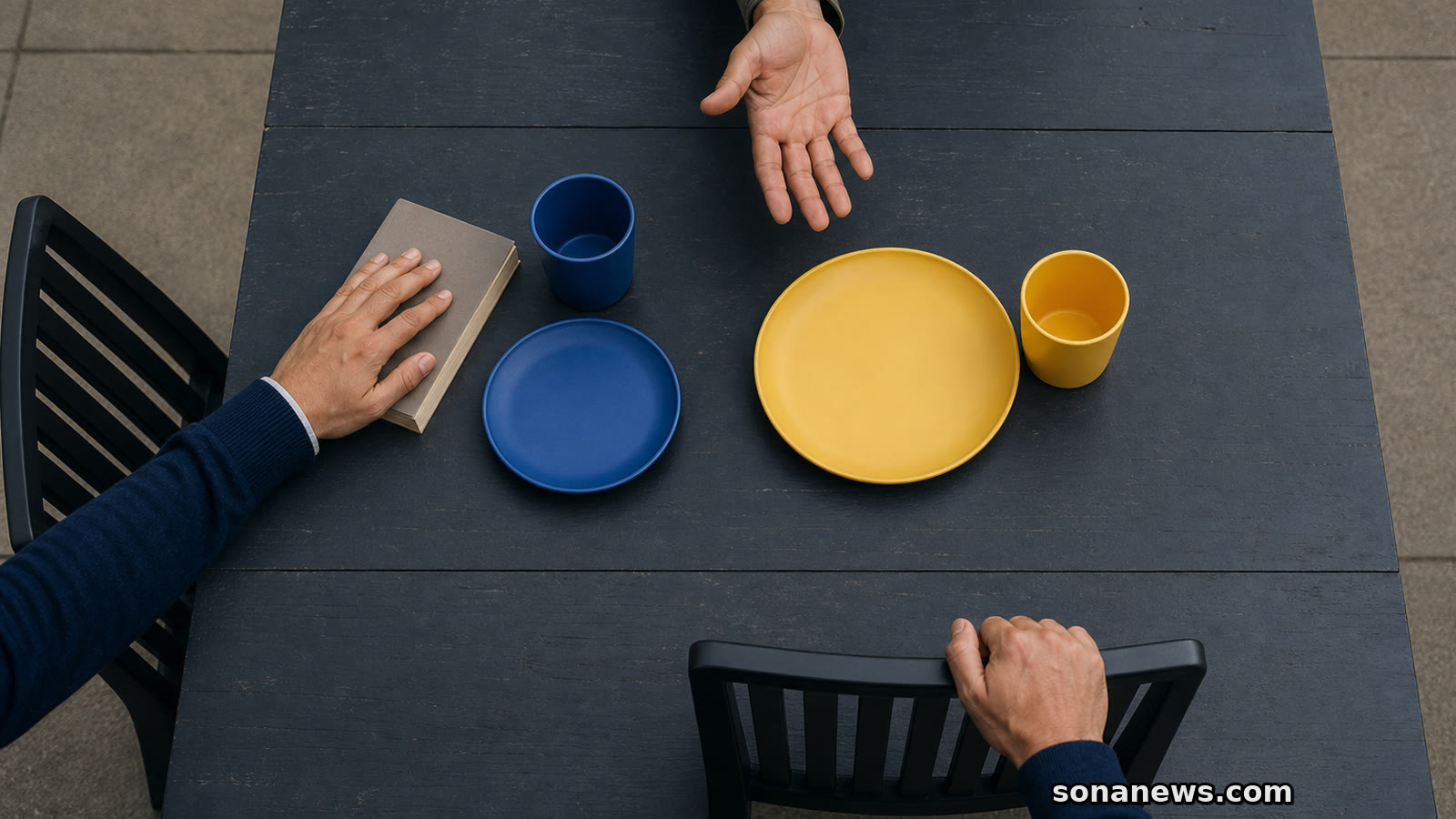
The researchers tested a deliberately simple signal. People arriving at an outdoor seating area on a university campus chose coloured tableware to indicate whether they were willing to talk to someone new or preferred not to. A woman posing as another participant was already seated with tableware that signalled conversation, solitude or neither. The link between colour and preference varied across sessions, so this was not a universal green-means-go rule.
Among the final sample of 563 participants, 56% spoke to the stranger when she displayed the social signal. That compared with 41% when the tableware carried no preference and 20% when it signalled solitude. Conversations in the social-signal condition were also reported as longer and deeper.
The result makes an everyday piece of awkwardness unusually concrete. Starting a conversation is not only a judgement about one's own mood or skill. It is a guess about someone else's willingness. Make that willingness easier to read and some of the social risk changes.
Before participants were assigned to a condition, 76% said they were willing to make a new connection. The authors called this group “social butterflies” as convenient shorthand. Among them, 68% interacted with the stranger when she displayed a social signal, compared with 50% in the neutral condition and 25% when she signalled solitude.
The pattern was different among participants who had said they preferred not to talk. The researchers found no statistically significant effect of condition on their social behaviour, although that group was smaller. In other words, the signal appeared to help willing people find one another without producing clear evidence that reluctant people were pushed into conversation.
That is the most useful part of the study. It does not turn sociability into a civic duty. A visible yes only works ethically when a visible no remains ordinary and respected.
The mood findings also deserve restraint. Across the full sample, participants in the social-signal condition felt more socially connected than those who saw the solitude signal, but not more connected than those in the neutral control. Their positive mood was only slightly higher than the control result, at the edge of conventional statistical significance, and was not higher than the solitude condition. Stronger mood differences appeared within the subgroup already willing to connect.
This is not evidence that coloured crockery cures loneliness. It is evidence that a legible preference changed behaviour in one carefully arranged setting.
The seating area was small. The study ran in daylight. The stranger looked up and smiled but did not start the conversation. She was instructed to respond and mirror questions rather than introduce new topics. Participants had a shared campus context, snacks and an obvious reason to be at the table.
Those details are not decorative. They reduced several barriers at once: noticing another person, seeing the setting as safe, having a familiar social script and accepting responsibility for the first word. A coloured plate on a crowded late-night train, in an unfamiliar city or in a workplace with a power imbalance could operate very differently.
The sample was also campus-heavy. Its average age was 21.8, 77% were undergraduates, and 249 of the 812 initial participants were excluded under preregistered criteria, largely because they did not notice the other person or did not correctly understand the tableware signal. The exclusions make the intended comparison cleaner, but they also reveal a practical problem. A signal cannot guide behaviour if people miss it or cannot decode it.
The authors are explicit about the boundary. Their calculations suggest signals should increase the total number of interactions only where at least half of people are open to a new connection. In a setting where most people want solitude, explicit preferences could reduce conversation. That may still be a respectful outcome rather than a failed one.
The finding fits a longer line of small-scale social psychology, without making every result interchangeable. In 2014, Nicholas Epley and Juliana Schroeder asked train and bus commuters to connect with a stranger, remain disconnected or travel as usual. Participants who connected reported a more positive journey and no loss of productivity, while a separate group predicted solitude would feel better.
Another 2014 study by Gillian Sandstrom and Elizabeth Dunn found that students reported greater happiness and belonging on days when they interacted with more classmates than usual. That work was largely correlational. It supports the relevance of acquaintances and weak ties, but does not show that adding one conversation will improve any particular person's wellbeing.
The newer tableware experiment advances the question from whether brief contact can feel worthwhile to how willing strangers might recognise one another. Its answer is less romantic than “be brave” and more compatible with boundaries: make social availability visible, then leave the choice intact.
Some settings already use this logic. A designated communal table, a hosted activity, chairs angled towards a shared surface or an invitation from staff can make conversation feel permitted. Headphones, a closed laptop posture or a quiet zone can make the opposite preference easier to respect. None is perfectly legible across cultures, disabilities or individual circumstances.
The World Health Organization's Commission on Social Connection places parks, libraries and cafés among the forms of social infrastructure that can support connection. Its 2025 report addresses loneliness and isolation at a much larger scale than one campus experiment. The useful bridge between them is design, not a medical promise. Public and commercial spaces influence whether people can notice, approach or avoid one another without embarrassment.
A better icebreaker cannot solve that architecture by itself. Sometimes the first question is not what to say. It is whether the setting has made room for an honest yes, an equally comfortable no and less guessing in between.
Editorial note. This article reports population and experimental research for general information. It is not medical or mental-health advice, and brief conversation is not a treatment for loneliness or social isolation.
Sources
- **Li, Lok, Stenlund and Dunn, “Explicit Signals Enhance Social Engagement Between Strangers,” *Social Psychological and Personality Science* 17(2), 160-168:** Full article, preregistered methods, final sample, conditions, exclusions, behavioural results, subgroup findings, mood limits and the authors' caution about context. First published online May 12, 2025 and included in the March 2026 issue
- **PubMed record for the same field experiment:** Confirms the authors, abstract, final sample of 563, journal record and central claim that explicit signals can increase the frequency, length and depth of interaction without forcing people who prefer solitude
- **Epley and Schroeder, “Mistakenly Seeking Solitude,” *Journal of Experimental Psychology: General* (2014):** Reports train, bus and waiting-room experiments in which participants underestimated the experience of connecting with strangers
- **Sandstrom and Dunn, “Social Interactions and Well-Being: The Surprising Power of Weak Ties,” *Personality and Social Psychology Bulletin* (2014):** Reports associations between more weak-tie interactions, happiness and belonging, including daily interactions with classmates
- **World Health Organization Commission on Social Connection:** Sets the wider public-health context, defines social connection and identifies social infrastructure such as parks, libraries and cafés among possible community-level supports
- **WHO Commission report, “From loneliness to social connection: charting a path to healthier societies” (June 30, 2025):** Broad global evidence and policy framework. It does not validate coloured tableware as a treatment or universal intervention
Help us improve
Was this article useful?
One anonymous tap helps Sona improve future reporting, headlines and source context.
Up next

Across 11 experiments, people were more willing to give when invited to continue a run of donors. The effect offers a useful lesson about social signals, and a warning about how easily momentum can be staged.
Continue readingMore in Lifestyle