Euclid’s Milky Way image gives Roman a head start on hidden planets
ESA's Euclid paused its dark-universe survey for one day to map more than 60 million stars near the galactic centre. The useful part is how that snapshot can help NASA's Roman telescope decode future microlensing events.

The first temptation is to treat Euclid's new Milky Way view as another beautiful space picture. It is beautiful, but that is not the most useful part.
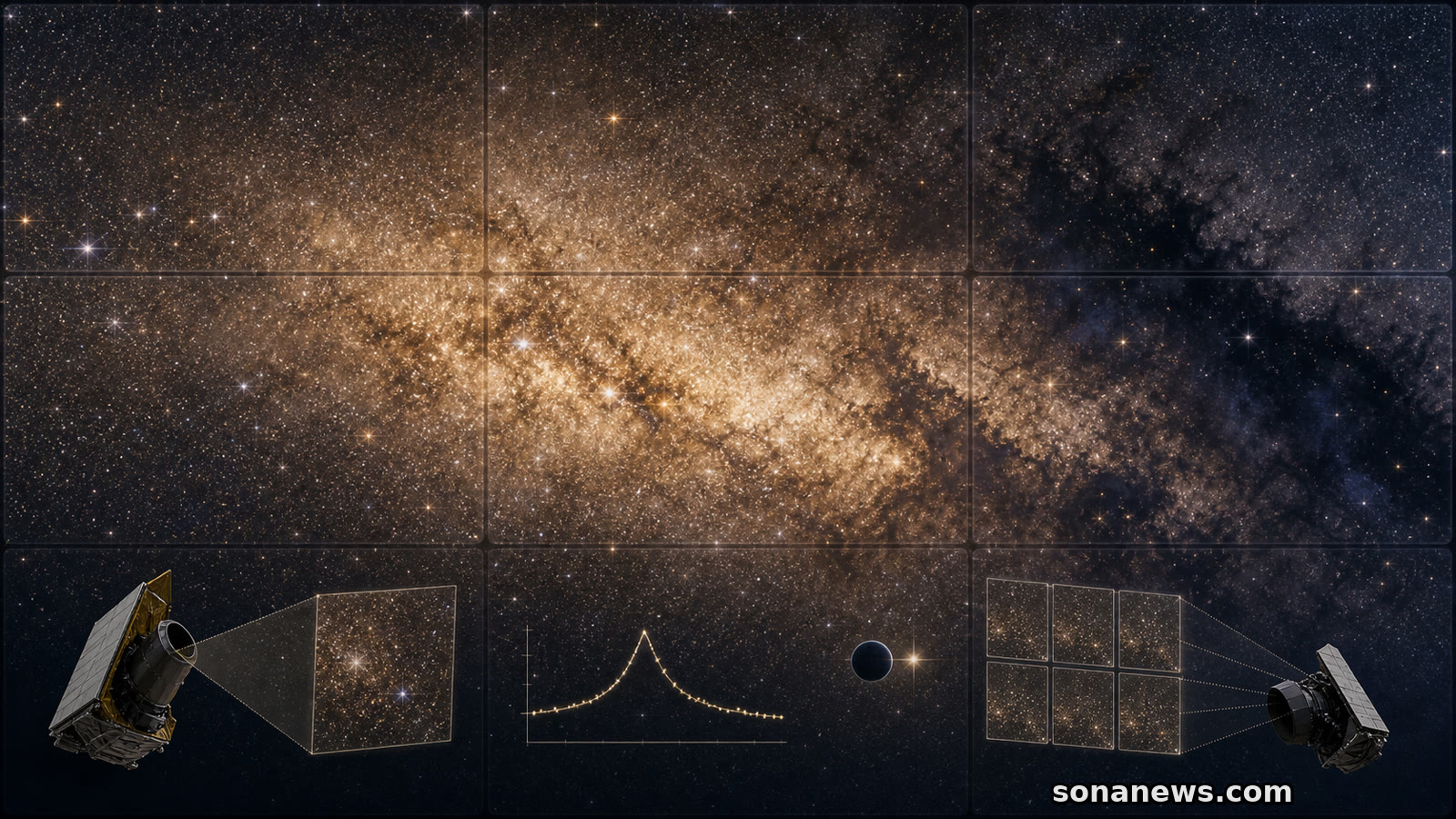
ESA says the Euclid mission has released the largest and most detailed visible-light image yet made of the centre of the Milky Way. It is packed with more than 60 million stars, plus nebulas, star clusters and the dark lanes of dust that make the galaxy's crowded heart so hard to read. The image was built from nine pointings taken during about 26 hours in March 2025, then released on 24 June 2026.
That timing matters because Euclid was not built mainly for this job. Its prime mission is to map the dark Universe by surveying distant galaxies across a huge fraction of the sky. For one carefully planned day, it turned toward our own galaxy instead. NASA describes the observation as the only time Euclid has paused its normal cosmology survey. The pause was not a sightseeing detour. It created an early reference map for a region NASA's Nancy Grace Roman Space Telescope is expected to monitor repeatedly after launch.
Roman is now scheduled by NASA to launch on 30 August 2026. One of its core programmes, the Galactic Bulge Time-Domain Survey, will stare again and again at dense star fields toward the Milky Way's centre. NASA says the survey will cover six fields totalling 1.7 square degrees, with one field piercing the centre of the galaxy and the others nearby. During its main observing seasons, Roman is designed to take a new look at each field every 12 minutes.
The public version of that may sound simple: watch stars and find planets. The actual method is stranger and more patient. Roman will search for microlensing, which happens when a foreground object drifts almost exactly in front of a more distant star from our point of view. The nearer object's gravity bends and magnifies the background starlight for a while. That temporary brightening can reveal planets, brown dwarfs, neutron stars and even isolated stellar-mass black holes, including objects too faint to see directly.
This is where Euclid's one-day image earns its place. A single future brightening is not always enough to identify what did the lensing. Astronomers also need to know which star was in front, which star was behind, and how the two moved relative to each other before the alignment. NASA's release says Euclid's earlier snapshot can be combined with Roman's later repeated observations to help separate those pieces. For possible rogue planets, that distinction is crucial: a planet may truly be travelling without a star, or it may be orbiting so far from its host that the host is hard to connect to the event.
The new image also shows why this work is difficult. The galactic bulge is crowded in a way ordinary sky pictures do not convey. Millions of stars overlap visually. Dust blocks some lines of sight. ESA says Euclid's visible-light camera can separate individual stars in this packed region and cover a very wide field quickly. It also says the mosaic includes 51 known planetary systems. That does not mean Euclid has suddenly found a trove of new habitable worlds. It means the same map can become a measuring stick when future events happen.
There are limits, and they should stay visible. Euclid's observation is shallower than Roman's coming survey and has less colour information. Visible light also struggles where dust is densest. Roman's infrared vision is better suited to seeing through parts of the central Milky Way, while its repeated visits are what turn a starfield into a time-domain experiment. Euclid supplies the early photograph. Roman is expected to supply the film.
The scale is still worth pausing over. NASA's survey page says Roman's bulge programme will monitor hundreds of millions of stars and is expected to find more than 1,000 planets through microlensing. STScI has separately described precursor work in the same region because these surveys are not only about catching a brightness spike. They are about turning that spike into a mass, a distance and a plausible object type. The best discoveries will probably not come from any single telescope acting alone.
That is the quiet lesson in the Euclid picture. Modern astronomy often works by layering observations from instruments with different habits. Euclid is wide and sharp. Roman is built for wide, repeated infrared monitoring. Hubble, ground surveys and future follow-up all add context. Together, they can make the Milky Way's messy centre less like a bright blur and more like a moving catalogue of stars and hidden objects.
For readers, the useful takeaway is not that a spectacular image has solved a planet mystery. It has not. The better point is more restrained: astronomers now have a baseline view of an unusually crowded region before Roman begins its long watch. If Roman catches a cold planet, a rogue world or a dark compact object bending starlight there, Euclid's earlier snapshot may help turn that fleeting flicker into a much firmer identification.
Sources
- Source: "Euclid View of Milky Way Heart Previews Core Survey by NASA's Roman", NASA, Extracted 2026-06-26. Verified: 24 June 2026 publication, Euclid's one-day pause from its normal survey, nine images, about 5 square degrees, overlap with Roman's coming bulge survey, similar-resolution but shallower reference data, and the microlensing value of an earlier snapshot
- Source: "ESA's Euclid captures the Milky Way's crowded heart", European Space Agency, Extracted 2026-06-26. Verified: largest and most detailed visible-light image of the Milky Way centre, more than 60 million stars, 23 March 2025 observation, about 26 hours, nine pointings, VIS instrument, 51 known planetary systems in the region, and exoplanet confirmation context
- Source: "Galactic Bulge Time-Domain Survey", NASA Science, Extracted 2026-06-26. Verified: Roman's survey purpose, six fields covering 1.7 square degrees, two 72-day visibility stretches per year, six observing seasons, 12-minute cadence, microlensing method and expected object classes
- Source: "Hello, World! NASA Shares New Home for Roman Space Telescope Updates", NASA Science, Extracted 2026-06-26. Verified: Roman launch date of 30 August 2026, pre-launch processing context, Falcon Heavy launch vehicle, L2 destination and mission goals
- Source: "Euclid", Euclid NASA Science Center at IPAC, Extracted 2026-06-26. Verified: Euclid as an ESA mission with NASA participation, July 2023 launch, six-year survey, optical and near-infrared scope, and mission role in studying the dark Universe
Help us improve
Was this article useful?
One anonymous tap helps Sona improve future reporting, headlines and source context.
Up next
Hubble data trace a 10-sided atmospheric wave from faint 2023 hints to a clearer 2025 pattern. Its slow drift and 32-day wobble do not yet explain why it formed.
Continue readingMore in Space