Rubin's new COSMOS image is a baseline for a changing sky
Its first LSST Camera science release stacks hundreds of observations into a field of more than half a million galaxies. The bigger promise is finding what changes when Rubin returns.
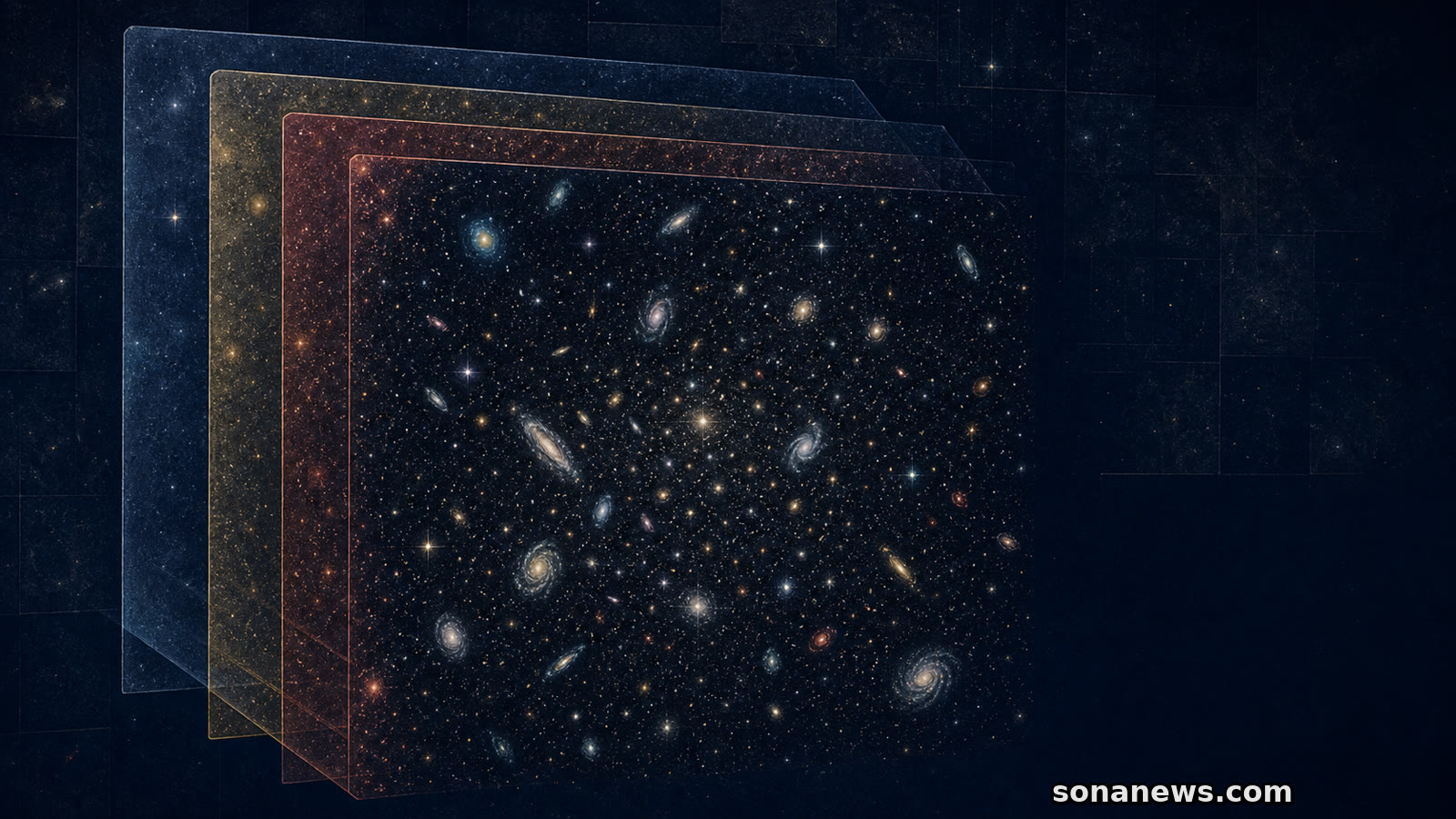

The first science image from the Vera C. Rubin Observatory's full LSST Camera is hard to take in at ordinary screen size. More than half a million galaxies occupy the deep view of the COSMOS field, alongside more than 50,000 stars. A few spirals catch the eye, but most of the frame is a grain of distant light.
The temptation is to treat that density as the result. It is not quite. The image marks Rubin's Early Data Preview 2, the observatory's first data preview based on the 3.2-gigapixel LSST Camera. Its larger scientific value is that it starts turning a famous, repeatedly observed patch of sky into a new baseline.
A baseline is what makes later change measurable. Rubin is built not only to see a great many objects, but to return to the sky over and over. In COSMOS, an area studied by major observatories for more than two decades, those returns can connect a deep historical archive with the changing sky that Rubin is designed to record.
The released COSMOS portrait is a co-add, which means hundreds of individual observations were aligned and combined. Stacking helps faint sources emerge more clearly than they would in a single exposure. The published colour view uses observations through Rubin's g, r and i optical filters, so it is a processed scientific composition rather than a single naked-eye snapshot.
That distinction does not make the image less real. It explains what kind of evidence it contains. A deep stack is excellent for finding and measuring faint, persistent objects. It is less suited to showing when one source brightened, faded or moved during the sequence, because time has been folded into the combined view.
The COSMOS field is especially useful for this exercise. It lies away from the busy plane of the Milky Way, with relatively few foreground stars and less obscuring dust than many other directions. Astronomers began building the field's modern observing record with Hubble in 2003, then added data across wavelengths from radio to X-rays.
That shared history makes COSMOS more than an attractive patch. Measurements from a new instrument can be compared with established observations, processing can be checked against familiar objects, and different wavelengths can be combined to ask how galaxies and larger structures developed.
Early Data Preview 2 combines science-validation observations collected between April 2025 and January 2026. The release includes deep co-added data across 3,000 square degrees of the night sky, about one-sixth of the visible Southern Hemisphere sky. COSMOS is one part of that much larger preview.
Rubin's decade-long Legacy Survey of Space and Time has only recently begun, so EDP2 should not be confused with a mature survey release. It is scientifically useful now, but it also lets researchers test tools, inspect catalogues and learn where processing needs closer attention before the full stream of survey data accumulates.
Access also has a boundary that a striking public image can obscure. The image and Skyviewer are available for anyone to explore, but the EDP2 data products are currently available to researchers in the United States and Chile and to authorised international data-rights holders. Rubin says the products will become publicly available after a two-year proprietary period.
The first EDP2 phase centres the deep combined view and catalogues. A second phase is expected between October and December 2026. Rubin says it should add processed images from individual visits, template images and difference images.
A difference image is made by comparing a new observation with a reference template so that detected changes stand out. That is where the static abundance of the COSMOS portrait becomes a changing-sky system. Supernovae and other transient or variable objects can be separated from the much larger population that appears stable at that moment, then flagged for follow-up.
The release does not announce a particular new explosion in COSMOS, and the hero illustration does not invent one. The honest information gap is procedural: the deep image establishes what the field looks like after many observations are combined; later products will help researchers isolate what did not stay the same.
Three questions help separate a handsome image from the scientific product behind it:
- Is it a single visit, a stack or a difference image? Each answers a different question about depth and time.
- Which filters were combined? Colour often encodes measured light through selected bands, not a direct human-eye view.
- Who can use the underlying data now? A public visual release does not necessarily mean the complete catalogue and processing environment are already open to everyone.
For the new COSMOS view, the answers are unusually clear. It is a deep g, r and i stack built from hundreds of observations; it belongs to a validation preview rather than a finished decade-long survey; and its full data access remains limited for now.
The image is still a milestone. Not because half a million galaxies have suddenly appeared, but because Rubin has begun giving an old astronomical reference field a new kind of memory. The important picture will eventually be the sequence.
Sources
- NSF NOIRLab: Rubin Observatory Opens Deep Window on Famous Cosmic Field. Published 31 July 2026. Verified: release status, galaxy and star counts, hundreds of combined observations, 3.2-gigapixel camera, COSMOS observing history, EDP2 coverage and dates, distinction from the full LSST, expected second-phase products and current access boundary
- NSF NOIRLab image record: Rubin Looks Deep Into a Famous Cosmic Field. Released 31 July 2026. Verified: observation provenance, co-added treatment, image dimensions and field location, relative foreground-star density, faint galactic cirrus, and the g, r and i filters used in the published view
- Vera C. Rubin Observatory: LSST Camera. Verified: camera scale, 3,200-megapixel sensor, optical path, six-filter system and the role of filter measurements in constructing scientific colour views
- Vera C. Rubin Observatory: Data Policy. Updated 25 June 2026. Verified: distinction between public and proprietary products, two-year proprietary period for processed images and annual releases, and eligibility categories for Rubin data rights
Help us improve
Was this article useful?
One anonymous tap helps Sona improve future reporting, headlines and source context.
Up next
Hubble data trace a 10-sided atmospheric wave from faint 2023 hints to a clearer 2025 pattern. Its slow drift and 32-day wobble do not yet explain why it formed.
Continue readingMore in Space