NASA's radar missed an asteroid. Its tiny thrust gave away a comet
1998 SH2 passed Earth safely, but not where gravity-only calculations expected. Decades of tracking and a barely visible tail exposed the outgassing behind the error.
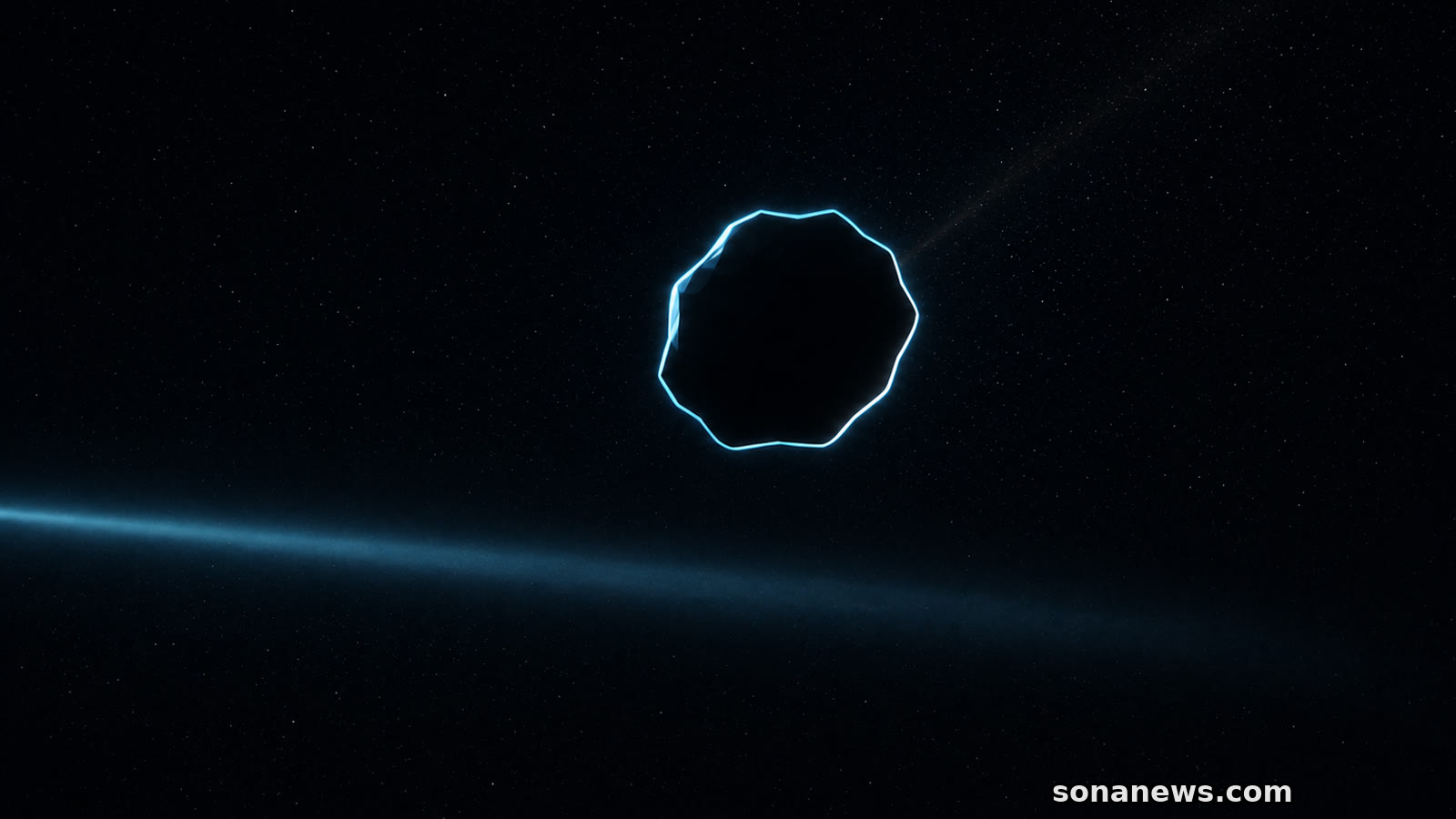

NASA's planetary radar went looking for a near-Earth asteroid in August 2025 and found empty sky. The beam had not failed. The object was simply not where a gravity-only orbit predicted it should be.
That miss turned out to be the most useful clue in the story of 1998 SH2. A study published in *Nature Astronomy* has now shown that the small body was giving itself a tiny extra push by releasing material as it warmed. Deep telescope images later found the faint tail that ordinary survey frames had missed. The object classified as an asteroid was a comet.
The sequence began before 1998 SH2's safe close approach to Earth in late August 2025. NASA's Goldstone radar team scheduled observations with the Deep Space Network's 70-metre DSS-14 antenna. Its pointing was based on 148 optical measurements collected between 1998 and 2016. The target had completed two trips around the Sun since the last of those observations.
On 26 August, the radar did not detect it inside the antenna's beam. An observatory in Brazil recovered the object optically on 31 August, 153 arcseconds away from the gravity-only prediction. The paper describes that gap as a 19-sigma discrepancy, far beyond the formal uncertainty in the forecast. A second Goldstone attempt detected the object on 2 September after the orbit had been corrected.
The close approach was not an impact scare. NASA says 1998 SH2 passed safely within roughly 3 million kilometres of Earth during its four-and-a-half-year orbit. The scientific problem was subtler: what force had moved a roughly 380-metre object far enough to spoil the first radar pointing?
Researchers fitted the full record from 1998 to 2025 with an additional acceleration along the object's path. They measured about minus 1.4 times 10 to the power of minus 11 metres per second squared. That is extraordinarily small in everyday terms, but it accumulated over two unobserved orbits.
Sunlight can also nudge an asteroid through the Yarkovsky effect, in which unevenly emitted heat produces a slight recoil. The study estimates that the largest Yarkovsky acceleration compatible with an object this size would be about one-tenth of the measured value. The authors therefore looked to cometary outgassing, where warming ice turns to gas and acts as a weak thruster.
That interpretation still needed visible evidence. Fifty-three ATLAS survey images from September and early October 2025 showed no obvious coma or tail. Deeper observations were different. Images from the Danish 1.54-metre telescope in Chile, the Canada-France-Hawaii Telescope and the Very Large Telescope revealed a low-surface-brightness tail. In the clearest CFHT data, the tail extended about 20 arcseconds west of the object.
The combination mattered. The displaced orbit indicated a non-gravitational force; the faint tail showed material leaving the body. NASA says 1998 SH2 will now receive the comet designation P/1998 SH2.
The result does not mean that every asteroid with an imperfect orbit is secretly a comet. Nor does it make P/1998 SH2 newly dangerous. It shows why the physical identity of a near-Earth object matters when teams project where it will be in the future.
Gravity dominates those calculations, but weak forces can become measurable over long gaps. A comet's outgassing can also vary as solar heating changes, adding uncertainty that an asteroid-only model would miss. Better classification therefore improves both follow-up planning and impact-risk assessment.
The paper connects P/1998 SH2 with the newer category of "dark comets": objects that look inactive in ordinary images but move as though some non-gravitational force is acting on them. Astronomers have identified 14 such objects in recent work, split into smaller inner-solar-system bodies and larger objects on more comet-like orbits. P/1998 SH2 no longer fully fits the "dark" label because powerful telescopes eventually saw its tail. That is precisely why it is useful. It demonstrates that weak activity can remain hidden for decades until the geometry, timing and telescope sensitivity line up.
The authors suggest that more of the larger dark comets may prove to be ordinary but exceptionally faint comets. That remains a hypothesis to test across a population, not a conclusion from one object. NASA's planned NEO Surveyor mission should find hard-to-see asteroids and comets in infrared light, while continued optical astrometry and radar will still be needed to track how individual paths change.
There is also a limit to what the new study established. The team inferred outgassing from the motion and tail; it did not directly identify water vapour. Its water production rate is a model-dependent estimate. The object's detailed shape and surface remain unresolved.
The durable lesson is procedural rather than dramatic. A missed radar detection prompted a revised orbit. The revised orbit suggested a force. Deeper images found the physical trace of that force. For planetary defence, "where is it?" and "what is it?" are not separate questions for long.
Sources
- Source: "NASA Study Finds Near-Earth Asteroid Is Actually Comet", NASA Jet Propulsion Laboratory, Extracted 2026-07-16. Verified: safe 2025 close approach, failed and successful Goldstone observations, outgassing explanation, faint-tail confirmation, P/1998 SH2 designation and planetary-defence context
- Source: Farnocchia et al., "Non-gravitational acceleration indicative of cometary activity of near-Earth object", *Nature Astronomy*, Extracted 2026-07-16. Verified: peer-reviewed status, 1998 to 2025 astrometry, 153-arcsecond recovery offset, measured acceleration, Yarkovsky comparison, telescope observations, tail length, limitations and open CC BY 4.0 licence
- Source: "NASA Researchers Discover More Dark Comets", NASA Jet Propulsion Laboratory, Extracted 2026-07-16. Verified: 14-object dark-comet context, inner and outer populations, and the distinction between asteroid-like appearance and comet-like motion
- Source: "NEO Surveyor", NASA Science, Extracted 2026-07-16. Verified: NASA mission purpose and its role in detecting hard-to-find near-Earth asteroids and comets in infrared light
Help us improve
Was this article useful?
One anonymous tap helps Sona improve future reporting, headlines and source context.
Up next
NASA is moving towards a final pre-flight telescope for the ESA-led gravitational-wave mission. Its amber glass-ceramic structure matters as much as its gold mirror.
Continue readingMore in Space