TESS found a planet by looking at a star that brightened once
Gaia23bra b is a super-Jupiter found with microlensing, not the usual transit dip. The useful lesson is about old sky data, careful timing and the coming Roman telescope.
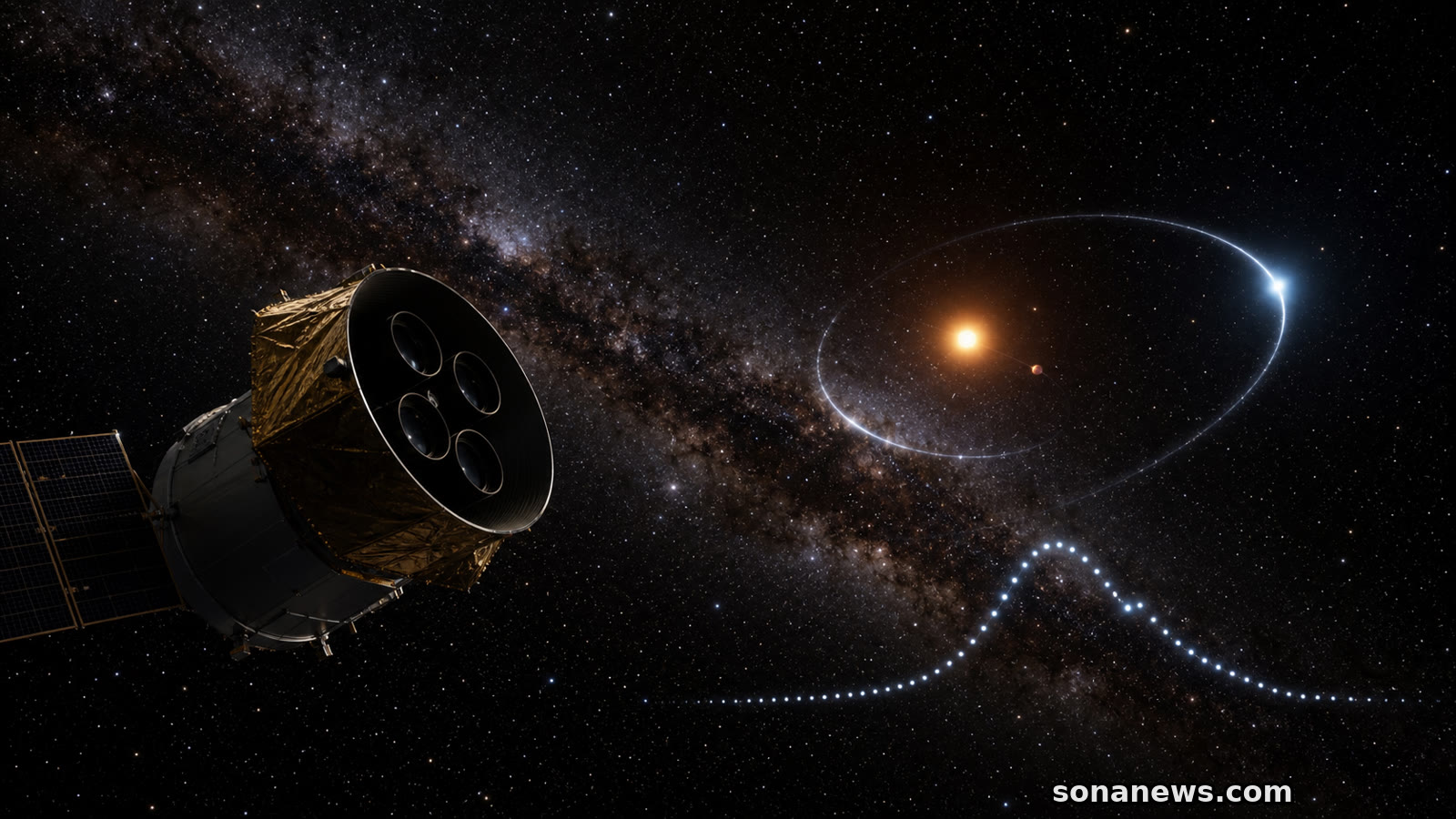

Most exoplanet discoveries begin with a star getting slightly dimmer. A planet passes in front of it, from our point of view, and the lost starlight becomes a clue. NASA’s TESS mission was built around that idea, which is why its full name starts with Transiting. This week’s more interesting detail is that TESS has now helped find a planet by catching a star getting brighter instead.
NASA said on 1 July that researchers using TESS data had identified Gaia23bra b, described in the study as the first gravitationally bound microlensing planet detected by the spacecraft. The planet is not a neat little world skimming close to its star. The paper reports a Jovian planet about 1.63 times Jupiter’s mass, orbiting a K dwarf host at a minimum projected separation of roughly 4.8 astronomical units. In solar-system terms, that puts the scale nearer Jupiter’s neighbourhood than the tight, hot orbits that many transit surveys find most easily.
The discovery did not start with TESS. It started in 2023 with ESA’s Gaia mission, whose Science Alerts system flagged a star that had brightened. That can happen when a foreground object passes almost exactly in front of a more distant background star. The foreground object’s gravity bends and magnifies the background starlight. If the foreground star has a planet, the planet can leave a smaller kink in the brightening pattern. That is gravitational microlensing: not a picture of the planet, but a time-stamped distortion in light.
Gaia saw enough to raise the alert, but not enough to show the whole story. The decisive extra clue came because TESS happened to be watching the same patch of sky across two observing sectors. The study says TESS’s high-cadence observations showed caustic-crossing features, the sharp light-curve structure that points to a binary lens. In this case, the binary lens was interpreted as a host star with a planetary companion.
That is the part worth slowing down for. TESS was not repurposed into a magic planet camera. It did what a survey telescope does well: it took repeated brightness measurements, often enough to preserve a short-lived feature that sparser observations could miss. Gaia supplied the long-baseline alert. TESS supplied denser timing during the right window. The planet emerged from the combination.
The result is also a useful correction to the way exoplanet news is often told. A new planet is not automatically important because it is huge, strange or potentially habitable. Gaia23bra b matters because it sits in a discovery method gap. Transit searches are powerful, but they favour planets that cross their stars from our line of sight and often favour close-in worlds. Microlensing can find colder, wider-orbit planets and systems farther into the Galactic plane, including arrangements that would never line up as a visible transit for Earth-based observers.
There are limits. Microlensing events usually do not repeat. When the alignment is gone, the brightening is gone. That makes follow-up awkward and keeps the uncertainties different from those in a tidy transiting system. The sensible reading is not that TESS will now produce a flood of Jupiter twins on demand. It is that old and overlapping sky surveys may hold more one-time signals than scientists originally expected to mine from them.
The timing is helpful because NASA’s Nancy Grace Roman Space Telescope is designed to make microlensing one of its strengths. NASA’s Roman material says its Galactic Bulge Time Domain Survey will use microlensing to look for planets in habitable-zone and wider orbits, including analogues to most planets in our solar system. Gaia23bra b is not Roman’s result, but it is a small preview of the logic: watch crowded star fields carefully, keep the cadence high, and let gravity reveal planets that do not announce themselves by blocking their star.
There is a quieter lesson here for readers who are not keeping a spreadsheet of exoplanet methods. Space science increasingly depends on data being reusable in ways the original mission brochure did not fully promise. Gaia mapped positions, motions and brightness across more than two billion stars and other objects. TESS was launched to search nearby bright stars for transiting planets, while also monitoring many kinds of variable objects. Put their records together and a single brightening in 2023 can become a new planetary system in 2026.
That is less glamorous than a clean artist’s impression of a giant world, but more honest. Gaia23bra b is inferred from a light curve, a model and the brief geometry of two stars lining up across space. It is not a destination and not a sign of life. It is a reminder that the sky is already being watched in overlapping layers, and that sometimes the important planet is the one a telescope was not expected to find.
Sources
- Source: "NASA’s TESS Mission Finds Planetary System in New Way", NASA Science, Extracted 2026-07-05. Verified: July 1, 2026 publication; Gaia23bra b discovery framing; first TESS microlensing planetary system; Gaia alert origin; TESS denser light-curve coverage; comparison between transits and microlensing
- Source: "TESS's First Bound Microlensing Planet: A Binary Microlensing Event Revealing a Planetary Companion toward the Galactic Plane", arXiv / The Astrophysical Journal Letters, Extracted 2026-07-05. Verified: first gravitationally bound microlensing planet detected by TESS; Gaia23bra b name; K dwarf host; planet mass around 1.63 Jupiter masses; projected separation around 4.8 AU; Gaia plus TESS joint modelling
- Source: "TESS (Transiting Exoplanet Survey Satellite)", NASA Science, Extracted 2026-07-05. Verified: TESS mission purpose, visible-light space telescope status, launch date, extended mission and broader brightness-monitoring role beyond transiting planets
- Source: "Gaia", European Space Agency, Extracted 2026-07-05. Verified: Gaia science-observation period, more than three trillion observations of more than two billion stars and objects, and mission role mapping positions and properties in the Milky Way
- Source: "Microlensing", NASA Science, Extracted 2026-07-05. Verified: Roman Space Telescope microlensing goals, ability to find planets in habitable-zone and wider orbits, and explanation that microlensing is suited to worlds missed by transit surveys
Help us improve
Was this article useful?
One anonymous tap helps Sona improve future reporting, headlines and source context.
Up next
NASA is moving towards a final pre-flight telescope for the ESA-led gravitational-wave mission. Its amber glass-ceramic structure matters as much as its gold mirror.
Continue readingMore in Space