NASA’s Dragonfly is being sealed for a world with methane rain
The Titan-bound rotorcraft has passed structural and pressure tests. The useful story is why a flying laboratory needs to survive dense air, deep cold and its own vibrations.
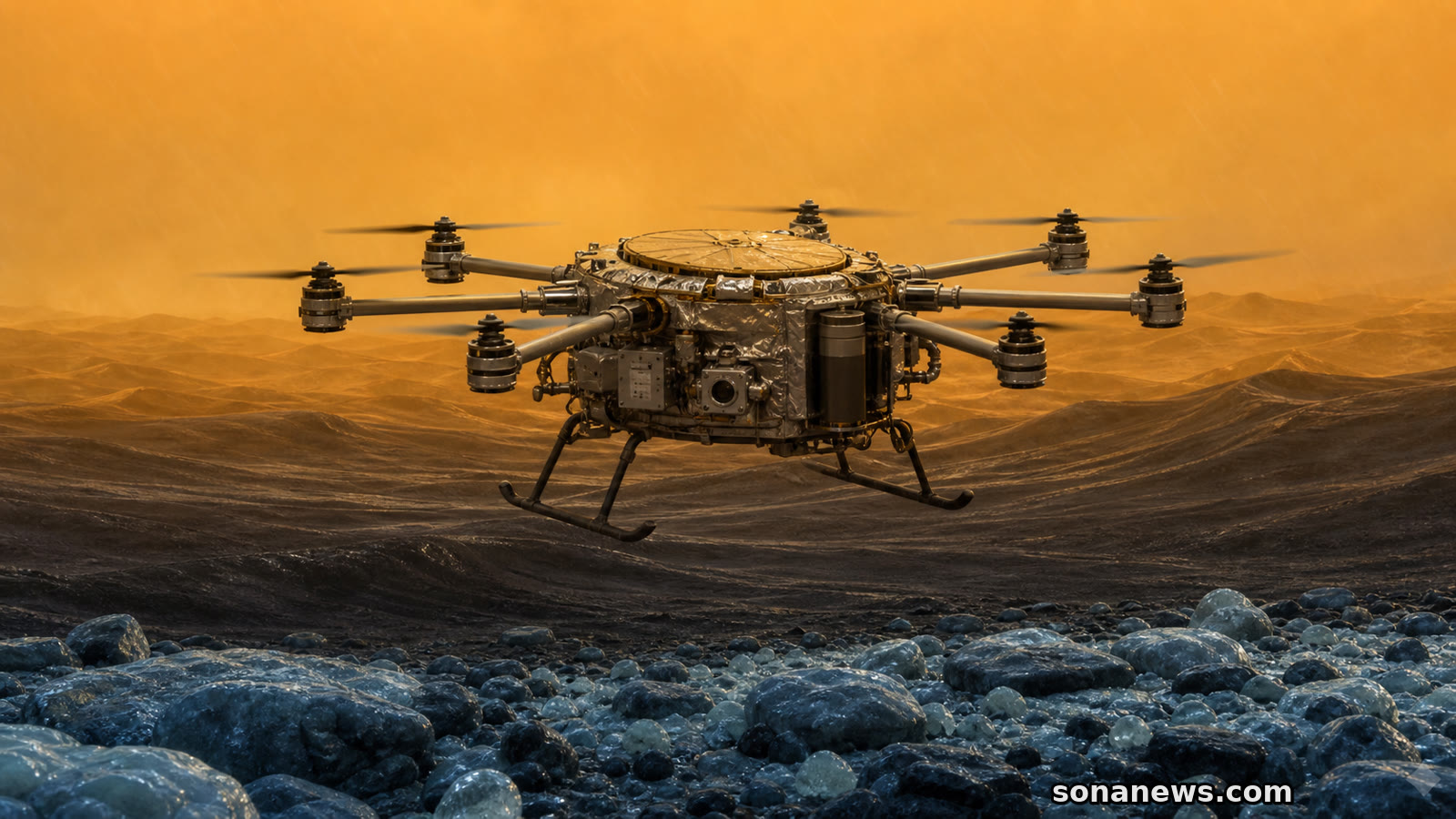

Before NASA’s Dragonfly can fly across Titan, engineers have to find out whether the machine leaks. That sounds mundane beside the promise of visiting Saturn’s largest moon. It is also exactly the sort of question that decides whether a distant mission works.
NASA reported on 9 July that Dragonfly’s nearly 13-foot-long fuselage had moved into its next integration phase after roughly a month of structural testing at the Johns Hopkins Applied Physics Laboratory in Maryland. The team began installing mechanical, thermal and electrical systems on 1 July. Wires, avionics and science instruments will turn the bare frame into a flying laboratory, but only after its structure has shown that it can cope with launch, atmospheric entry, landing and flight.
The unusual part was a sealing test. Spacecraft are commonly designed for vacuum or very thin air. Titan is different. NASA says pressure at its surface is about 60 per cent greater than at Earth’s surface, while the average temperature is close to minus 179C. Its atmosphere is mostly nitrogen with methane mixed in, and methane can form clouds and rain. Engineers pressurised Dragonfly’s outer structure to identify gaps and measure how much air could flow through it. That result feeds the thermal analysis that tells the team whether the lander is sealed well enough.
A pressure test is not merely about keeping weather out. Heat moves differently when dense, extremely cold air can circulate through a structure. Dragonfly carries electronics, instruments and a power system that have to remain inside their operating limits. The outer shell, insulation and seals therefore work as one thermal problem. NASA quoted the mechanical team describing the sealing results as extremely good, but the update is a milestone rather than a guarantee. Integration and system-level testing still lie ahead.
Dragonfly also has to live with the vibrations it creates. The machine is a rotorcraft with eight rotors, not a wheeled rover. During ground vibration testing, engineers suspended its structure a few inches above the clean-room floor on long bungee cords. They then measured how motion introduced at the rotor positions travelled through the frame towards sensors and other equipment. A second configuration placed the lander on its skids to examine its structural response while at rest.
That distinction matters because Dragonfly will alternate between two very different jobs. It must fly autonomously through Titan’s thick, hazy atmosphere, then settle down and behave like a field laboratory. NASA’s mission page says the planned 3.3-year mission could move several miles on a flight and visit dunes as well as Selk Crater. At each stop, instruments are intended to analyse surface material and study chemistry, geology and atmospheric conditions.
The vehicle’s round high-gain antenna makes the same trade-off visible. NASA says the 87.4-centimetre disc sits on a motorised arm. It will rise while Dragonfly is stationary so the spacecraft can send science data towards Earth, then fold into a locking mechanism before the next flight. The stowed position helps the antenna withstand rotor vibration and avoids unwanted resonance with the rest of the lander. Its design has also been tested for Titan’s cold, dust and possible methane rain.
These engineering details keep the science claim in proportion. Dragonfly is scheduled to launch no earlier than July 2028 and arrive in late 2034. NASA is explicit that it is not a mission to detect life. Its aim is to investigate habitability and the chemistry that precedes biology, using mobility to compare materials from more than one location. Titan is valuable because carbon-rich compounds settle on a surface shaped by methane and ethane, while water ice behaves like rock in the deep cold.
The latest tests do not show that Dragonfly can already fly on Titan. They show that the flight structure has passed specific ground checks and can proceed into a more complete form. Components still have to be installed, tested together, launched and operated after a six-year journey. Schedule language should remain provisional because complex planetary missions can change.
Still, the sealing test is a neat way to understand why Dragonfly is unusual. A Mars rover mostly has to tolerate a thin atmosphere and roll across one connected landscape. Dragonfly is being built to take advantage of Titan’s dense air while resisting the same atmosphere’s pressure, cold and weather. It must be an aircraft, a lander, a laboratory and a radio station in the same body.
That makes the clean-room work less photogenic than an artist’s image of orange dunes, but more revealing. The mission’s ambition is not proved by the size of its destination or by loose talk about alien life. It is proved one measured leak and one vibration mode at a time.
Sources
- Source: "NASA’s Dragonfly Clears Key Tests as Titan Rotorcraft Takes Shape", NASA Science, Extracted 2026-07-12. Verified: 9 July update, 29 June fuselage milestone, 1 July integration start, vibration and sealing methods, pressure comparison, antenna dimensions and stowing mechanism, Titan environment and current test status
- Source: "Dragonfly", NASA Science, Extracted 2026-07-12. Verified: no-earlier-than July 2028 launch, late 2034 arrival, 3.3-year planned mission, multi-site flights, habitability and prebiotic-chemistry objectives, and explicit statement that Dragonfly is not a life-detection mission
- Source: "Dragonfly Mission Begins Rotorcraft Integration, Testing Stage", Johns Hopkins Applied Physics Laboratory, Extracted 2026-07-12. Verified: APL mission role, car-sized nuclear-powered rotorcraft, six-year voyage, integration sequence, avionics and power checks, test campaign and provisional launch path
- Source: "Dragonfly Flight System Faces the Heat", Johns Hopkins Applied Physics Laboratory, Extracted 2026-07-12. Verified: heat-shield testing, 2028 and 2034 planning, high-gain antenna function, communications architecture and minus 179C operating environment
- Source: "Titan: Facts", NASA Science, Extracted 2026-07-12. Verified: surface temperature, pressure, nitrogen and methane atmosphere, organic haze and dunes, methane rain and surface liquids, and the role of water ice as rock
Help us improve
Was this article useful?
One anonymous tap helps Sona improve future reporting, headlines and source context.
Up next

NASA is moving towards a final pre-flight telescope for the ESA-led gravitational-wave mission. Its amber glass-ceramic structure matters as much as its gold mirror.
Continue readingMore in Space