Webb watched a giant exoplanet heat up in real time
HD 80606 b is not a second Earth. It is a strange gas giant whose stretched orbit lets astronomers watch an atmosphere change within hours.

The phrase “exoplanet weather” can sound tidier than the science really is. Most worlds beyond the Solar System are too far away to show clouds moving across a familiar disc. Astronomers usually work with small changes in light, careful models and a great deal of patience. That is why HD 80606 b is useful: it gives them a planet whose atmosphere is pushed hard enough, and quickly enough, for change to be measured over a human evening rather than over geological time.
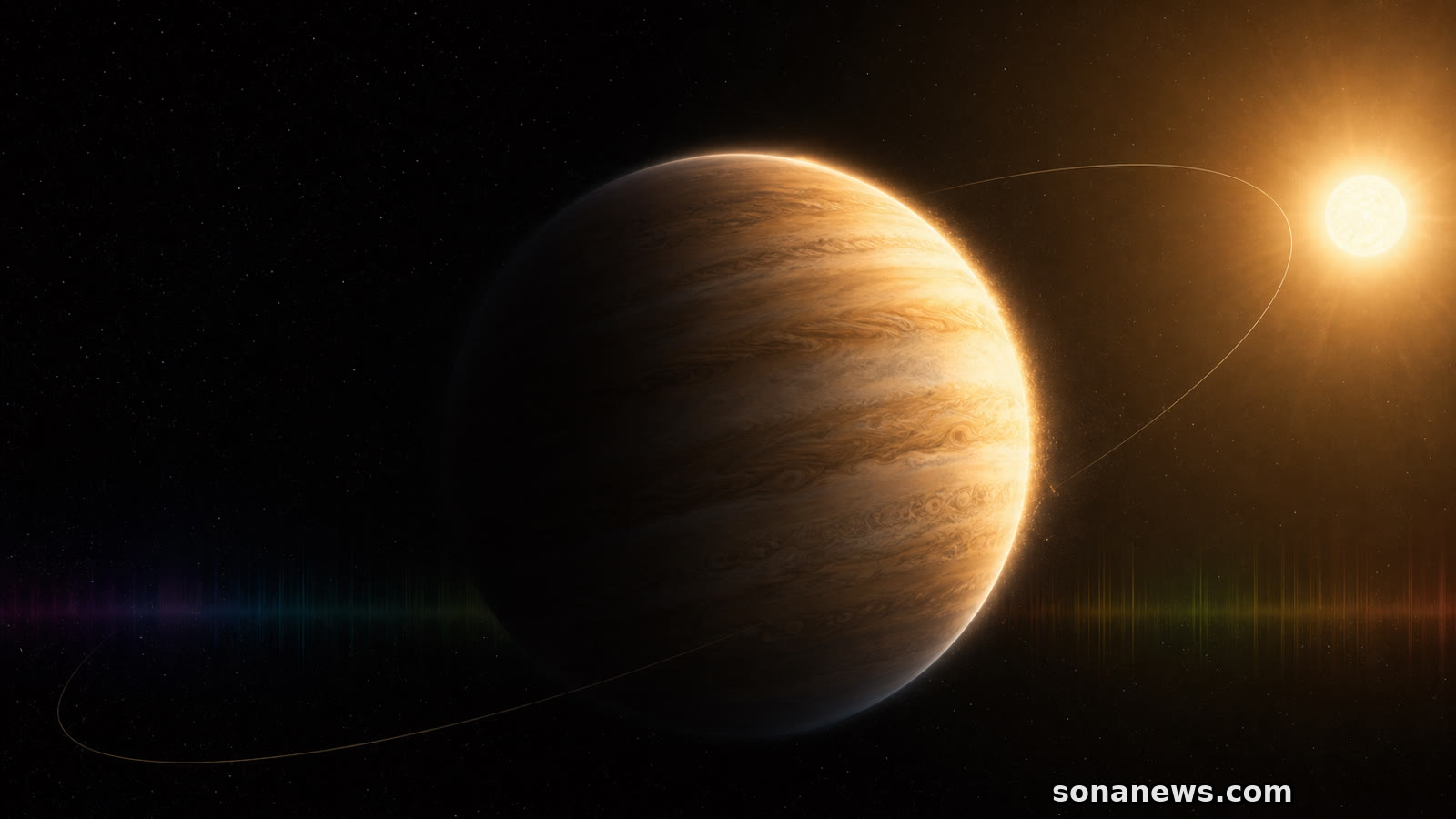
NASA said on 16 June that the James Webb Space Telescope had observed HD 80606 b as it swept through the closest part of its orbit around a Sun-like star. The planet is a gas giant, a little over four times Jupiter’s mass in NASA catalogues, and it follows an extreme 111-day orbit. For much of that orbit it sits farther out. Then it dives inward at periastron, the point of closest approach, and receives a sudden blast of starlight.
Webb’s Mid-Infrared Instrument, MIRI, watched that passage before, during and after periastron. According to NASA, the planet’s temperature rose by about 1,100 degrees Fahrenheit during the close pass. The number is striking, but the point is not that the planet is dramatic. It is that the heating happens on a timescale short enough for an infrared telescope to track how a giant atmosphere responds.
That makes HD 80606 b different from the simpler mental picture of a hot Jupiter. Many hot Jupiters sit close to their stars on tight, nearly circular orbits, so one side may be exposed to intense heating all the time. HD 80606 b is more like a long-haul traveller who spends most of the journey in one climate and then suddenly drops into another. NASA’s exoplanet catalog lists an eccentricity of 0.93, which is a technical way of saying the orbit is highly stretched rather than round.
The close pass turns the planet into a natural stress test. When a giant atmosphere is heated so rapidly, scientists can look for changes in temperature structure, chemistry and cloud behaviour. NASA’s release says Webb’s spectra may help distinguish signatures from molecules such as methane and carbon dioxide. That does not mean anyone has found life, oceans or a habitable surface. This is a massive gas planet under punishing conditions. Its value is as a laboratory for planetary physics.
The observation also shows why Webb matters for exoplanets even when it is not taking a postcard image. Webb sits at the Sun-Earth L2 region and observes in infrared light, which is useful for measuring heat. In this case, the planet also passed behind its star from Webb’s point of view, an event called a secondary eclipse. Comparing the system’s light before and during that eclipse helps researchers separate the planet’s thermal glow from the star’s glare.
There is a useful history here. NASA notes that the now-retired Spitzer Space Telescope had already studied this unusual planet. Webb builds on that older infrared work with sharper sensitivity and more detailed spectroscopy. The cautious way to read the result is not “Webb solved exoplanet weather”. It is that Webb has given researchers a better dataset for one of the most lopsided known giant-planet orbits.
The NASA Exoplanet Archive lists HD 80606 b as a confirmed planet discovered in 2001 by radial velocity, the wobble a planet’s gravity causes in its star. It is also known to transit, which means it can cross the star’s face from our line of sight. That combination makes the system especially valuable. Astronomers have orbital information, a planet that sometimes hides behind the star, and now a fresh infrared record of a rapid heating event.
For readers, the attraction of the story is not that HD 80606 b is relatable. It is profoundly unlike Earth. The attraction is that it makes a normally invisible process slightly more observable. Atmospheres are not static wrappers around planets. They move energy, alter chemistry and form or erase clouds as conditions change. On Earth those changes are tangled with weather systems we can see from satellites. Around a distant star, the signal is reduced to light curves and spectra.
That is where the science becomes quietly impressive. A world dozens of parsecs away can be used to test how giant planets react when their star suddenly matters more. The answer will not be a single neat forecast. It will be a set of constraints on models that researchers can compare with other hot Jupiters, eccentric planets and future Webb targets.
HD 80606 b may have been presented by NASA with a memorable “getting roasted” headline, but the better story is cooler than that. Webb did not catch a planet on fire. It watched heat move through an alien atmosphere at a moment when nature turned the dial sharply upward. For exoplanet science, that is the rare kind of drama that is actually useful.
Sources
- Source: “NASA’s Webb Catches Exoplanet Getting Roasted”, NASA Science, Extracted 2026-06-17. Verified: 16 June 2026 publication, 17 June update, Webb MIRI observation of HD 80606 b before, during and after periastron, 111-day orbit, roughly 1,100 degrees Fahrenheit heating, secondary eclipse context and cautious atmospheric-chemistry framing
- Source: “HD 80606 b”, NASA Science Exoplanet Catalog, Extracted 2026-06-17. Verified: gas giant classification, G-type host star, 111.4-day orbital period, high eccentricity, discovery announced in 2001 and mass/radius catalogue context
- Source: “HD 80606 Overview”, NASA Exoplanet Archive / IPAC, Extracted 2026-06-17. Verified: confirmed planet status, radial-velocity and transit detection, orbital period, stellar companion notes and host-system parameters
- Source: “James Webb Space Telescope”, NASA Science, Extracted 2026-06-17. Verified: Webb active mission status, NASA / ESA / CSA partnership, infrared observatory role, L2 location and featured HD 80606 b context
- Source: “Exoplanets”, NASA Science, Extracted 2026-06-17. Verified: general exoplanet definition, more than 6,000 confirmed exoplanets and the reason distant planets are studied through indirect measurements
Help us improve
Was this article useful?
One anonymous tap helps Sona improve future reporting, headlines and source context.
Up next
Hubble data trace a 10-sided atmospheric wave from faint 2023 hints to a clearer 2025 pattern. Its slow drift and 32-day wobble do not yet explain why it formed.
Continue readingMore in Space