Mars has a miniature version of the cycle behind Earth's auroras
MAVEN data connect magnetic reconnection, electric currents and plasma flow over patches of magnetised crust. The result explains how local auroras can form without a planet-wide magnetic shield.
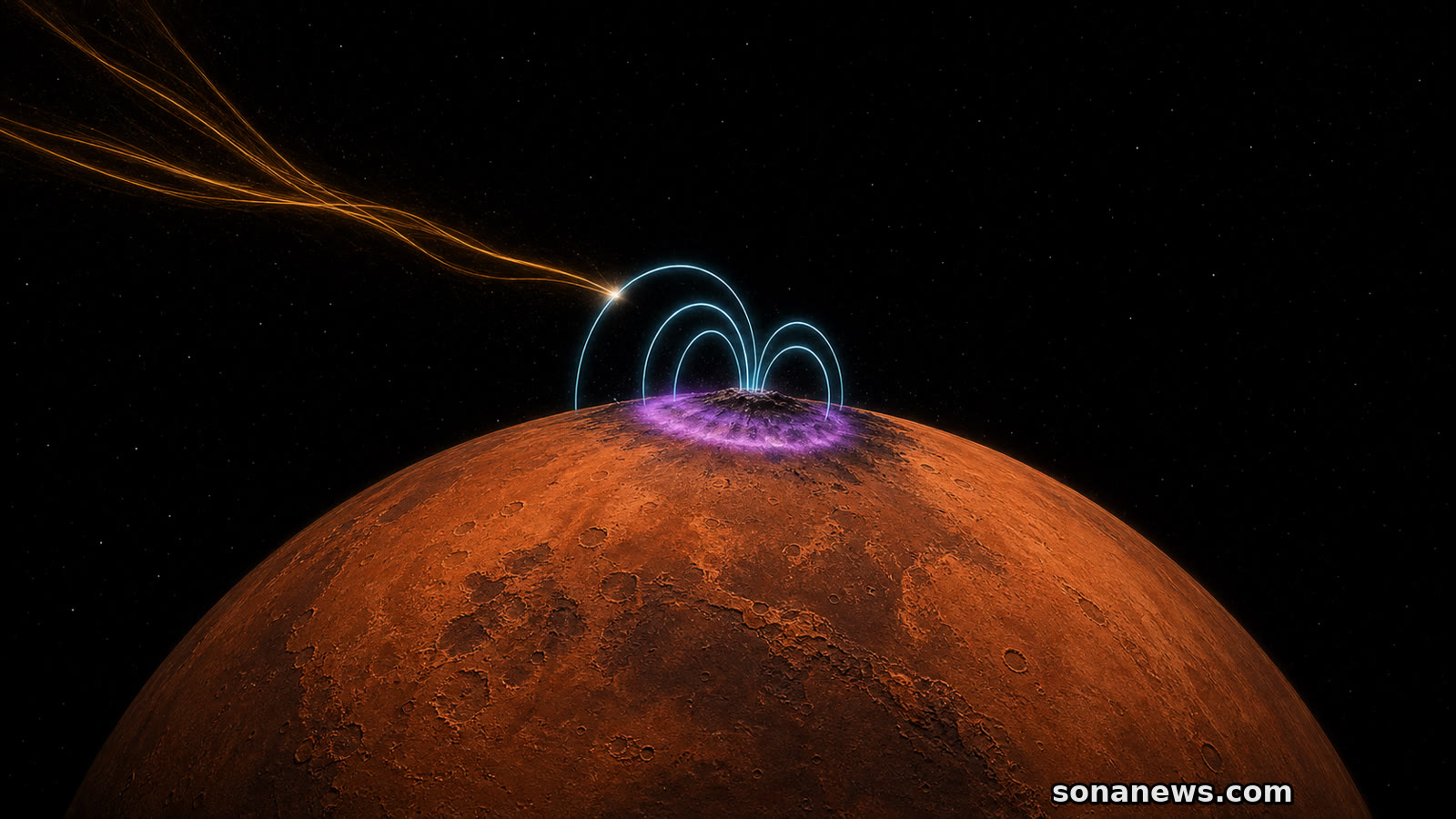

Mars does not have the global magnetic shield that guides auroras towards Earth's poles. It has something much patchier: regions of ancient crust that remain strongly magnetised. A new analysis of NASA's MAVEN data shows that some of those regions can run a miniature version of the magnetic cycle behind familiar terrestrial auroras.
The result, published in *Nature Communications* on 23 July, links processes that had often been studied separately at Mars. Magnetic fields reconnect, electrical currents run between the upper atmosphere and space, plasma circulates, and electrons are accelerated downwards with enough energy to make atmospheric gases glow. Together, the measurements provide a coherent explanation for localized, discrete auroras over parts of the Martian crust.
That does not mean Mars has quietly regained an Earth-like magnetosphere. The researchers call the process a "Dungey-like" cycle precisely because the setting is different. Earth's cycle operates inside a global dipole field. The Martian version is tied to small magnetic patches, at roughly one-twentieth the spatial scale and in fields about one-hundredth as strong.
At Earth, magnetic field lines carried by the solar wind can reconnect with the planet's field on the sunward side. The newly opened lines are swept towards the nightside, reconnect again in the magnetotail, then close and move back towards the planet. This circulation of magnetic flux and plasma is called the Dungey cycle.
The resulting currents and electric fields can accelerate electrons into the upper atmosphere. Collisions with atmospheric atoms and molecules create auroral light. The glow is the visible outcome of a much larger circuit.
Mars lost its planet-wide internal magnetic field long ago, but parts of its crust preserve magnetism from an earlier era. Those patches complicate the way the solar wind meets the planet. Previous MAVEN work had connected strong southern crustal fields with discrete auroras and found evidence for reconnection, but the route from reconnection to accelerated electrons was incomplete.
The new paper fills that gap with measurements of ionospheric plasma flow. Its main case comes from a five-minute MAVEN pass near the dusk terminator on 25 February 2017, over some of the planet's strongest crustal fields. The team combined data from the spacecraft's magnetometer, Solar Wind Electron Analyzer and STATIC ion instrument.
The magnetometer revealed field perturbations consistent with currents flowing along magnetic field lines. Electron measurements showed energized particles associated mostly with upward field-aligned current. STATIC, working near the limit of what the instrument could resolve, measured east-west flows of oxygen ions in the ionosphere.
The directions matter. Taken together, the currents, electron acceleration and reversing ion flows fit a small circulation pattern around neighbouring crustal magnetic regions. External field lines reconnect with a local magnetic arcade, open and move tailward. A second reconnection closes them again. The new loops relax towards Mars while plasma moves their footpoints through the ionosphere.
Electric fields associated with that circulation help establish the current system. Where ordinary electron flux is not enough to carry the current, electrons can be accelerated towards the atmosphere. The paper estimates that the measured electrons had enough energy flux to produce ultraviolet auroral emission detectable by MAVEN's Imaging Ultraviolet Spectrograph.
This is not a claim based on one neat photograph. The detailed event combines in-situ measurements taken as the spacecraft crossed the region. The paper also identifies six additional examples with similar signatures at different crustal fields or on different dates. That supports the idea that the cycle operates repeatedly, but it is not a global survey of every Martian aurora.
MAVEN's operational story gives the publication an unusual coda. NASA lost contact with the spacecraft on 6 December 2025 and declared the mission over on 3 June 2026 after recovery efforts failed. The aurora result comes from data collected years earlier, and NASA says the mission's archive will continue to support research.
That archive is unusually valuable because MAVEN measured the solar wind, magnetic fields, charged particles and the upper atmosphere from the same platform. The new study needed that combination to turn several signatures into one physical sequence. It also shows why an instrument result can mature long after the pass that recorded it.
There are limits to the comparison with Earth. Mars' crustal fields are uneven, rotate with the planet and interact with a draped solar-wind field rather than a stable global dipole. The cycle described by the authors resembles part of Earth's dusk-side system, not a pocket-sized copy of the whole magnetosphere. "Dungey-like" is a framework for the shared physics, not a claim that the planets are magnetically equivalent.
The wider value is comparative. If magnetic reconnection and auroral current systems can organise themselves across such different scales, researchers gain another way to interpret plasma environments around planets with weak, local or complicated fields. Mars has not borrowed Earth's shield. It has shown that one of Earth's auroral mechanisms can work in fragments.
Sources
- Source: "NASA's MAVEN Illuminates New Understanding of Auroras at Mars", NASA Science, Extracted 2026-07-23. Verified: published result, Dungey-cycle comparison, crustal-field context, instruments used, localized aurora mechanism and mission-end status
- Source: Xu et al., "Miniature Dungey-like cycle at Mars", *Nature Communications* 17, 6129 (2026), Extracted 2026-07-23. Verified: peer-reviewed evidence, 25 February 2017 case, six additional events, 20-fold scale and 100-fold field-strength comparisons, current, electron and ion-flow measurements, limitations and CC BY 4.0 status
- Source: "NASA Says Farewell to MAVEN Mars Mission", NASA, Extracted 2026-07-23. Verified: loss of contact on 6 December 2025, mission end declared 3 June 2026, more than 800 mission publications and continued value of archived data
- Source: "MAVEN", NASA Science, Extracted 2026-07-23. Verified: mission purpose, instrument and programme context, September 2014 Mars arrival, and current end-of-mission status
Help us improve
Was this article useful?
One anonymous tap helps Sona improve future reporting, headlines and source context.
Up next
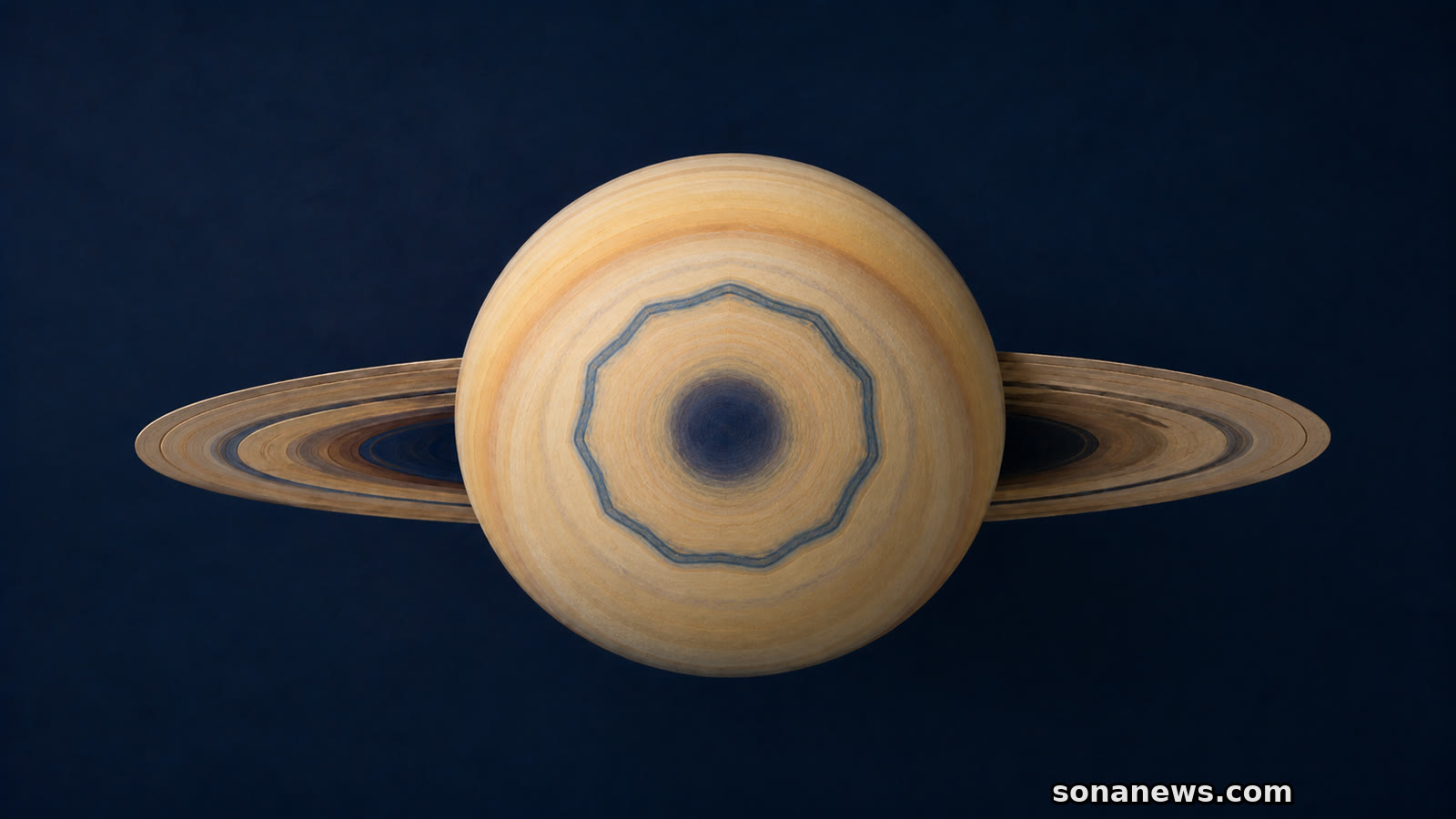
Hubble data trace a 10-sided atmospheric wave from faint 2023 hints to a clearer 2025 pattern. Its slow drift and 32-day wobble do not yet explain why it formed.
Continue readingMore in Space