CAPSTONE 02 will have two spacecraft swap roles near the Moon
NASA's in-development mission is targeted for 2027. Its twin spacecraft will alternate between chaser and target while testing navigation, formation flying and communications in lunar orbit.
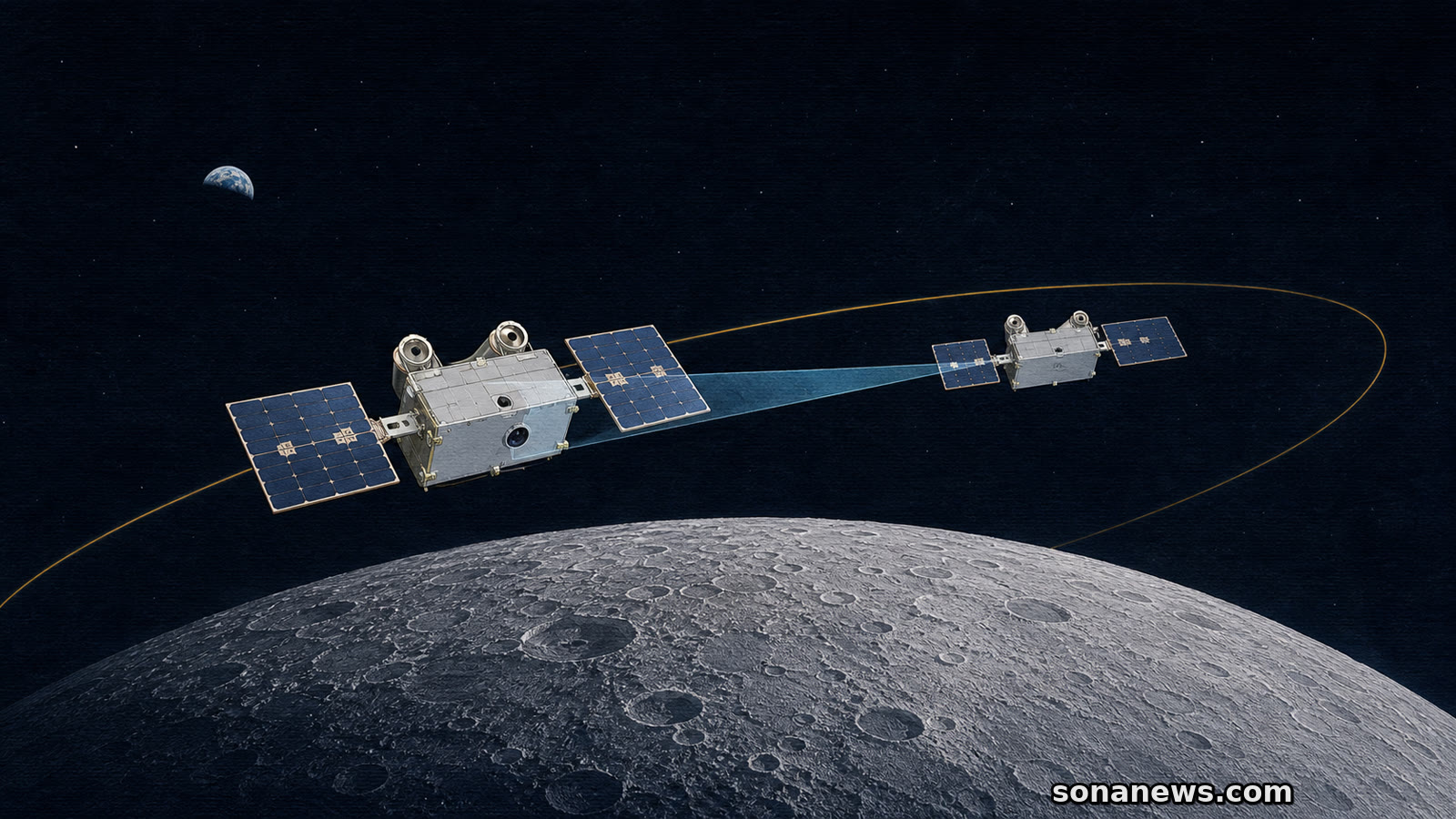

A spacecraft approaching another spacecraft near the Moon must solve a more difficult problem than simply following a line on a map. Earth and lunar gravity pull on both vehicles, the target is moving, and decisions made in deep space cannot depend on instant instructions from a control room.
NASA's newly announced CAPSTONE 02 mission is intended to rehearse that problem with a matched pair. Targeted for launch in 2027, the in-development technology demonstration will send two identical small spacecraft into lunar orbit. Each will be able to act as the vehicle that approaches, known as the chaser, or the vehicle being approached, known as the target.
That role swap is the important idea. Rather than treating rendezvous as one scripted pass, operators plan to run a series of proximity operations and formation-flying scenarios with both spacecraft. The aim is to learn how relative navigation behaves in the coupled gravity of Earth and the Moon before similar techniques are relied upon for more consequential lunar missions.
The original CAPSTONE spacecraft proved that a small commercial mission could operate in a near-rectilinear halo orbit, the elongated lunar orbit planned for NASA's Gateway. It also tested autonomous navigation, networking and communications. After launching in June 2022, the microwave-oven-sized CubeSat completed its primary objectives and then became a software testbed. NASA's work with the spacecraft concluded in June 2026.
CAPSTONE 02 is not simply a replacement. NASA describes a shift from validating an orbit to testing how two vehicles behave relative to each other. A single spacecraft can compare its estimated position with tracking from Earth or with known celestial bodies. A pair can also measure, observe and respond to a moving partner whose position must be understood continuously.
Both new spacecraft are expected to be about 400 kilograms and supplied by Terran Orbital Systems. NASA says operators will test rendezvous, loitering and formation flying, with the vehicles alternating between chaser and target. The separation matters: proximity operations are controlled approaches, not necessarily docking. NASA has not said that the CAPSTONE 02 pair will dock, carry people or become permanent lunar infrastructure.
The planned experiments are related to the navigation strategies expected when NASA's Orion spacecraft approaches a lunar lander. That makes the demonstration relevant to future crew transfers, but it is not a rehearsal with crewed hardware. CAPSTONE 02 is a risk-tolerant testbed intended to expose weaknesses in software, sensors and procedures while the stakes are lower.
NASA says the pair will combine ground tracking, optical sensors and sightings of celestial bodies to locate one another. An optical imaging payload from Lawrence Livermore National Laboratory will support the navigation work and collect images of the Moon. Three NASA-developed navigation software suites are due to gather data during the mission's low-energy transfer, which would carry the spacecraft beyond the Moon before they settle into lunar orbit.
That long route is part of the experiment rather than dead time. Navigation software can be compared across changing geometries on the way out, while the spacecraft build an independent picture of where they are. Once near the Moon, each vehicle becomes both observer and observed. Switching the roles broadens the test because errors tied to one sensor angle, lighting condition or vehicle state should not always appear in the same place.
The mission will also continue developing the Cislunar Autonomous Positioning System, or CAPS, first demonstrated by the original CAPSTONE. The principle is to determine a spacecraft's position relative to another spacecraft without relying exclusively on Earth-based tracking. Reducing that dependence could free ground antennas from some routine navigation work and make multi-spacecraft operations more resilient when a direct link is unavailable.
CAPSTONE 02 has other jobs too. NASA plans to test cislunar communications and keep characterising the radiation environment around the Moon. Those measurements do not turn the mission into a complete lunar network or a definitive radiation survey. They are supporting observations from a technology demonstrator whose central novelty is the paired, role-swapping flight test.
The 2027 date is a target, not evidence that hardware is already in lunar orbit. NASA announced that Advanced Space had received the contract, and the spacecraft and software still have to be built, integrated, launched and operated. Mission schedules and designs can change during development.
Even a successful demonstration would answer a bounded question: whether this combination of sensors, software and procedures can manage selected rendezvous and formation scenarios in the real cislunar environment. It would not certify every future lander, eliminate ground support or prove that autonomous docking near the Moon is routine.
That limitation is also the reason to fly the test. Earth-based simulations cannot reproduce the full three-body environment, communications gaps, lighting changes and hardware behaviour of two vehicles around the Moon. CAPSTONE 02 is designed to turn those abstractions into observed trajectories and operational data. Its most useful result may not be a dramatic close approach, but a clearer account of what two spacecraft need to know about each other before either is trusted to come closer.
Sources
- Source: "NASA Announces New Spacecraft Technology Demonstration Mission at Moon", NASA, Extracted 2026-07-26. Verified: 2027 target, contract with Advanced Space, two identical approximately 400-kilogram spacecraft, chaser and target role-swapping, rendezvous, proximity operations, formation flying, navigation inputs, software, optical payload, communications and radiation work
- Source: "CAPSTONE 02", NASA, Extracted 2026-07-26. Verified: mission status and purpose, paired spacecraft design, lunar-orbit technology-demonstration scope and relationship to future exploration
- Source: "NASA's CAPSTONE Completes Extended Mission Testing Lunar Technologies", NASA, Extracted 2026-07-26. Verified: original CAPSTONE mission completion, near-rectilinear halo orbit work, autonomous navigation, optical navigation, delay-tolerant networking and June 2026 conclusion of NASA activities
- Source: "What is CAPSTONE?", NASA, Extracted 2026-07-26. Verified: original spacecraft scale, 2022 launch, orbit characteristics, spacecraft-to-spacecraft navigation and mission objectives
Help us improve
Was this article useful?
One anonymous tap helps Sona improve future reporting, headlines and source context.
Up next
Hubble data trace a 10-sided atmospheric wave from faint 2023 hints to a clearer 2025 pattern. Its slow drift and 32-day wobble do not yet explain why it formed.
Continue readingMore in Space