Curiosity's new Martian polygon field is a clue, not a verdict
The rover's 340-image Valle Grande panorama shows centimetre-scale fractures across the ground and around Miraflores butte. Mud drying is only one candidate process.
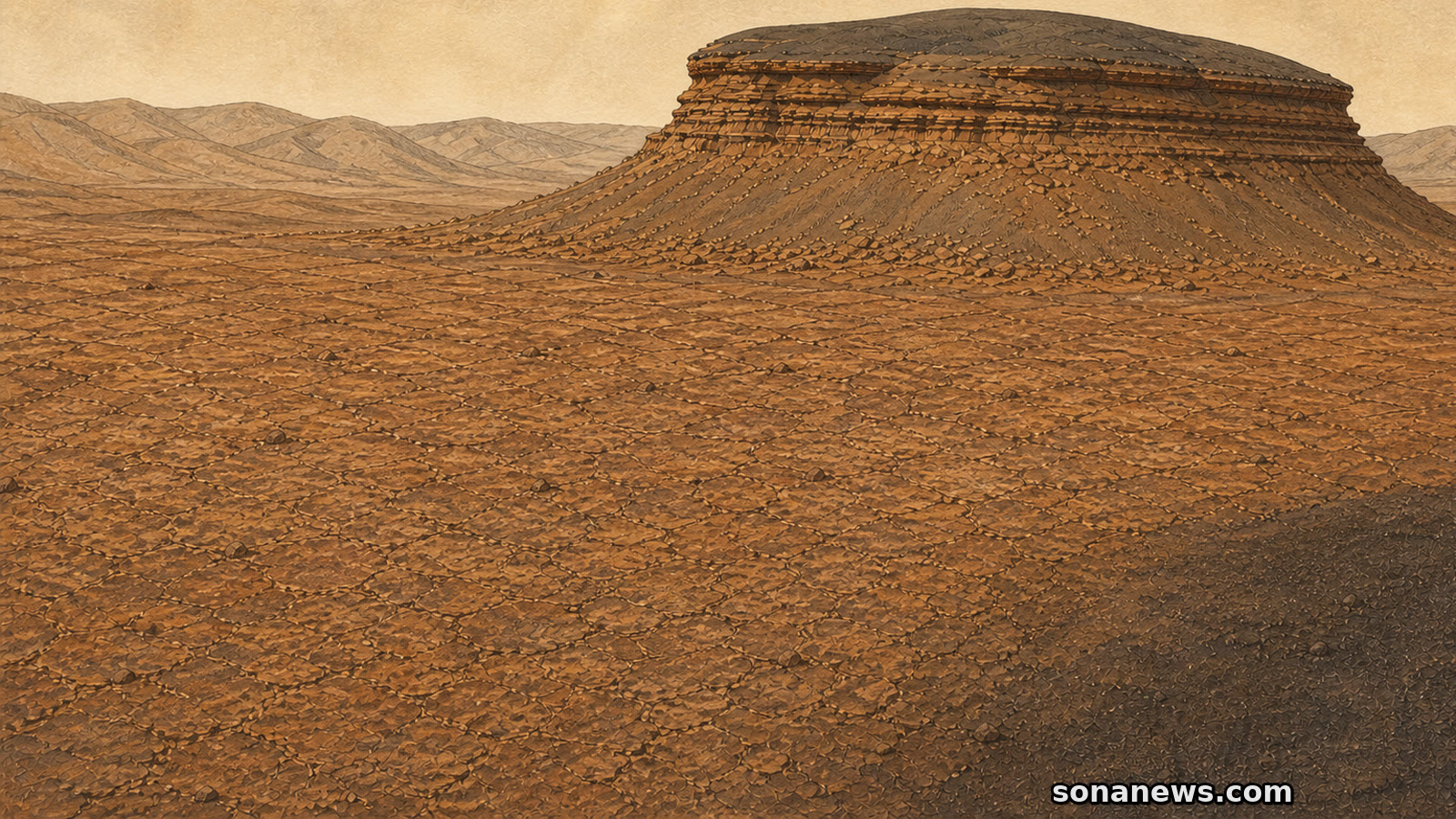

A wide Martian panorama can make an answer feel obvious before the science has earned it. Curiosity's latest view shows thousands of small polygons tessellating the ground like a cracked mosaic. The pattern runs across Valle Grande and around a layered butte called Miraflores.
It is tempting to call the shapes dried mud. Curiosity has found ancient mud cracks elsewhere on Mount Sharp, and those older features do support a story of repeated wet and dry conditions. But NASA's 29 July announcement is careful about the new field: scientists have not yet determined how it formed.
That distinction is the real result for now. Curiosity has documented an unusually extensive, measurable pattern. The landscape is a clue, not a verdict on ancient water or climate.
Curiosity's Mastcam recorded the scene in 340 individual images on 19 and 20 June 2026, the mission's Martian days 4,930 and 4,931. Image specialist Jason Achilles assembled the frames into a panorama. NASA notes that the published colour was adjusted to resemble how the terrain would look under Earth-like lighting, so the image is designed for geological reading rather than as a literal record of the ambient colour cast.
The small polygons are roughly centimetre-scale, with NASA descriptions placing them at about 4 to 10 centimetres across. They cover a broad area instead of a single isolated patch. They also continue around Miraflores, a roughly 6-metre butte capped by a thick layer of dark sand.
Those observations matter because distribution is part of the evidence. A pattern that crosses a large field and relates to nearby layers can tell geologists more than one attractive close-up. Yet extent alone does not identify the process.
| The panorama supports | It does not yet support | |---|---| | Curiosity observed a widespread field of small polygonal fractures | The polygons are confirmed mud cracks | | The network occurs across Valle Grande and around Miraflores | Liquid water was present when every polygon formed | | The team can compare geometry, chemistry and geological context | One formation mechanism has survived peer review | | The field is different enough to merit investigation | Curiosity found life, fossils or a biosignature |
Polygonal ground is not a process by itself. It is a shape that can emerge when a material repeatedly contracts, fractures or reorganises stress. Different starting materials and environmental cycles can converge on a similar-looking network.
NASA lists several possible routes for the Valle Grande field. Surface material can shrink as it dries. Repeated temperature changes can expand and contract rock or sediment. Burial and compaction can reorganise stresses. Sediment can also shrink when it loses water or when minerals change chemically. These are candidate explanations, not findings announced for this site.
That is why the word "honeycomb" is useful as a visual description but weak as a diagnosis. Regularity can reveal that forces were repeated or distributed across a surface. It cannot, on its own, say whether the controlling cycle involved moisture, heat, pressure or mineral chemistry.
Curiosity's earlier discovery at a site called Pontours provides an important contrast. In 2023, a team reported hexagonal patterns at the transition between clay-rich and sulfate-rich layers on Mount Sharp. The peer-reviewed *Nature* paper linked the geometry and geological setting to sustained wet-dry cycling on early Mars.
The key was not merely that the surface contained polygons. Repeated drying can make cracks evolve from T-shaped junctions toward Y-shaped junctions, producing more hexagonal networks. At Pontours, the crack geometry, mineral setting and preservation together supported that interpretation.
The new Valle Grande field has not been folded into the same conclusion. NASA says the Curiosity team has been measuring the shapes and chemistry while considering multiple origins. Until those observations are connected in a published analysis, the older result shows what one well-supported wet-dry case can look like; it does not classify every later polygon field.
A convincing origin story needs a chain of evidence. Researchers would want to know whether the junction angles and polygon sizes change systematically, whether the network cuts across layers or follows them, and whether particular minerals occur inside the fractures, along their edges or in the surrounding rock. They would also compare the field with other elevations and rock units along Curiosity's route.
The order of events matters too. A fracture network that formed while sediment was soft records a different history from cracks that opened after rock had hardened and been exposed to large temperature swings. Later erosion can also sharpen, widen or partly erase an older pattern.
None of those tests guarantees a dramatic answer. They narrow the set of processes that can explain the same ground. In planetary geology, eliminating an attractive but incompatible mechanism is progress.
When a new shape from Mars resembles something familiar on Earth, separate four questions:
1. **What was directly observed?** Look for dimensions, instrument, location and extent. 2. **What is being inferred?** Words such as "could," "consistent with" and "candidate" mark an interpretation that is still bounded. 3. **What comparison is doing the work?** An Earth analogue or older Mars site is evidence only when materials and context match closely enough. 4. **Has the mechanism been published?** A mission update can announce a valuable observation before a full analysis reaches peer review.
For Valle Grande, the direct observation is already substantial: a 340-frame record of a broad, unusually fine polygon field in a specific geological setting. The cause remains open. The most interesting next update will not be another nickname for the texture, but evidence that distinguishes one physical recipe from the others.
Sources
- [NASA/JPL: Curiosity Mars Rover Discovers Field of Honeycomb Textures]( published 29 July 2026. Verified: release status, 340 Mastcam frames, 19 and 20 June capture dates, sols 4,930 and 4,931, Jason Achilles panorama assembly, colour adjustment, polygon scale, broad extent, Miraflores context and unresolved origin
- [NASA Photojournal PIA26729: Curiosity Discovers a Field of Martian Polygons]( added 29 July 2026. Verified: image provenance, frame count, field and butte description, approximate polygon size and the set of possible formation conditions
- [Rapin et al.: Sustained wet-dry cycling on early Mars, *Nature*]( published 9 August 2023. Verified: peer-reviewed Pontours interpretation, clay-to-sulfate transition context, crack-junction geometry and sustained wet-dry cycling conclusion for that earlier site
- [NASA/JPL: Cracks in Ancient Martian Mud Surprise Curiosity Rover Team]( published 9 August 2023. Verified: accessible explanation of T- to Y-junction evolution, repeated wet-dry cycles and the distinction between the Pontours result and a generic polygon diagnosis
Help us improve
Was this article useful?
One anonymous tap helps Sona improve future reporting, headlines and source context.
Up next
Hubble data trace a 10-sided atmospheric wave from faint 2023 hints to a clearer 2025 pattern. Its slow drift and 32-day wobble do not yet explain why it formed.
Continue readingMore in Space