Headphone volume is only part of the hearing-risk story
WHO guidance pairs sound level with listening time. A weekly exposure tracker can make that relationship clearer, but it is not a hearing test or a personal safety guarantee.
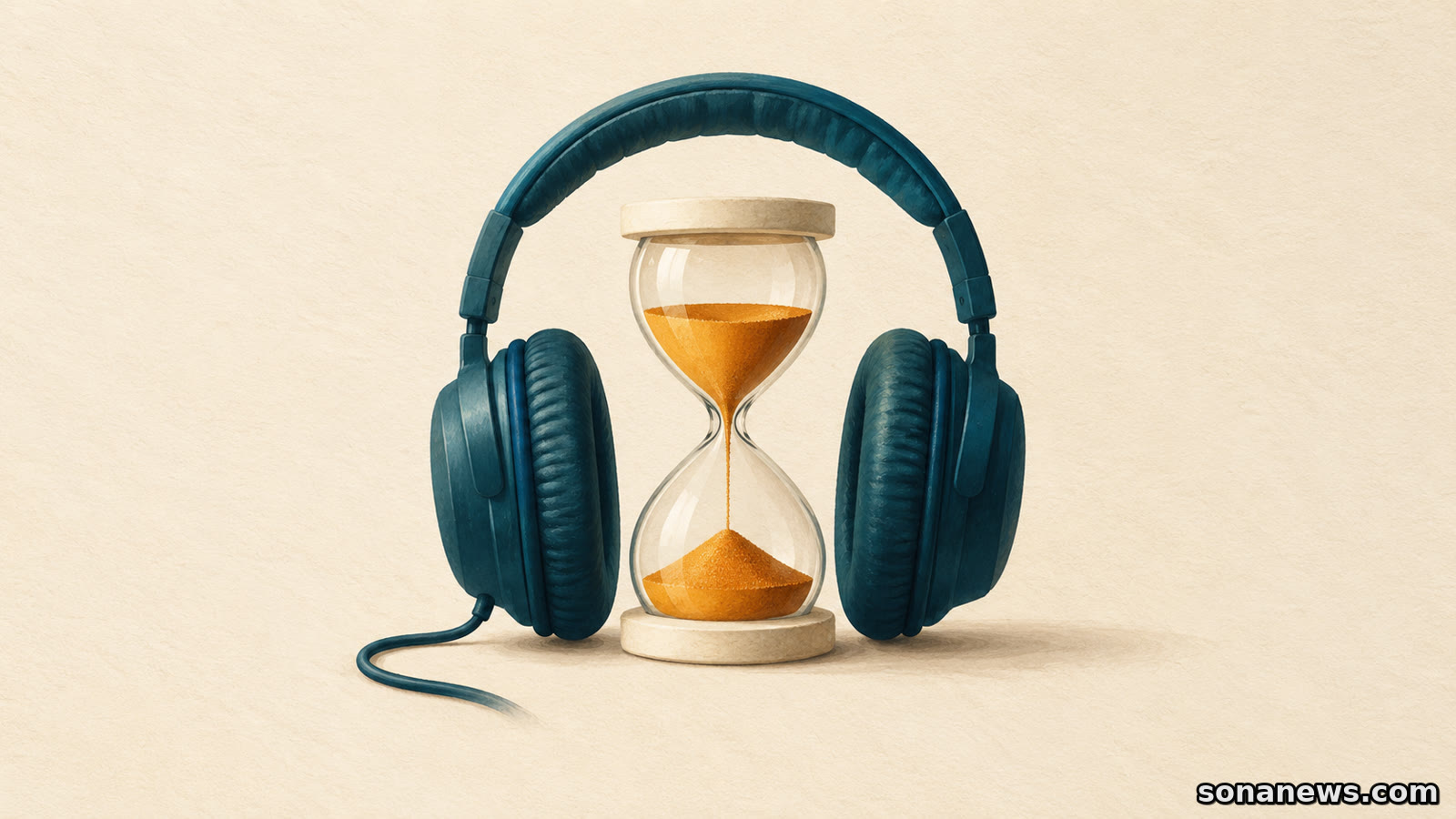

A volume control answers one question: how loud is the next call, album or game? It does not answer how long the listening has lasted. That second question is central to the World Health Organization's guidance on protecting hearing, which considers sound level, duration and repeated exposure together.
The difference is substantial. WHO's safe-listening guidance gives an example of 40 hours a week at an average sound level of 80 decibels, but only four hours at 90 decibels. These are public-health reference figures, not a personalised promise that a particular listening session cannot cause harm. They show why volume alone is an incomplete measure.
For people using headphones across work and leisure, the useful distinction is between a volume setting and accumulated sound exposure. A device feature that tracks both level and time can describe something the volume slider cannot. It still cannot establish whether someone has hearing loss or account for noise it has not measured.
The WHO and International Telecommunication Union standard for personal audio devices describes a dosimetry function: software that tracks sound level and listening duration, then expresses exposure as a percentage of a reference allowance. In plainer terms, it combines how loud the audio is with how long it plays.
The standard sets out an adult reference mode of 80 decibels for 40 hours per week. It also specifies a separate mode for children of 75 decibels for the same weekly duration. The adult reference should therefore not be presented as a universal setting for every listener.
This is a device-design standard, not evidence that every pair of headphones already includes the function. Its recommendations also cover listening profiles, volume-limiting options and information for users. A product's actual monitoring features need to be distinguished from what the standard recommends.
The allowance is not a target to use up. WHO's comparison between 80 and 90 decibels illustrates how quickly the reference listening time contracts as sound gets louder. It is not a rule that anything below a displayed percentage is harmless, or that damage begins at an exact minute after it.
A weekly headphone summary describes the exposure within that system's measurement scope. It should not automatically be read as a record of everything a person has heard. A loud concert, power tools or noise at work may sit outside the headphone history.
The US National Institute on Deafness and Other Communication Disorders, part of the National Institutes of Health, lists high-volume headphone listening alongside concerts, woodworking tools and other sources of harmful noise. Its explanation stresses sound level, distance from the source and exposure time. The relevant issue is the sound reaching the ear, not whether it comes from entertainment or a job.
WHO likewise advises people working in noisy settings to consider their exposure outside working hours. That does not mean an ordinary quiet activity needs to become another health metric. It means that a low reading in one device's log cannot establish that the rest of the day was quiet.
A useful distinction when reading a sound report is what it measures: audio played through headphones, sound around the phone, or a hearing check. WHO discusses all three kinds of tools. They answer different questions, and one result should not be substituted for another.
WHO recommends well-fitted, noise-cancelling headphones because they can reduce the need to raise listening volume in a noisy setting. The point is not that the label makes any chosen volume safe. It is that less background competition can make turning the audio up less tempting.
That recommendation also differs from guidance on hearing protection in loud environments. The US Centers for Disease Control and Prevention lists earplugs and protective earmuffs among the devices used for that purpose. A consumer headphone feature should not be treated as proof that a product provides suitable protection for a particular noisy activity.
Across these sources, the prevention message is consistent: lower sound levels, less time around loud noise, distance from the source where possible and appropriate hearing protection. WHO also recommends breaks in a quiet environment. These are general public-health measures, not a calculation of an individual's remaining safe minutes.
Noise-related hearing changes are not always immediately obvious. NIDCD says damage can develop gradually, and that a person may not notice it until difficulties become more pronounced. It also distinguishes prolonged exposure from a single extremely loud burst, which can cause immediate injury.
That is why a weekly allowance should not be used to judge a sudden intense sound. Nor does feeling better after a noisy event prove that there was no lasting effect. NIDCD notes that apparently temporary hearing loss can resolve while some long-term damage remains.
WHO advises a professional hearing assessment for persistent ringing or difficulty following conversations. It also notes that tinnitus can have causes other than loud sound. This article does not provide a symptom checklist for self-diagnosis, and a phone's exposure history cannot determine the cause of a hearing problem.
The practical value of a listening summary is more modest: it makes duration visible alongside volume. A short louder session and a long quieter one are not interchangeable simply because both felt comfortable. The question is not only where the slider sits, but what sound exposure has accumulated and what the device's record leaves out.
Editorial note. This article is general health information, not medical advice, a hearing assessment or a personalised listening limit. Sound-exposure figures cannot diagnose hearing loss or establish that a particular exposure is safe for you. A qualified healthcare or hearing-care professional can assess hearing concerns and advise on individual circumstances. Do not use an app reading or this article to delay seeking care for new or concerning symptoms.
Sources
- **WHO: Deafness and hearing loss, safe listening** Published 6 March 2026; read in full on 6 October 2026. Verifies the 80-decibel/40-hour and 90-decibel/four-hour weekly examples, level-duration-frequency relationship, noise-cancelling rationale, quiet breaks, monitoring distinctions and professional assessment guidance. This is existing guidance, not a new October announcement
- **WHO and ITU: Safe listening devices and systems** Official standard overview, read 6 October 2026. Verifies dosimetry, adult and child reference modes, listening profiles and volume-limiting recommendations. The article does not infer that any named product implements the standard or that the standard measures an individual's clinical risk
- **NIH/NIDCD: Noise-Induced Hearing Loss** Page last updated 16 April 2025; read in full 6 October 2026. Verifies exposure sources, distance and duration, gradual versus sudden effects, and the limitation of apparently temporary hearing changes. Older prevalence estimates are deliberately not reused as current statistics
- **CDC: Preventing Noise-Induced Hearing Loss** Reviewed 13 April 2026; read 6 October 2026. Verifies general prevention measures and earplug/earmuff categories. No treatment claim, individual protection specification or product endorsement is drawn from it
Help us improve
Was this article useful?
One anonymous tap helps Sona improve future reporting, headlines and source context.
Up next
Tap water, sterile saline and disinfecting solutions do different jobs. Guidance from US health agencies and a UK eye hospital explains why the distinction matters.
Continue readingMore in Health