SPHEREx's brown dwarf spectra expose a gap in cloud models
NASA's sky survey is reading the chemistry of dim, cooling objects between planets and stars. The difficult part is turning their light into reliable atmospheric properties.

A dim point of light can tell astronomers that an atmosphere contains methane. Working out the temperature, size and cloud behaviour of the object producing it is harder. New results from NASA's SPHEREx telescope show how wide that gap can be for brown dwarfs, objects too small to sustain the hydrogen fusion that powers stars.
In an account published on 8 October, NASA describes a study of nearby brown dwarfs whose light carries signatures of water, methane, carbon dioxide and carbon monoxide. The observations provide a test for theoretical atmospheres. Models reproduce broad chemical trends, but struggle to match all the measured features at once, particularly where clouds are changing as the objects cool.
The study, led by Zafar Rustamkulov at Caltech's IPAC and published in The Astrophysical Journal on 28 September, is not a set of close-up weather photographs. Its evidence consists of spectra: measurements of how bright an object is at different wavelengths. That distinction is the key to reading both the findings and the colourful illustrations accompanying them.
Brown dwarfs form from collapsing gas, as stars do, but lack enough mass for sustained hydrogen fusion in their cores. They cool over time rather than maintaining the long-lived energy source of a star like the Sun.
The isolated brown dwarfs discussed in the study are heated from within, rather than by a nearby host star. Their atmospheres share some chemistry with giant planets, making them useful laboratories for understanding gaseous worlds. They are not miniature Earths, and finding familiar molecules in them is not evidence of a habitable surface or life.
Their clouds are not necessarily familiar, either. The paper describes a cooling sequence in which magnesium silicate clouds appear and later sink below the visible atmospheric layers. At lower temperatures, other condensates and methane-rich chemistry become important. Astronomers compare different objects along this sequence; they have not watched one brown dwarf age through its entire life.
SPHEREx measures light across 102 spectral channels, covering wavelengths from 0.75 to 5 micrometres. Most of that range is infrared, beyond human vision. The channels are not a list of 102 chemicals. They are separate windows on the light, from which scientists try to identify overlapping molecular signatures.
Molecules absorb particular bands of radiation. An atmosphere can therefore leave a pattern of brighter and dimmer regions in the spectrum escaping into space. NASA's spectroscopy explainer describes how molecules such as water, carbon dioxide and methane have distinct absorption patterns, associated with changes in their energy.
Observing from orbit also avoids an important obstruction. Water in Earth's atmosphere absorbs some of the wavelengths that scientists want to measure from brown dwarfs. SPHEREx can sample those regions without first looking through that foreground atmosphere.
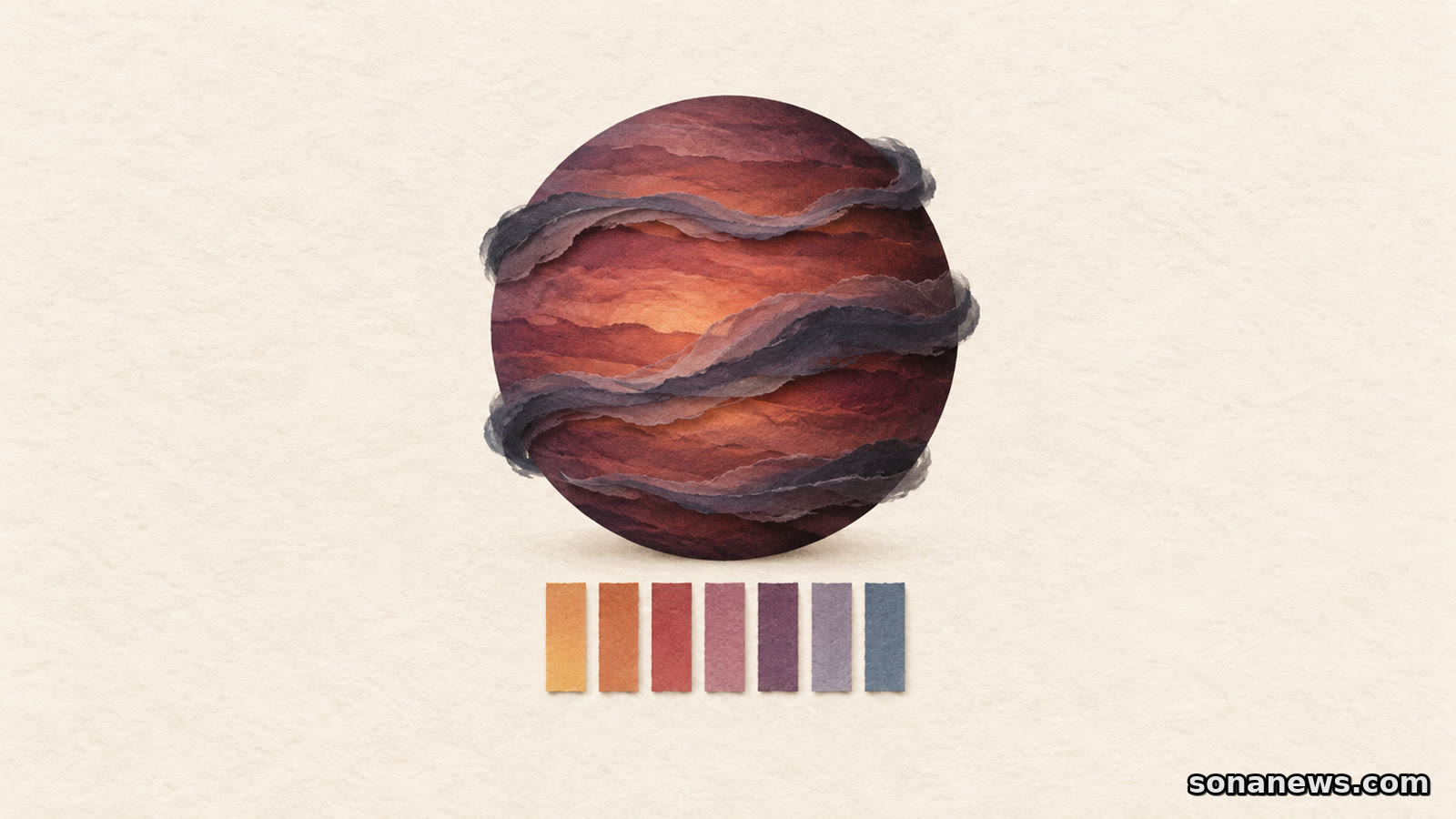
None of this turns a distant point into a detailed view of cloud bands. A spectrum tells researchers about light from the object as a whole. A richly textured globe in an illustration is an interpretation, not the telescope's spatially resolved view.
The team compared the observations with five families of atmospheric models. These differ in how they handle clouds, chemical reactions and the movement of material between atmospheric layers. Some assume no clouds; others include them using different physical prescriptions.
The models broadly reproduce the shift towards methane as brown dwarfs cool. But matching a general sequence is not the same as reproducing an individual object's spectrum. The paper finds persistent difficulty matching several near-infrared brightness peaks and a relatively transparent region around 4 micrometres at the same time.
The transition between the warmer L-type and cooler T-type brown dwarfs is especially troublesome. This is a regime where cloud properties and chemistry are changing. Adding clouds to a model does not automatically fix its fit to the carbon-bearing molecules. The authors argue for more work linking cloud physics and chemistry, not for abandoning atmospheric modelling.
That matters because a model fit is often how researchers estimate an isolated object's temperature, radius and other properties. When different model assumptions give different answers from the same light, a precise-looking result can carry a larger underlying uncertainty. The study explicitly warns that the best-fitting parameters need not reflect an object's true properties when the fit itself is poor.
SPHEREx has gathered spectra of thousands of brown dwarfs. This paper examines a much smaller, curated set designed to compare spectral types and atmospheric conditions. It is not a claim that thousands of newly discovered objects have all received detailed, settled descriptions.
Selection and measurement limits remain important. The researchers excluded or replaced some targets affected by nearby sources, poor coverage or other complications. At the coldest end, useful detections cover less of the spectrum. Patterns in a carefully chosen sample still need testing against a broader population.
The authors also did not present a fully flexible atmospheric reconstruction with formal uncertainties for every fitted parameter. Their comparison uses existing model grids to expose where assumptions succeed or fail. Readers should treat it as a benchmark for improving those tools, rather than a definitive weather report for each object.
The survey's strength is breadth. NASA's mission overview describes an all-sky programme, while the mission's press kit distinguishes that approach from the detailed targeting of telescopes such as Webb. A common set of spectral measurements makes comparisons possible across many more objects.
Further observations should improve the measurements and widen the sample. They will not remove the need to understand what clouds and chemistry do to escaping light. For now, SPHEREx has made that interpretive problem clearer: the data are rich enough to reveal where the models still fall short.
Sources
- NASA/JPL, NASA's SPHEREx Telescope Sees Menagerie of Brown Dwarfs, 8 October 2026. Accessed 11 October 2026. Verifies current announcement, observed molecules, orbital advantage, thousands of spectra and limited completed comparison. Distinguishes telescope images from artist impressions. Its count of 37 agrees with the paper's conclusion, while the paper's abstract describes 33 field objects plus additional comparisons; the article avoids an unqualified combined sample count
- Rustamkulov et al., SPHEREx 0.75-5 micrometre Spectra for a Sequence of Nearby Brown Dwarfs, The Astrophysical Journal, published 28 September 2026. Accessed 11 October 2026. Full article inspected, especially sections 1.2-1.4, 2.2-2.3, 4-7. Supports wavelength coverage, five grids, cloud chemistry, selection limitations, weak cold-end detections, model systematics and absence of formal fit uncertainties. This is the research paper; the agency release is not independent replication
- NASA Science, SPHEREx mission overview. Accessed 11 October 2026. Confirms active mission, March 2025 launch and all-sky spectral-survey purpose. Future-tense programme descriptions are not treated as proof that all planned data collection is complete
- NASA/JPL, SPHEREx press kit. Accessed 11 October 2026. Historical pre-launch background for spectral channels and wide survey versus targeted telescope observations. Its obsolete launch target is not used as current status evidence
- NASA Science, Spectroscopy 101: How Absorption and Emission Spectra Work. Accessed 11 October 2026. Background for molecular absorption and energy changes, not a separate confirmation of SPHEREx results
Help us improve
Was this article useful?
One anonymous tap helps Sona improve future reporting, headlines and source context.
Up next
Passive prisms can help locate lunar landers without using power. The difficult work happens on the spacecraft trying to find them.
Continue readingMore in Space