Your thank-you note may matter more than its perfect wording
US research finds that people can underestimate how welcome their appreciation will be. The useful lesson is about sincere, specific thanks, not a guaranteed way to improve a relationship.
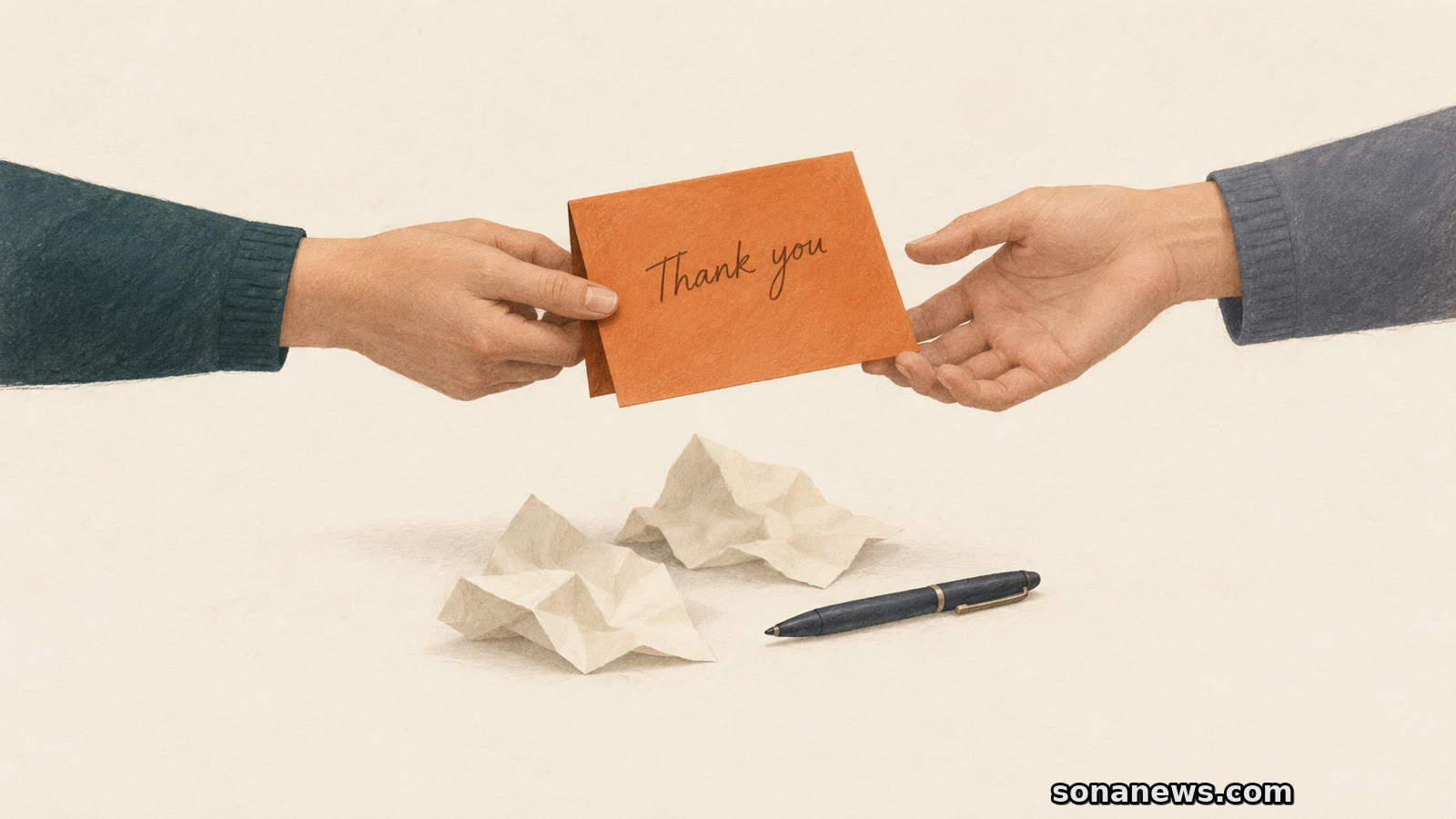

You know what someone did for you. Finding a sentence that seems equal to it can be harder. A colleague made time, a friend kept showing up, or a teacher offered encouragement that stayed with you. Then the note waits while you look for a less ordinary way to say thank you.
That hesitation has a useful counterpart in US behavioural research: the person writing an appreciation letter and the person receiving it may be judging rather different things. The writer worries about getting the words right. The recipient has also received evidence that their kindness was noticed.
Two older research papers help separate those questions. A 2018 study examined mistaken expectations about gratitude letters; a 2016 paper examined what romantic partners said when thanking each other. Neither is a new 2026 discovery, a worldwide survey of manners or proof that gratitude fixes a difficult relationship. Together, they offer a more modest reason not to turn an honest thank-you into a writing examination.
In the 2018 paper, Amit Kumar and Nicholas Epley asked participants to write to someone who had affected their life meaningfully. Writers described what that person had done and why they were grateful. They then predicted how the recipient would feel; researchers contacted recipients for their own reports.
Across the three letter-writing experiments in the paper, writers underestimated how positive recipients would feel and overestimated their awkwardness. They also underestimated recipients' surprise about the reasons for the gratitude. These were comparisons between predicted and reported reactions, not simply writers saying they felt good after completing an exercise.
The distinction matters. Writers were not generally expecting their letters to be unwelcome. In the first experiment, they already expected a positive response. Recipients reported an even more positive one. The finding is about an underestimation of appreciation, not evidence that every feared social encounter secretly goes well.
There are limits to how far that result travels. The letter-writing samples included MBA students and people recruited at the University of Chicago. Not every recipient completed a survey. The researchers considered whether more enthusiastic recipients might have been more likely to respond and explained why they did not think that fully accounted for the findings. They could not eliminate the concern altogether.
One experiment also asked writers how articulate, warm and sincere recipients would find their letters. Recipients rated the writers more favourably than the writers predicted on both competence and warmth. The gap was larger for competence.
That supports a gentler interpretation than the familiar instruction to stop overthinking everything. Someone can be a poor judge of how clumsy their own expression will seem. The University of Chicago's account of the study highlights concern about choosing the right words as a possible barrier to expressing appreciation.
It does not follow that wording is irrelevant. The researchers did not randomly assign beautifully written and badly written versions of the same letter. Nor did this comparison establish that warmth, rather than competence, caused the recipient's response. Those evaluations were related, and the paper explicitly acknowledges that causal limitation.
The practical distinction is between making the message clear and trying to make it flawless. Removing an ambiguous sentence may help someone understand you. Replacing every ordinary phrase with something impressive may not answer the more important question: have you told them what you appreciated?
A separate 2016 paper by Sara Algoe, Laura Kurtz and Nicole Hilaire looked at video-recorded conversations between romantic partners. Researchers coded expressions that praised the other person's actions and expressions that concentrated on the benefit to the speaker.
Across 370 conversations from three samples, more other-praising behaviour was associated with the recipient feeling more understood, validated and cared for, as well as reporting more positive emotion. This was not a contest between elaborate and plain language. It concerned what the appreciation was directed towards.
The evidence was correlational, as the authors make clear. The participants were heterosexual couples recruited around Chapel Hill, North Carolina, and predominantly white. The study does not prove that a particular sentence will produce the same response across cultures, friendships or workplaces. It also does not mean mentioning how someone helped you is selfish or ineffective.
As an everyday example, thanking someone for patiently explaining a confusing process recognises their attention and effort. Only saying that the process is now easier describes your benefit. A note can do both. That example is an editorial illustration, not wording tested in either paper.
For someone who already wants to express genuine thanks, a manageable starting point is a particular action, what it meant to you and something you valued in the person doing it. These are writing prompts drawn from the research, not a validated three-step formula. They leave room for an ordinary voice rather than a ceremonial speech.
Nothing in these studies establishes that expensive stationery, a handwritten card or a long letter is necessary. They do not settle whether paper, email or a spoken message is best for a particular person. A card is one way to express appreciation, not a scientifically superior medium.
Context still matters. Gratitude is not a reason to ignore a request for no contact, seek forgiveness indirectly or attach a demand for another favour. A recipient does not owe an immediate reply, an equally emotional response or reassurance that the wording was good enough. Those are boundaries around the gesture, not exceptions that a positive study result can erase.
The useful question is smaller than whether the note will transform the relationship. It is whether someone who did something meaningful for you knows what you noticed. A clear answer to that can be worth sending before you find the perfect opening line.
Sources
- Kumar and Epley, Undervaluing Gratitude: Expressers Misunderstand the Consequences of Showing Appreciation, Psychological Science, 2018. Checked 10 October 2026. Full paper retrieved through the author-copy link used by Chicago Booth. Experiments 1, 2 and 4 contain actual letter exchanges; the other studies test expectations and willingness. Supports prediction-response differences, competence versus warmth, sample context and nonresponse limitations. No causal claim that warmth outweighs wording, no handwriting advantage and no long-term treatment benefit are inferred
- University of Chicago, People underestimate value of sending letters of appreciation. Checked 10 October 2026. Institutional explanation of the 2018 paper and the concern about articulating gratitude. This is context for the same research, not an independent replication. The primary paper, rather than the simplified press-release experiment count, governs the article
- Algoe, Kurtz and Hilaire, Putting the You in Thank You, Social Psychological and Personality Science, 2016. Checked 10 October 2026. Full methods, results and discussion inspected. Supports 370 conversations across three samples, other-praising associations, heterosexual and predominantly white Chapel Hill sample context, and explicit correlational limitation. The unsuccessful experimental manipulation is not presented as causal support; no universal script or effect size is claimed
Help us improve
Was this article useful?
One anonymous tap helps Sona improve future reporting, headlines and source context.
Up next

UK charity guidance makes a useful distinction: passing clothes on, selling them again and recycling their fabric are different routes. A wardrobe clear-out needs a destination, not just a bag.
Continue readingMore in Lifestyle