A ventless dryer still needs a plan for the water
Heat-pump tumble dryers do not need an exhaust hose through an outside wall. Their water tank, drainage options and installation instructions still deserve a check before delivery.
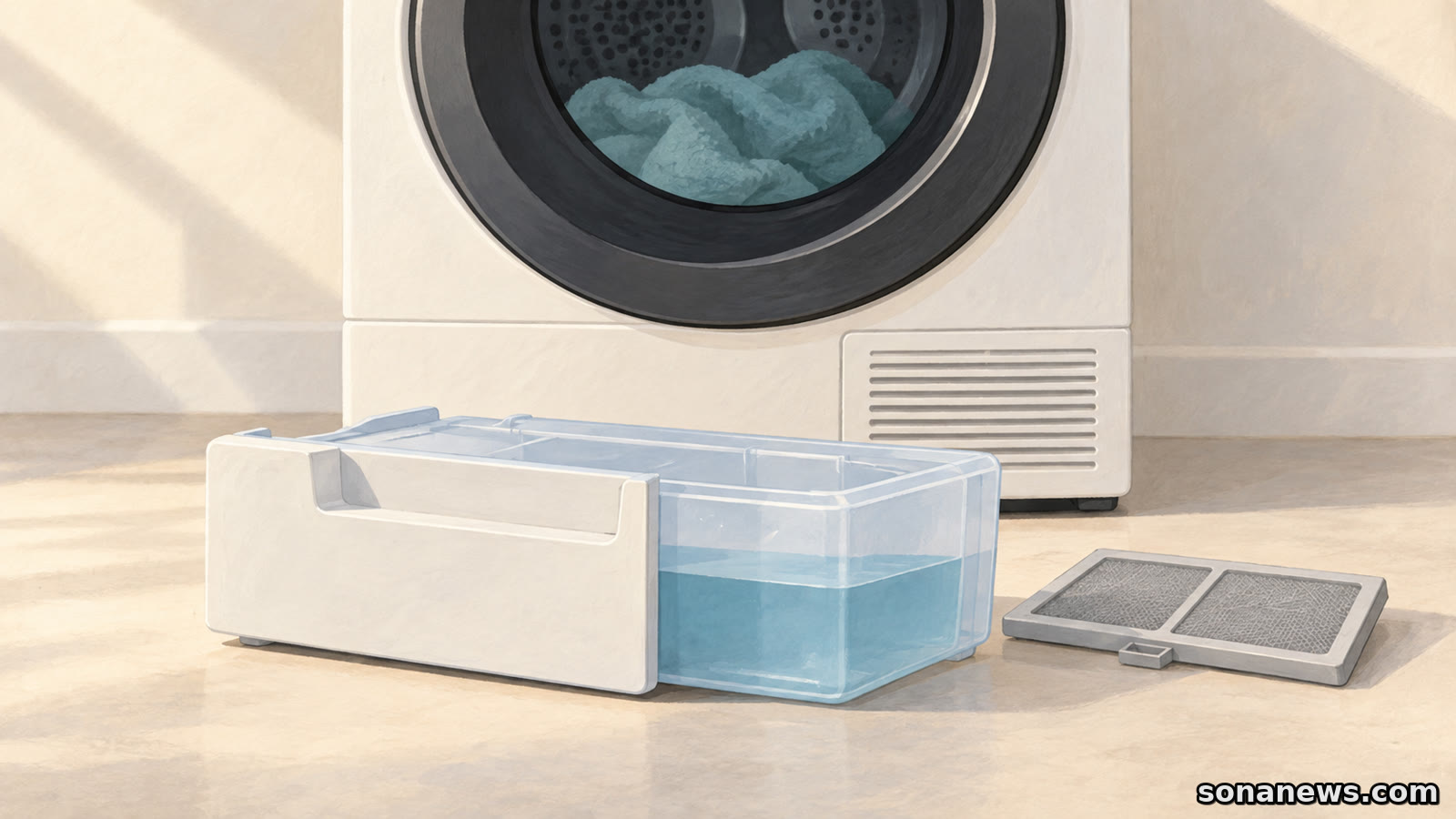

A heat-pump tumble dryer can solve an awkward household problem: finding a route for an exhaust hose to the outside. It does not make the water in a load of wet washing disappear. That moisture still needs somewhere to go, usually a collection tank or a suitable drain connection.
The distinction matters before delivery, particularly if the attraction is putting a dryer somewhere an older vented machine could not go. A space that fits the cabinet is only the beginning. There must also be a workable way to deal with the water, reach the parts that need cleaning and meet the model's installation requirements.
This is established appliance guidance, not a new universal rule. The sources below cover US government information, European Commission guidance, a Samsung regional support example and UK energy advice. Designs and requirements differ by model and market. None of those pages makes an unfamiliar dryer suitable for a particular cupboard or garage.
The US ENERGY STAR programme describes a heat-pump dryer as a closed-loop system. Warm air removes moisture from the clothes, then passes through an evaporator that removes the moisture before the air is reused. Unlike a conventional vented dryer, it does not send that warm, humid drying air outside through an exhaust hose.
The resulting water is a separate matter. ENERGY STAR identifies several ways of handling it: manually emptying a water tank, using a manufacturer-provided drain hose, or an arrangement that allows the dryer to use the washer's drain. Which options are available, and how they must be installed, belongs in the instructions for the exact appliance.
That gives a buyer a more useful question than simply asking whether the dryer is ventless: will this installation use the tank, or a supported direct-drain arrangement? The answer affects the daily routine as well as where the machine can sensibly stand.
A collection tank avoids the need for a permanent drain connection on models designed to work that way. In exchange, it becomes something the household has to empty and refit as instructed. Its position and accessibility therefore matter, especially when considering a stacked arrangement or a confined utility space.
Samsung's Levant support guide, updated in September 2026, offers a concrete example. It describes manual tank emptying after each drying cycle, or continuous drainage through an external hose. It also says the dryer pauses when its full-tank indicator comes on until the tank is emptied or a drainage blockage is cleared.
Those are instructions for the products covered by that guide, not a universal description of every brand. The transferable point is the choice of routine. A buyer who expects never to handle a tank needs to establish that direct drainage is supported and practical, rather than discover the requirement once a load is waiting.
The guide also contains hose-routing and height restrictions. Those should not be copied across to another machine. A direct drain is not permission to attach any available hose or improvise a connection; the appliance's installation instructions and a suitably qualified installer are the appropriate reference.
Removing the outside exhaust requirement does not remove the need to check the room. The European Commission's consumer guidance explicitly calls for adequate ventilation at the installation site and warns against ambient temperatures rising too high. It also directs users to the manufacturer's cleaning instructions.
Cold locations deserve a separate check. In its Northern Ireland guidance, the Energy Saving Trust warns that using heat-pump dryers below manufacturers' specified ambient temperatures can slow drying, increase energy use or cause faults and shutdowns. An unheated garage may therefore be a poor match for a particular machine, even if there is ample floor space.
There is no single temperature range or clearance measurement in this article to apply to all models. Before choosing the spot, compare the manual's requirements with the actual location. An enclosed cabinet, a utility room and an outbuilding are not interchangeable merely because each has an electrical socket.
Direct drainage changes how water leaves the appliance. It does not remove the rest of the maintenance instructions. ENERGY STAR says regular maintenance, including filter cleaning, helps keep a heat-pump dryer running efficiently.
The Commission makes an important qualification: some models self-clean their lint filter, condenser or both. Owners should clean the relevant components at least as often as the manufacturer recommends, using the method in the manual. That is a reason to check the design, not to assume every filter can be washed or every heat exchanger should be removed.
Service access belongs in the placement decision. If reaching the tank or a user-serviceable filter requires an awkward manoeuvre, that inconvenience will recur. Product photographs and cabinet dimensions alone do not establish whether those routine tasks will be easy in the proposed space.
For an existing dryer, this is not a call to replace a working appliance or diagnose a fault from a general article. For a new one, the useful pre-delivery check is quite concrete: identify how it will handle condensed water, where routine access is needed and whether the room meets its instructions. A ventless design removes one installation constraint. It does not remove the water from the conversation.
Editorial note. General household information, not model-specific installation, electrical, plumbing or repair advice. Follow the appliance manual and garment care labels. Have installation requirements checked by a suitably qualified professional where needed; do not alter connections or dismantle components based on this article. The illustration does not depict a verified installation or a particular manufacturer's machine.
Sources
- Source: ENERGY STAR, Heat Pump Dryer, Accessed 8 October 2026. Verifies the closed-loop process, evaporator, absence of an outside exhaust, tank/direct-drain options and filter maintenance. US programme information is not treated as a universal installation permission. Percentage savings, brand recommendations and its broad room-location wording are not reproduced
- Source: European Commission, Tumble Dryers, Accessed 8 October 2026. Consumer guidance verifies adequate room ventilation, avoiding excessive ambient temperatures, manufacturer-specific cleaning and possible self-cleaning filters or condensers. Legislative market restrictions, projected savings and energy-label changes are outside this article's claims
- Source: Samsung Levant, How to drain a Samsung Heat Pump Smart Dryer, Updated 14 September 2026; accessed 8 October 2026. Verifies the specific example of after-cycle tank emptying, external drainage, full-tank pause and model-relevant hose restrictions. No hose height, port lettering, repair procedure or error code is generalized or reproduced as instruction
- Source: Energy Saving Trust, New tumble dryer energy labels in Northern Ireland, Updated 20 May 2026; accessed 8 October 2026. Used only for the discussion of cold spaces and manufacturer ambient-temperature restrictions. Northern Ireland sales rules, tariff examples and statements about Great Britain are not used for current legal or savings claims
Help us improve
Was this article useful?
One anonymous tap helps Sona improve future reporting, headlines and source context.
Up next
A short cycle is not automatically a full-drum wash. UK manufacturer guidance shows why the programme's load limit matters more than the capacity on the machine.
Continue readingMore in Home & Living