The phone-free dinner is not a trend. It is a small piece of social infrastructure
A meal with fewer screens will not mend loneliness on its own, but the renewed interest in low-key hosting points to a real need: repeated, undramatic time with other people.
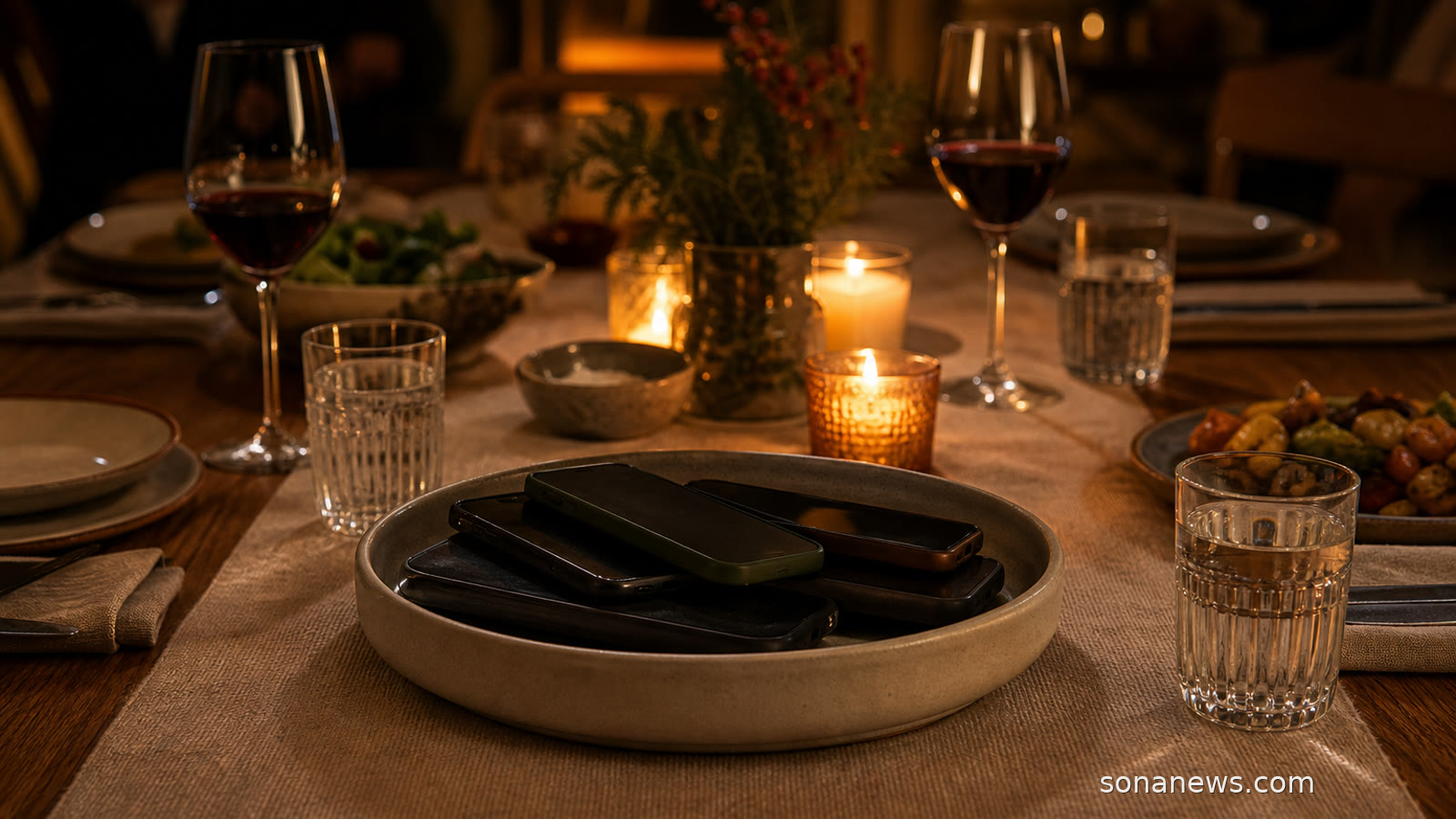

The most revealing object on a dinner table is sometimes the bowl by the door. Not the flowers, not the mismatched plates, not the carefully browned potatoes, but the place where guests leave their phones face down, half willingly and half as a joke. For the next hour, nobody needs to perform a disappearance. They only need to make reaching for the screen slightly less automatic.
A phone-free dinner can sound like one more lifestyle rule, the sort of tiny domestic instruction that arrives already polished for social media. Place the devices elsewhere. Light a candle. Cook something rustic. Rediscover conversation. The danger is obvious: turn ordinary hospitality into another aesthetic project, then wonder why it feels like work.
The more useful reading is less glossy. A low-screen dinner is not a cure for loneliness, nor proof of superior taste. It is a small attempt to protect attention in a culture that has made partial presence normal. It matters only if it is repeatable, generous and undramatic enough for real people to use.
The public-health language around social connection has become more serious in recent years. The U.S. Surgeon General’s 2023 advisory, “Our Epidemic of Loneliness and Isolation,” describes social connection as a fundamental human need and frames loneliness and isolation as a public-health crisis. The advisory says that in recent years about one in two adults in America reported experiencing loneliness. It also argues that loneliness is more than a bad feeling, associating poor social connection with risks to individual and societal health.
Those are large claims, and a dinner party should not be asked to carry all of them. Loneliness is not solved by telling individuals to host better. It is shaped by work, housing, family structure, disability, bereavement, migration, transport, money, neighbourhood safety and the design of digital platforms. A person who is isolated does not need a magazine spread about effortless entertaining. They may need time, access, trust, care and community services.
Still, the advisory’s practical language is strikingly ordinary. It urges people to answer a phone call from a friend, make time to share a meal, listen without the distraction of a phone, perform an act of service and express themselves authentically. These are not grand gestures. They are small repetitions. The meal is not important because it is photogenic. It is important because it gives conversation a place to sit down.
This may explain the quiet return of the unfussy dinner. Not the formal version with seating plans and competitive cooking, but the version where someone makes soup, asks others to bring bread, and accepts that the chairs do not match. The appeal is not nostalgia for better manners. It is relief from a social life that has become both overconnected and undernourishing: many messages, fewer pauses; constant contact, less settled attention.
Phones complicate the room because they are not neutral objects. They are calendars, cameras, payment tools, maps, work devices, family lifelines and entertainment systems. Asking guests to abandon them entirely can be rude or unrealistic. A parent may need to be reachable. A carer may need alerts. Someone anxious may prefer not to be separated from a device. The better approach is not purity. It is consent and tone. “Shall we put phones away for dinner?” is different from a host policing adult behaviour.
The bowl by the door works only when it lowers pressure. It says: this hour is not content; you do not have to photograph the food; you do not have to reply at once; nobody here is being measured. That last point may be the hidden luxury. Much of modern leisure arrives with a performance layer. A dinner without that layer can feel modestly radical, not because it is new, but because it lets a private evening stay private.
There is also a class caution. Hosting can be expensive. Space is unequal. Time is unequal. Some homes are not safe or comfortable places to gather. A serious lifestyle piece should not pretend everyone can lay a table for six. The underlying habit can be adapted: tea after a walk, a shared lunch break, a regular call, a library meeting room, a park bench, a potluck, a standing breakfast once a month. The point is not the table. The point is recurring, attentive contact.
Food helps because it gives people something to do with their hands while conversation finds its level. It allows silence without immediate failure. It gives an evening a beginning and an end. It can make invitation less abstract: come over at seven, there will be pasta. In a culture that often asks relationships to survive on spontaneous availability, a meal offers a scheduled mercy.
The World Happiness Report 2025 landing page, from the University of Oxford’s Wellbeing Research Centre and its editors, is a reminder that social connection now sits firmly inside mainstream wellbeing research, not only lifestyle commentary. This article does not rely on extracted chapter data from that report; the accessible page verified the report and citation only. The harder evidence cited here remains the Surgeon General’s advisory, whose strongest use for this article is not to medicalise dinner, but to take ordinary connection seriously.
A phone-free dinner will not fix loneliness. It may not even produce a brilliant conversation. The evening may include burnt rice, a late guest, a disagreement about the news and someone checking a message in the hallway. That is fine. Social life does not need to be optimised before it matters.
What it needs, more often, is a protected occasion. A place where people are invited without being curated, where attention is a shared courtesy rather than a private achievement. The small bowl by the door is not the story. The story is the permission it gives the table: stay here for a while.
Sources
- U.S. Department of Health & Human Services / Office of the U.S. Surgeon General - “Our Epidemic of Loneliness and Isolation” PDF - - extracted 2026-06-04. Verified: framing of social connection as a fundamental human need; about one in two adults in America reporting loneliness; practical language encouraging shared meals and listening without phone distraction
- World Happiness Report 2025 - - extracted 2026-06-04. Verified: report landing page, editors, citation and Oxford Wellbeing Research Centre publication note. Used only as background that wellbeing research is mainstream; no chapter-specific numeric claim used
Help us improve
Was this article useful?
One anonymous tap helps Sona improve future reporting, headlines and source context.
Up next

UK tool libraries offer an alternative to buying equipment for occasional jobs. Examples in London and Edinburgh show why collection windows, cleaning and the next borrower belong in the plan.
Continue readingMore in Lifestyle