Canada’s airport declaration can start 72 hours before the kiosk
Advance Declaration moves the questions to a phone or browser, but it is an optional head start at 10 airports, not permission to enter Canada.
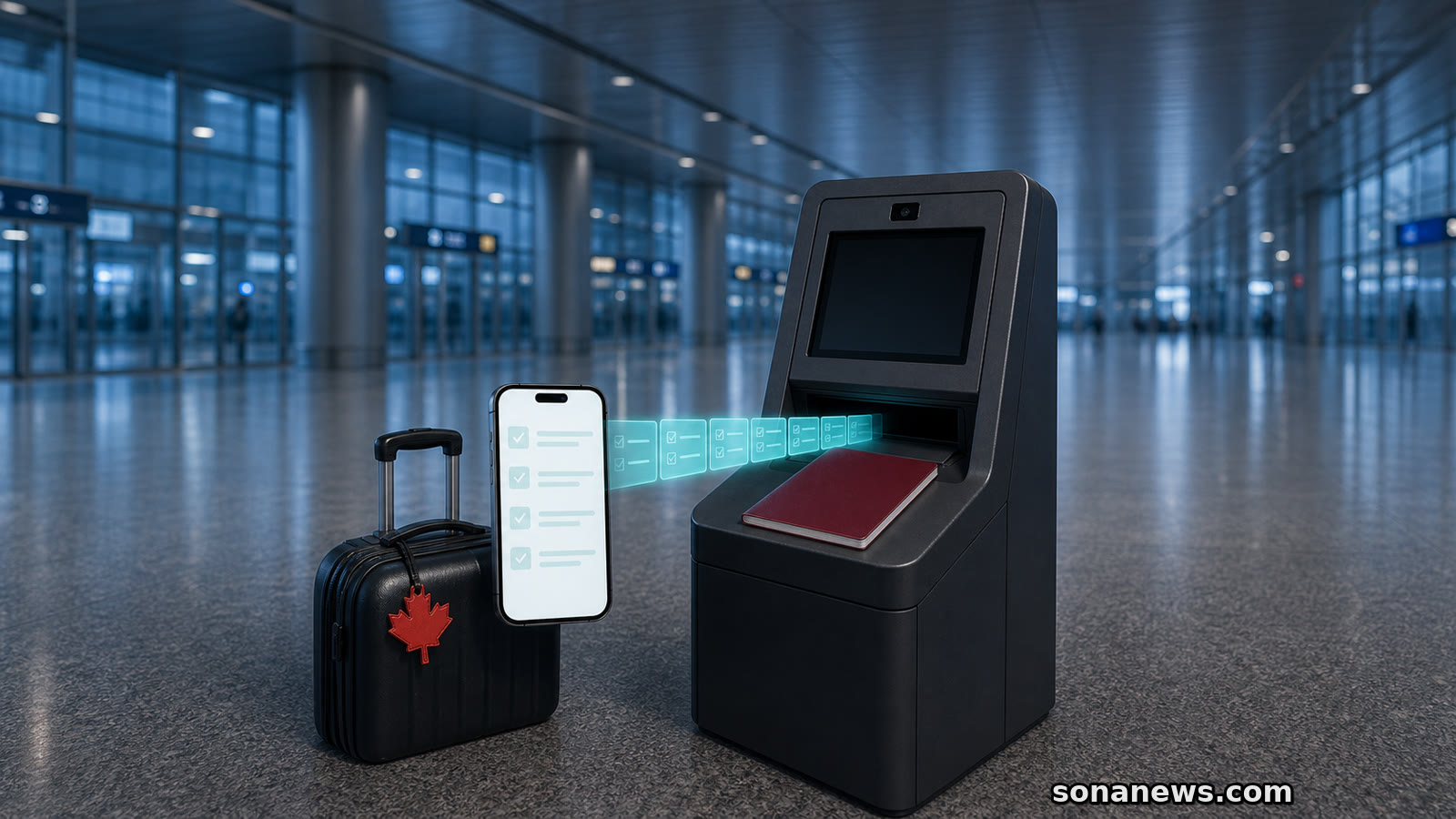

Canada’s airport declaration can begin before the arrivals hall. A traveller flying into one of 10 participating airports can prepare the customs and immigration questions in Advance Declaration, using the ArriveCAN app or its web version, up to 72 hours before the flight.
That sounds like a digital border lane, but the more useful description is a head start. The Canada Border Services Agency, or CBSA, says the submitted answers must still be reviewed and certified after landing at a primary inspection kiosk or eGate. The traveller then takes the resulting receipt to a border services officer for further processing. The phone does not replace the airport process.
The distinction matters because several different pieces of travel administration can sit on the same screen. Advance Declaration is not an electronic travel authorisation, visa, passport or decision on admission. It is the early preparation of the declaration that would otherwise be completed on arrival. Travellers remain responsible for checking the entry documents and conditions that apply to their own nationality, status, route and purpose of travel.
The current official process starts by signing in to ArriveCAN, confirming a passport or Canadian permanent resident card, answering the customs and immigration questions truthfully and submitting the declaration within the stated 72-hour window. A successful submission produces a confirmation screen, email and reference number.
Landing starts the second half. At the kiosk or eGate, the traveller scans the same travel document, reviews the prepared declaration, edits it if something has changed and certifies the final version. The machine produces a receipt for the officer. CBSA’s kiosk guide describes the broader sequence as choosing a language, scanning the travel document, taking a photo, verifying fingerprints where required, answering the declaration questions and taking the receipt onward.
This is why “submitted” is not the same as “finished”. A delayed flight or changed answer does not automatically make the original information final. CBSA says a declaration can be edited at the kiosk or eGate. If it is not certified there within 72 hours of submission, it expires and a new one is needed.
The airport list is another boundary. Advance Declaration is currently offered for flights arriving at Vancouver, Calgary, Edmonton, Winnipeg, Toronto Pearson, Billy Bishop Toronto City, Ottawa, Montréal-Trudeau, Québec City and Halifax. Toronto Pearson is covered in terminals 1 and 3.
CBSA’s general kiosk list is slightly longer because it also includes Hamilton. That does not make Hamilton an Advance Declaration airport. It shows why a traveller should check the specific feature list rather than assume that any airport with a border kiosk accepts a declaration prepared in advance.
At airports without a kiosk or eGate, CBSA says travellers are given a declaration card on the aircraft or can obtain one on arrival, then make the declaration to an officer. The digital option is therefore a route within the arrival system, not a universal replacement for paper or in-person processing.
NEXUS is a separate lane too. CBSA says Advance Declaration cannot currently be used with NEXUS kiosks. A NEXUS member following the dedicated trusted-traveller process should not assume that an Advance Declaration will merge into it. The official guidance for the actual airport and traveller programme remains the better reference.
Group size affects the final step. Up to five travellers can use one regular kiosk for their declarations. A kiosk is also the route for a group travelling with children under 14. eGates process people individually and are available to solo travellers aged 14 or over who meet the stated conditions. Unaccompanied children under 14 and several other listed groups must see an officer for in-person processing.
The promised benefit is narrower than skipping the border queue. CBSA says users can prepare at their own pace, use Advance Declaration express lanes where provided, and complete the kiosk or eGate stage up to 50 per cent faster. That is a claim about the declaration transaction, not a guarantee for the whole journey through immigration, baggage collection or customs. Queue length, staffing, flight arrivals and any further checks can still shape the total time.
There is also no need to force the digital route into every trip. The official wording presents Advance Declaration as something travellers can use, not a new pre-flight requirement for everyone entering Canada. Someone who does use it should keep the practical chain intact: submit within the window, travel with the matching document, update changed answers, certify on arrival and take the receipt to the officer.
Privacy is part of that chain rather than a reason to invent reassurance. CBSA says information entered at a kiosk or eGate is encrypted and sent securely, and that the device deletes its copy after the receipt is printed. The agency retains the data and a copy of the receipt in its systems under government information, privacy and security policies. It also says the kiosk or eGate takes a photograph to compare with the travel document and prints that picture on the receipt.
Advance Declaration moves a familiar airport task without removing its final checkpoint. Its value is not that the border has disappeared into an app. It is that the quiet part of the declaration can happen before landing, while the identity check, confirmation and officer interaction remain where they belong: at the Canadian airport.
Editorial note. This article is general travel, customs and immigration-process information based on CBSA pages available at publication time. It is not personalised legal, customs, immigration, privacy or travel advice. Eligibility, entry documents, declarations and admission can depend on nationality, status, route, purpose, goods and individual circumstances. Travellers should verify current requirements and airport coverage through the CBSA and the relevant Canadian immigration authorities before travel.
Sources
- Source: "Use Advance Declaration to save time at the border", Canada Border Services Agency, Extracted 2026-07-20. Verified: optional digital preparation through ArriveCAN, up-to-72-hour window, express-lane availability, CBSA’s up-to-50-per-cent faster transaction claim, 10 participating airports and NEXUS-kiosk exclusion
- Source: "How to submit your Advance Declaration", Canada Border Services Agency, Extracted 2026-07-20. Verified: sign-in and document steps, truthful answers, confirmation and reference number, airport review and certification, five-person kiosk limit, eGate age boundary, officer receipt, editing changed answers and 72-hour expiry if not certified
- Source: "Declare your travel information at an airport kiosk or eGate: Save time at Canada’s main airports", Canada Border Services Agency, Extracted 2026-07-20. Verified: kiosk and eGate role, full current location list including Hamilton, Toronto Pearson terminal coverage, eGate location and paper-card route at airports without the technology
- Source: "Declare your travel information at an airport kiosk or eGate: Who is eligible", Canada Border Services Agency, Extracted 2026-07-20. Verified: resident and foreign-national use, kiosk versus eGate group treatment, NEXUS separation, under-14 rules and groups requiring in-person processing
- Source: "Declare your travel information at an airport kiosk or eGate: How to use the kiosks and eGate", Canada Border Services Agency, Extracted 2026-07-20. Verified: language, document scan, photograph, conditional fingerprint, declaration certification, receipt and officer sequence, group limit and outage route
- Source: "Declare your travel information at an airport kiosk or eGate: Privacy information", Canada Border Services Agency, Extracted 2026-07-20. Verified: encryption and transfer statement, deletion from the kiosk or eGate after receipt printing, CBSA retention, photograph comparison and receipt image
Help us improve
Was this article useful?
One anonymous tap helps Sona improve future reporting, headlines and source context.
Up next
On the A13-A14 Paris-Normandy route, drivers without automatic payment have 72 hours to settle the toll. Rental cars need a separate check.
Continue readingMore in Travel