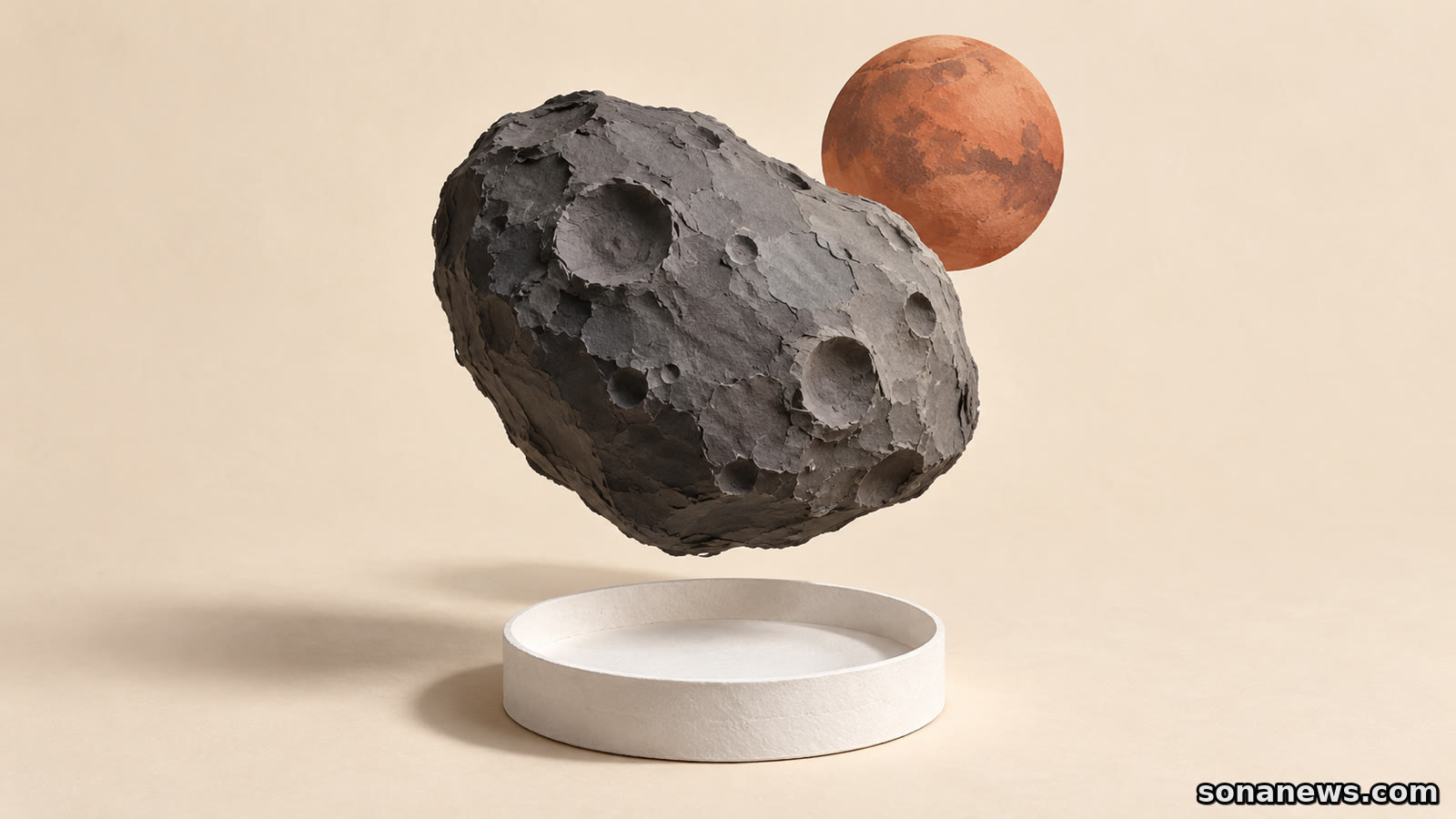
NASA's Psyche used Mars as a dress rehearsal for a metal world
The May gravity assist did more than redirect the spacecraft. It tested cameras, a magnetometer and a neutron detector against a planet scientists already know.
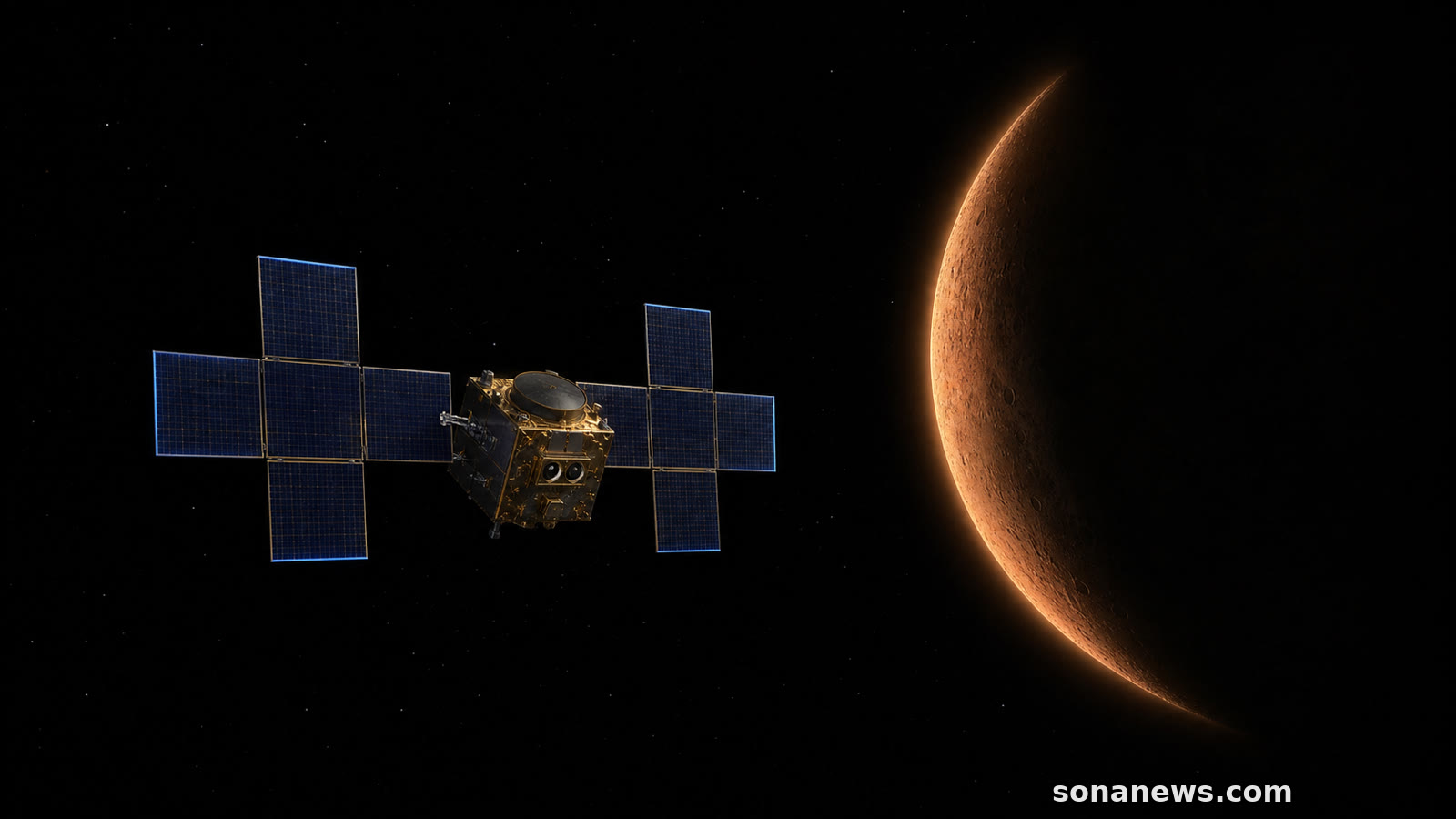

NASA's Psyche spacecraft did not treat Mars as a scenic stop. Its 15 May flyby was a rare chance to test asteroid instruments against a planet already mapped by several missions, giving the team a reference target before Psyche reaches a much less familiar metal-rich world in 2029.
The spacecraft passed 4,609 kilometres above the Martian surface. Mars added about 1,000 miles per hour to its speed and shifted its orbital plane by roughly one degree without Psyche spending propellant on the manoeuvre. Tracking data from NASA's Deep Space Network confirmed that the spacecraft left on the planned trajectory.
That navigation success mattered, but the weeks of instrument analysis reported by NASA and the Jet Propulsion Laboratory on 17 July revealed the flyby's second purpose. Psyche's cameras, magnetometer, and gamma-ray and neutron spectrometer all operated during the encounter. Their measurements broadly matched what other missions already know about Mars.
This is exactly why Mars made a useful rehearsal. A test on an unknown object can show that an instrument produced data, but not necessarily whether the result is accurate. At Mars, researchers can compare Psyche's observations with established measurements from orbiters and rovers, exposing calibration problems before the spacecraft is working around its main target.
Psyche's gamma-ray and neutron spectrometer is designed to help identify chemical elements at the asteroid's surface. Cosmic rays striking a planetary body can cause its material to emit neutrons and gamma rays with energies linked to composition.
At Psyche's flyby altitude, the team did not expect gamma rays from Mars to be detectable. It did expect some neutrons escaping from the surface and atmosphere to reach the instrument. The neutron detector recorded the anticipated rise in counts near closest approach, while the gamma-ray channel did not register Mars. That combination was a validation, not a failure: the two results fit the measurement limits predicted for the geometry.
The magnetometer had already sampled the solar wind and disturbances from coronal mass ejections during cruise. Mars provided something new for the instrument: its first magnetic signature associated with a celestial body.
As Psyche approached, the magnetometer measured a sharp increase at the Martian bow shock, where the solar wind encounters the magnetic environment around the planet. Mars lacks an Earth-like global magnetic field, but its atmosphere and patchy crustal magnetism still reshape the solar wind. MIT's instrument team said the dynamic passage validated performance under conditions more complicated than ordinary cruise measurements.
The result does not prove what Psyche will find at the asteroid. The mission will use the magnetometer to look for remanent magnetism that could help test whether the object is material from the core of an early planetary building block. Mars only showed that the sensor could recognise a known planetary interaction.
Psyche's multispectral imager consists of two matching cameras. On approach, the high phase angle made Mars appear as a thin bright crescent, with sunlight scattered through its atmosphere. Near the flyby, the cameras recorded the south polar ice cap, Huygens crater and wind streaks around impact craters.
The team is comparing those images with data from NASA, European and other Mars missions to check calibration and sensitivity to scattered light. The cameras also detected the moons Phobos and Deimos from far away. That observation rehearsed the satellite search Psyche will conduct for possible moonlets around its asteroid target.
The pictures are therefore useful because Mars is familiar, not because they overturn Martian science. Mission leaders said they did not expect major discoveries, and the released results are an operational calibration report rather than a peer-reviewed catalogue of new Mars findings. Any suggested new planetary insight will need its own analysis.
Asteroid Psyche is about 280 kilometres wide at its broadest point and contains substantial metal, but its origin remains an open question. It may preserve material from a planetesimal's core, although the mission must test that idea rather than assume it.
NASA expects the spacecraft to be captured by the asteroid's gravity in late July 2029, with the prime science mission beginning in August. Once there, the team cannot check an unfamiliar neutron signal, magnetic variation or camera artefact against a library as rich as Mars data.
The flyby reduced that uncertainty in advance. It linked each instrument to a known environment, tested how teams coordinate several investigations during a fast encounter, and produced limits as well as detections. Mars gave Psyche a course correction for free. Just as importantly, it gave the science team a full rehearsal before the target stops being familiar.
Sources
- Source: "NASA's Psyche Mission Delivers Mars Flyby Data, Time-lapse Video", NASA Jet Propulsion Laboratory, Extracted 2026-07-19. Verified: all three instrument-team results, the expected neutron enhancement, gamma-ray non-detection, bow-shock signature, crescent and surface imaging, moon detections, calibration comparisons, and summer 2029 trajectory
- Source: "NASA's Psyche Mission Aces Mars Flyby, Targets Metal-Rich Asteroid", NASA, Extracted 2026-07-19. Verified: 15 May close approach at 4,609 kilometres, 1,000-mile-per-hour speed increase, roughly one-degree plane change, Deep Space Network confirmation, target size, and August 2029 orbital science start
- Source: "Psyche Spacecraft Delivers Mars Flyby Data: A Detailed Look at Mars' Magnetic Signatures", MIT EAPS, Extracted 2026-07-19. Verified: magnetometer calibration context, first celestial-body signature, solar-wind history, bow-shock passage and relevance to future asteroid measurements
- Source: "Psyche", NASA Science, Extracted 2026-07-19. Verified: metal-rich asteroid mission objective, late-July 2029 capture, August prime-mission start, and the open planetesimal-core hypothesis
Help us improve
Was this article useful?
One anonymous tap helps Sona improve future reporting, headlines and source context.
Up next
The mission plans to bring material from Phobos to Earth in 2031. Its sample, paired with measurements from space, could help explain where Mars's moons came from.
Continue readingMore in Space