The wellness feed is a shopfront where expertise and sales share the same bio
A new Pew study maps 6,828 prominent U.S.-focused wellness influencers. Its useful lesson is not that every creator is suspect, but that credentials, personal stories and commerce now arrive in one continuous scroll.
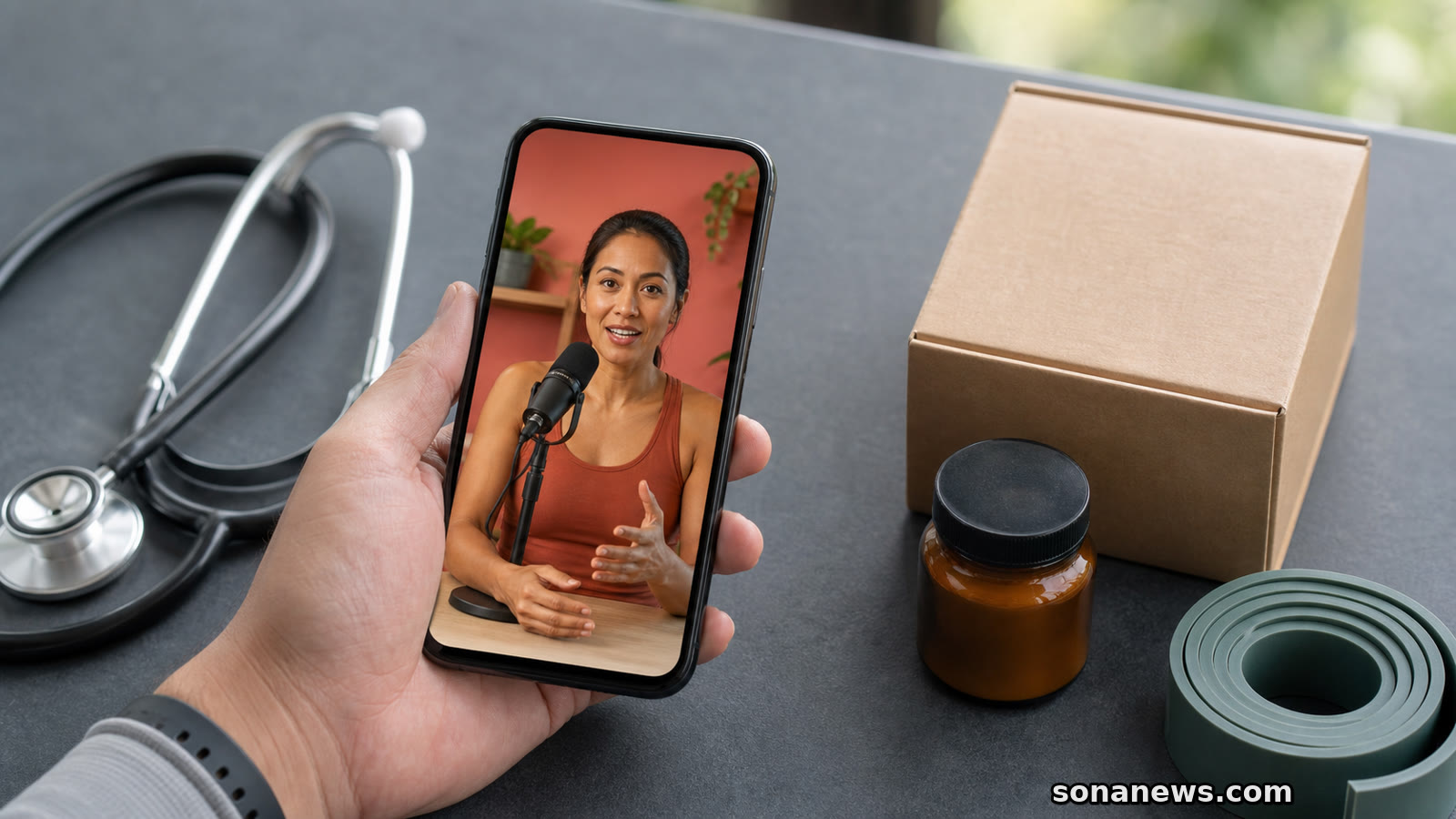

A wellness post can change category before the thumb has finished moving. It begins as a personal story, borrows the language of a consultation, becomes a podcast clip and ends beside a product link. The person speaking may be a doctor, a coach, a patient, a business owner, or several of those at once. The visual grammar barely changes.
That mixture is no longer a niche corner of lifestyle media. A Pew Research Center report released in May analysed 12,800 social accounts belonging to 6,828 prominent health and wellness influencers. To enter the study, an individual generally needed at least 100,000 followers on Instagram, TikTok or YouTube, or to host a top-ranked podcast, while posting mainly in English for a U.S. audience.
Pew also surveyed U.S. adults. Four in ten said they ever get health and wellness information from social media influencers or podcasts. The share was 52% among 18- to 29-year-olds and 49% among people aged 30 to 49. This does not mean four in ten Americans follow a particular creator, take the same advice or buy a product. It means the influencer and podcast layer is now a normal route by which health-adjacent ideas enter everyday life.
The profiles show why the feed can be hard to read at a glance. Pew found that 41% of the influencers described themselves as some kind of health care professional. Almost as many used other authority signals: 31% called themselves coaches and 28% entrepreneurs or business owners. The categories overlap. Thirteen per cent cited life experience, while 16% did not mention a background or expertise in their bios.
Those figures are descriptions of profiles, not a verification of qualifications and not a verdict on the accuracy of anyone's posts. Pew did not audit every credential or score every claim. That limitation matters. The study's value is in mapping the storefront: medical titles, coaching language, parenthood, personal recovery stories, book credits and business ownership can all sit in the same few lines.
The storefront metaphor is not an insult. Creators need income, and a clinic owner, author or trainer can have useful knowledge as well as something to sell. The problem is legibility. In traditional media, a reader could usually distinguish an advert, an advice column and a professional directory by their shape. In the feed, the same person, lighting and tone can carry all three.
Most people are not arriving with a research plan. Among the Americans who said they get wellness information from influencers or podcasts, 67% said they mostly happen to come across it, while 33% mostly look for it. That turns the scroll itself into distribution. A claim does not need to answer a deliberate question. It only needs to arrive between a recipe, a friend and a joke.
Trust is more measured than the loudest posts suggest. Just 10% of these consumers said they trust all or most of the wellness information they receive from influencers and podcasts. Almost two-thirds, 65%, trust some of it, while 24% trust not too much or none. This large middle is the real audience: neither credulous nor dismissive, but making quick judgements with incomplete context.
Commercial disclosure rules try to make one part of that context visible. In the United States, Federal Trade Commission guidance says a creator endorsing a product should clearly disclose a material connection to the brand, including payment, employment, family ties, free products or discounts. It says the disclosure should sit with the endorsement and be hard to miss, not buried on a profile page or beyond a click.
The UK rulebook makes the same design point in different legal language. Updated guidance from the Advertising Standards Authority says influencer marketing must be obviously identifiable, usually with a prominent upfront ad label. It warns that users struggle to separate adverts from surrounding editorial content, especially when creators use the same style for both. Competition and Markets Authority guidance, updated in 2025, also covers gifted, discounted, commissioned and own-brand posts.
These are U.S. and UK frameworks, not a universal global code. They also answer only the commercial question. An ad label says there is a relationship. It does not prove a health claim, establish expertise or tell a viewer whether a personal result will travel to another person. The FTC's own guide draws that boundary: endorsers cannot claim an experience they did not have or invent product claims that require evidence the advertiser lacks, including scientific proof that a product treats a health condition.
Pew's respondents were not uniformly negative about what they encountered. Of those receiving information from influencers or podcasts, 54% said it helped them better understand how to be healthy, while 12% said it made them more confused and 34% said it made little difference. At the same time, 26% said the information made them more worried about their overall health. Among 18- to 29-year-olds in this audience, that rose to 36%.
That tension explains the feed better than either panic or praise. Wellness creators can translate, motivate and make neglected experiences visible. They can also blend authority, intimacy, entertainment and retail until the viewer has to reconstruct the context alone. The cultural change is not simply that people seek health ideas online. It is that expertise and commerce now share a face, a voice and a bio. The small disclosure label matters, but the larger work is recognising which role is speaking.
Editorial note. This article examines wellness influencers as media, culture and consumer behaviour. It does not assess any named creator, verify individual qualifications, diagnose a condition, evaluate a treatment or provide medical, legal or advertising advice. Health decisions and urgent concerns require appropriate qualified professionals and authoritative local information.
Sources
- Pew Research Center - "Moms, Coaches, Doctors, Entrepreneurs: Who Are America's Health and Wellness Influencers?" - - extracted 2026-07-11. Verified: 7 May 2026 release; analysis of 12,800 accounts for 6,828 prominent influencers; inclusion criteria; 40% of U.S. adults and about half of adults under 50 getting wellness information from influencers or podcasts; profile descriptions; discovery, trust, understanding and worry findings; and the report's limits as profile analysis rather than credential verification or content-accuracy scoring
- U.S. Federal Trade Commission - "Disclosures 101 for Social Media Influencers" - - extracted 2026-07-11. Verified: material connections include financial, employment, personal and family relationships plus free or discounted products; disclosures should be hard to miss and placed with the endorsement; endorsers cannot describe an experience they did not have or make claims requiring evidence the advertiser lacks, including scientific treatment claims
- UK Advertising Standards Authority / CAP - "Recognising ads: Social media and influencer marketing" - - extracted 2026-07-11. Verified: advice updated 26 September 2025; influencer adverts must be obviously identifiable; users struggle to distinguish advertising from editorial content; prominent upfront "Ad" labelling is generally expected; bio-only disclosure is insufficient; and rules also cover affiliate and own-brand promotion within scope
- UK Competition and Markets Authority - "Social media endorsements: guidance for content creators" - - extracted 2026-07-11. Verified: guidance updated 3 September 2025; applies to gifted, discounted, directly paid and commissioned content, regardless of follower count, and also to creators posting about their own brands or products
Help us improve
Was this article useful?
One anonymous tap helps Sona improve future reporting, headlines and source context.
Up next
Slow looking offers a different plan for a gallery visit: choose a work, stay with it and compare what you notice. Museum guidance makes the case without turning art into another wellbeing prescription.
Continue readingMore in Lifestyle