Europe’s phone label turns the spec sheet into a durability scorecard
Battery cycles, drop resistance and repairability now sit beside energy efficiency on EU smartphone and tablet labels. The useful comparison starts below the letter grade.
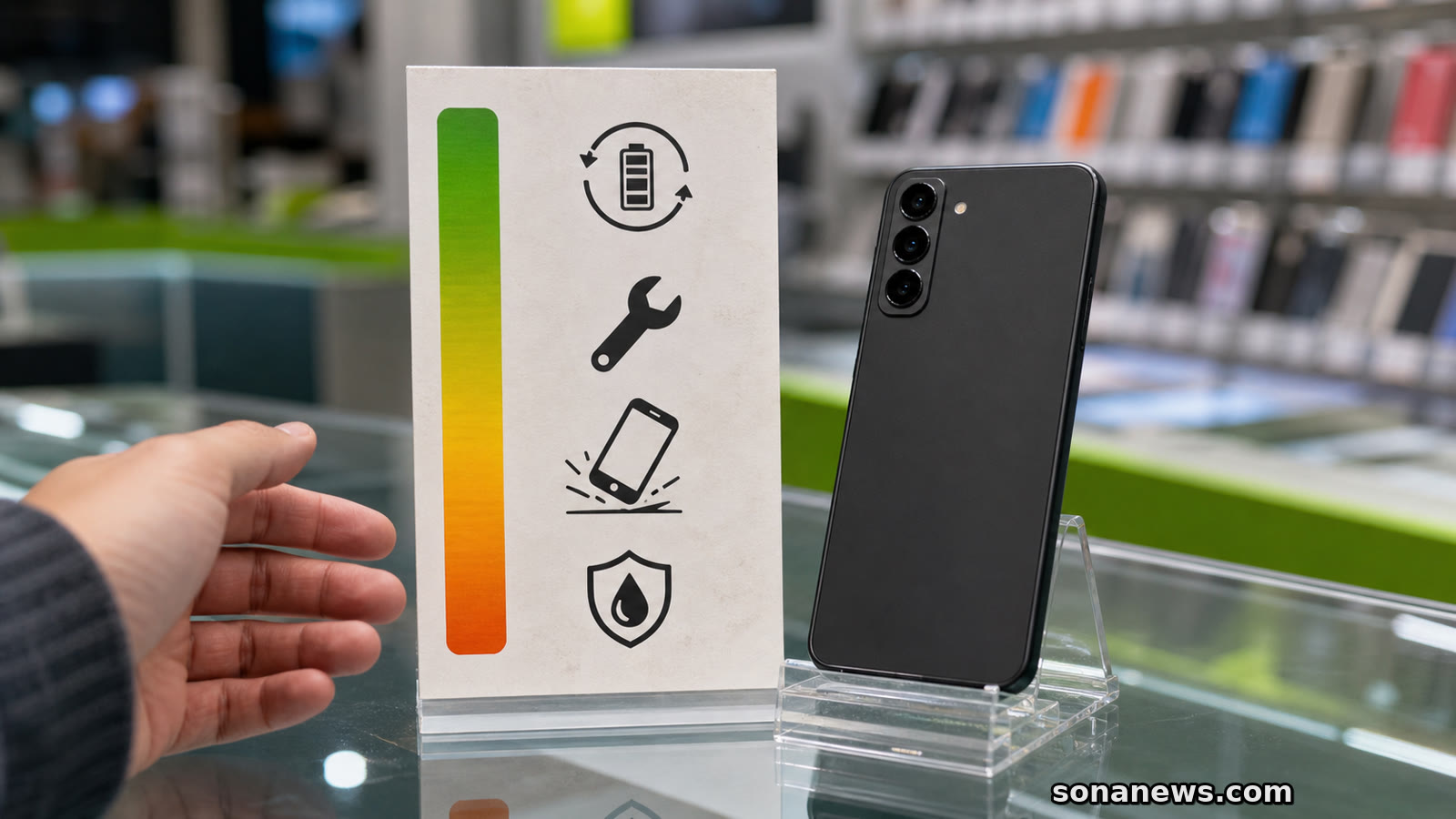

The most revealing detail on a new phone in Europe may not be on its screen. It is on the product label beside it.
Smartphones and slate tablets placed on the EU market since 20 June 2025 are covered by energy-labelling and ecodesign rules. The familiar coloured A-to-G scale is there, but the lower half of the label does more interesting work. It shows battery runtime, battery durability in charging cycles, resistance to repeated drops, repairability and protection against dust and water.
That turns a label associated with fridges and washing machines into something closer to a durability scorecard. The European Commission published fresh consumer guidance in June 2026, a useful reminder that the headline letter is only one part of the buying comparison.
The energy class still matters. It rates how efficiently the device uses its battery under a standardised test. Yet an A for efficiency is not a blanket verdict that one phone will last longer than another in every sense. A separate figure gives the tested hours and minutes available from a full charge. Real use will vary with brightness, apps, network conditions and signal strength, so the number is best read as a controlled comparison, not a personal battery promise.
Then comes a second battery number. The cycle figure declares how many full charge and discharge cycles the battery can withstand before its usable capacity falls below 80 per cent of the original rating. A cycle can be accumulated over several partial charges, rather than requiring one uninterrupted trip from empty to full. The accompanying ecodesign rules set a minimum: covered devices must retain at least 80 per cent of declared capacity after 800 cycles.
This distinction is easy to miss. Runtime asks how long one charge lasts. Cycle endurance asks how long the battery remains reasonably capable over repeated use. A phone can perform well on one and less impressively on the other. Reading both gives a more useful picture than treating “all-day battery” as a measurable standard.
The label also gives physical resilience its own symbols. Repeated free-fall reliability is graded from A down to D for smartphones, and to E for slate tablets, using standardised drop testing. The Commission’s consumer guide says a class A non-foldable smartphone must remain fully functional after 270 drops from one metre. The baseline ecodesign requirement is lower, including 45 one-metre drops for ordinary smartphones, with a separate test pattern for foldable models.
This does not mean any phone is drop-proof. A laboratory class cannot predict the angle of a fall onto a kerb, damage that appears later or the fate of an unprotected screen. It does, however, move impact resistance out of vague adjectives and into a test that can be compared across models.
Repairability gets an A-to-E class of its own. The underlying index considers factors such as the depth of disassembly, fasteners, tools, spare-parts availability, software support and repair information. The letter is not a quotation for a repair, nor does it guarantee that a local shop will have a particular part tomorrow. It is a signal about how the product was designed and supported.
The rules behind the label add useful detail. The Commission says critical spare parts must remain available for seven years after sales of a model end on the EU market, generally with delivery required within five to ten working days. Operating-system upgrades must be available for at least five years after the last unit of a model is placed on the market. Professional repairers must also have non-discriminatory access to software or firmware needed for replacement work.
There is a practical route beyond the printed card. Its QR code opens the EU’s European Product Registry for Energy Labelling, or EPREL, where a model has a fuller product information page. The Commission says EPREL provides the details behind the six parameters used to calculate repairability. Its consumer guidance also points readers towards suppliers’ publicly accessible spare-part and tool prices.
As with any QR code, the route deserves a glance before opening. The Commission advises checking that the destination is the official EPREL service and that a sticker has not been placed over the original code. EPREL does not ask for payment or personal data simply to view product information. A model can also be searched directly in the database if the physical label looks suspect.
Scope matters. These requirements apply to covered products newly placed on the EU market from the June 2025 date. They do not retrospectively put a label on every older phone still in a drawer or every remaining piece of older retail stock. The rules also exclude some categories, including products with a rollable main display, high-security communication smartphones and computer-like tablets outside the regulation’s definition of a slate tablet. People shopping outside the EU may encounter different labels or no equivalent at all.
The label will not settle every purchasing decision. Camera quality, accessibility, price, software ecosystem and storage still count. Nor does a high repairability class make a costly spare part cheap. What it can do is challenge the usual rhythm of the phone shop, where bright screens and launch-year features crowd out questions about year three.
A sensible comparison therefore moves down the card rather than stopping at the coloured arrow. Look at tested runtime, then cycle endurance. Compare the drop and ingress ratings. Check the repairability class, and open EPREL when two devices look close. The result is not a perfect forecast of ownership. It is a more honest product conversation than a row of superlatives.
Editorial note. This article is general technology, consumer-information and regulation reporting. It is not legal, repair, purchasing or product-compliance advice.
Sources
- Source: European Commission, “Smartphones and Tablets”, Extracted 2026-07-11. Verified: 20 June 2025 application date, product scope and exclusions, label fields, EPREL link, minimum 800-cycle battery requirement, spare-parts and operating-system support periods, drop and ingress measures, and repairability scoring
- Source: European Commission-funded Compliance Services, “New energy label for smartphones & slate tablets: Information for Consumers”, Published May 2026 and listed by the Commission on 11 June 2026; extracted 2026-07-11. Verified: how to read runtime and cycle figures, online display, free-fall classes and thresholds, repairability meaning, spare-parts access, baseline quality requirements and scope caveats. The guide states that the regulations prevail and is not legally binding
- Source: EUR-Lex, consolidated Commission Delegated Regulation (EU) 2023/1669 on energy labelling of smartphones and slate tablets, Consolidated 10 May 2026; extracted 2026-07-11. Verified: legal basis, in-force status, scope, labelling requirements and supplementary product information framework
- Source: EUR-Lex, consolidated Commission Regulation (EU) 2023/1670 on ecodesign requirements for smartphones, mobile phones, cordless phones and slate tablets, Extracted 2026-07-11. Verified: applicable ecodesign framework, covered product types, repair and durability requirements, test conditions and exclusions
- Source: European Commission, “Understanding the Energy Label”, Extracted 2026-07-11. Verified: A-to-G convention, EPREL QR-code purpose, direct database lookup and Commission guidance for checking that a QR code points to the official service
Help us improve
Was this article useful?
One anonymous tap helps Sona improve future reporting, headlines and source context.
Up next
Apple's repair labels distinguish reused components, unfinished calibration and parts it cannot verify. None is a complete verdict on a second-hand phone.
Continue readingMore in Tech