NASA’s new gamma-ray detector is getting an orbit test before it becomes a telescope
AstroPix is a small sensor story with a large scientific purpose: testing whether silicon pixel detectors can help fill a stubborn gap in how astronomers watch the high-energy universe.

Some space stories are built around a launch window or a photograph. This one is built around a detector that has to prove it can behave in orbit.
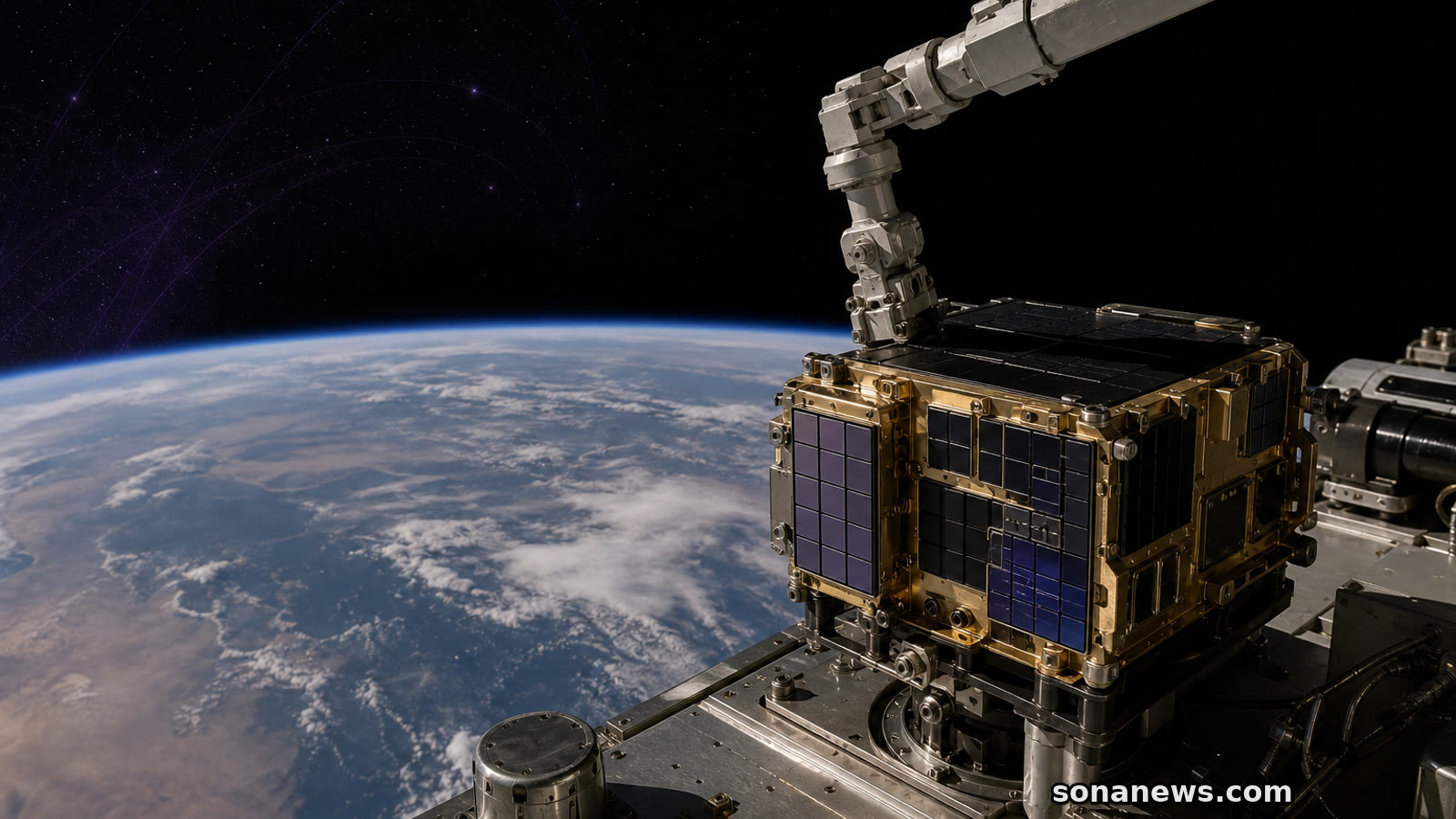
NASA says a prototype gamma-ray sensor called AstroPix will fly on its Fly Foundational Robots mission, a low Earth orbit technology demonstration targeted for late 2027. The payload, called the AstroPix Satellite Technology dEmonstration Payload, or A-STEP, is not being presented as a full new telescope. It is a trial run: a chance to see how a new kind of silicon pixel detector performs in space after a robotic arm repositions it on the spacecraft.
That sounds modest, and it is. It is also the point. High-energy astronomy depends on instruments that can measure light humans cannot see, at energies far beyond visible light. NASA’s article puts AstroPix’s planned measurement range at 20,000 to 700,000 electron volts. Visible light, by comparison, sits around 2 to 3 electron volts. The gap is not only poetic. It is technical, and it shapes what astronomers can learn from violent cosmic events.
Gamma rays are the highest-energy form of light. They can come from lightning in Earth’s atmosphere, powerful solar flares, collisions in distant galaxies, gamma-ray bursts and active galaxies powered by black holes. NASA’s Fermi telescope has shown how busy this sky can be, with years of observations tracking more than 1,500 changing gamma-ray sources in a public light-curve repository. Much of that activity is invisible to ordinary eyes, but not quiet.
The problem is that the middle of the gamma-ray range remains awkward. NASA says existing detectors are less sensitive between 500,000 and 1 million electron volts. That range matters for some of the events astronomers most want to understand, including gamma-ray bursts and active galaxies. A future telescope that can work better there could help researchers reconstruct where energetic particles are born, how jets are powered and how explosive events evolve.
AstroPix is one possible route toward that future. Its basic idea is familiar in outline but specialised in execution. NASA compares the detectors to the sensors in cellphone cameras, except these are built for gamma-ray light rather than visible pictures. Each AstroPix chip has four silicon pixel gamma-ray detectors, and each detector has 1,225 pixels. Stacking detectors in later missions could help scientists trace interactions through a telescope and build a clearer picture of incoming gamma rays.
The lineage is also useful. Technical papers and NASA’s own reports describe AstroPix as a monolithic CMOS active pixel sensor concept, adapted from pixel technology developed for particle physics. The attraction is not a single magic number. It is a combination of two-dimensional position information, low-power operation and integrated detection and readout within each pixel. In the lower-energy gamma-ray regime, where Compton-style event reconstruction matters, knowing exactly where interactions happen inside the detector can be the difference between a useful signal and a muddle.
There is a second story riding alongside the detector. Fly Foundational Robots is itself a demonstration mission, designed to test a commercial robotic arm and practical in-space manipulation. NASA describes the mission as a step toward robotic servicing, assembly and infrastructure in orbit, with the arm able to reposition an orbital replacement unit and support guest robotic tasks. In plain terms, the spacecraft is not only carrying a sensor. It is testing whether space hardware can be moved, upgraded or handled after launch with more routine confidence.
That pairing is quietly clever. A prototype detector needs time in orbit. A robotic demonstration needs objects worth manipulating. Putting AstroPix on the same platform gives NASA a way to gather detector data while also testing the kind of payload handling that future spacecraft may rely on. It is less glamorous than a flagship observatory, but it sits in the layer where flagship observatories often begin: a component, a test, a tolerance stack and a question about whether the lab result survives the real environment.
The right tone is caution, not hype. AstroPix is not about to solve gamma-ray astronomy by itself. The late-2027 flight will test performance, not deliver a finished all-sky revolution. NASA’s article notes that comparable technologies have flown on balloon work and that a prototype is also expected to be part of a sounding rocket payload. Orbit is a harder and more useful test because the instrument can experience the operating conditions that future space missions would have to endure.
That is why the story deserves attention now. Public space coverage often jumps from mission announcement to spectacular image, skipping the smaller engineering steps that make later science possible. Detectors are part of that hidden machinery. They decide which photons can be measured, how cleanly an event can be reconstructed and how much uncertainty follows the data back to Earth.
If AstroPix works as hoped, the payoff will not be a single dramatic picture. It will be a better way to catch some of the universe’s most energetic light, especially in a range where astronomers know they are still missing detail. The small sensor on the robotic testbed is not the telescope. It is a rehearsal for one.
Sources
- Source: "NASA Robotic Tech Demo Will Advance Prototype Gamma-Ray Detectors", Extracted 2026-06-13. Verified: AstroPix will fly on NASA’s Fly Foundational Robots mission targeted for late 2027; the payload is A-STEP; the detector range is 20,000 to 700,000 electron volts; visible light comparison, detector sensitivity gap and chip pixel details
- Source: "Fly Foundational Robots", NASA, Extracted 2026-06-13. Verified: mission status, technology demonstration purpose, low Earth orbit robotic arm test, late-2027 target, payload list including A-STEP and wider in-space servicing context
- Source: "NASA’s Fermi Captures Dynamic Gamma-Ray Sky in New Animation", Extracted 2026-06-13. Verified: gamma rays as high-energy light, Fermi LAT observation context, more than 1,500 light curves, blazar and multimessenger background
- Source: "AstroPix: ATLAS-Inspired Silicon Pixels for Future Space-Based Gamma-ray Telescopes", NASA Technical Reports Server, Extracted 2026-06-13. Verified: AstroPix as monolithic CMOS active pixel silicon sensor work, particle-physics lineage, motivation for two-dimensional position information, low noise and low power in future gamma-ray telescopes
- Source: "AstroPix: Novel monolithic active pixel silicon sensors for future gamma-ray telescopes", Extracted 2026-06-13. Verified: proceedings-paper support for the Compton-regime motivation, active pixel sensor design and future keV-MeV gamma-ray telescope context
Help us improve
Was this article useful?
One anonymous tap helps Sona improve future reporting, headlines and source context.
Up next
Hubble data trace a 10-sided atmospheric wave from faint 2023 hints to a clearer 2025 pattern. Its slow drift and 32-day wobble do not yet explain why it formed.
Continue readingMore in Space