The 2026 eclipse is already a low-sun planning problem
NASA’s new August 2026 eclipse map is not just a path of totality. For Europe, Iceland and the North Atlantic, it is a reminder that timing, horizon and safe viewing will matter as much as location.

The next widely discussed total solar eclipse is not arriving tomorrow. That is exactly why it is worth paying attention now.
NASA has published fresh public guidance and a new Scientific Visualization Studio map for the total solar eclipse of 12 August 2026. The path of totality will cross Greenland, Iceland, the Atlantic Ocean, Spain and a small corner of Portugal, with a partial eclipse visible across a far wider part of the Northern Hemisphere. Much of Europe, most of Canada, parts of the northern United States and northwestern Africa will see at least a partial event.
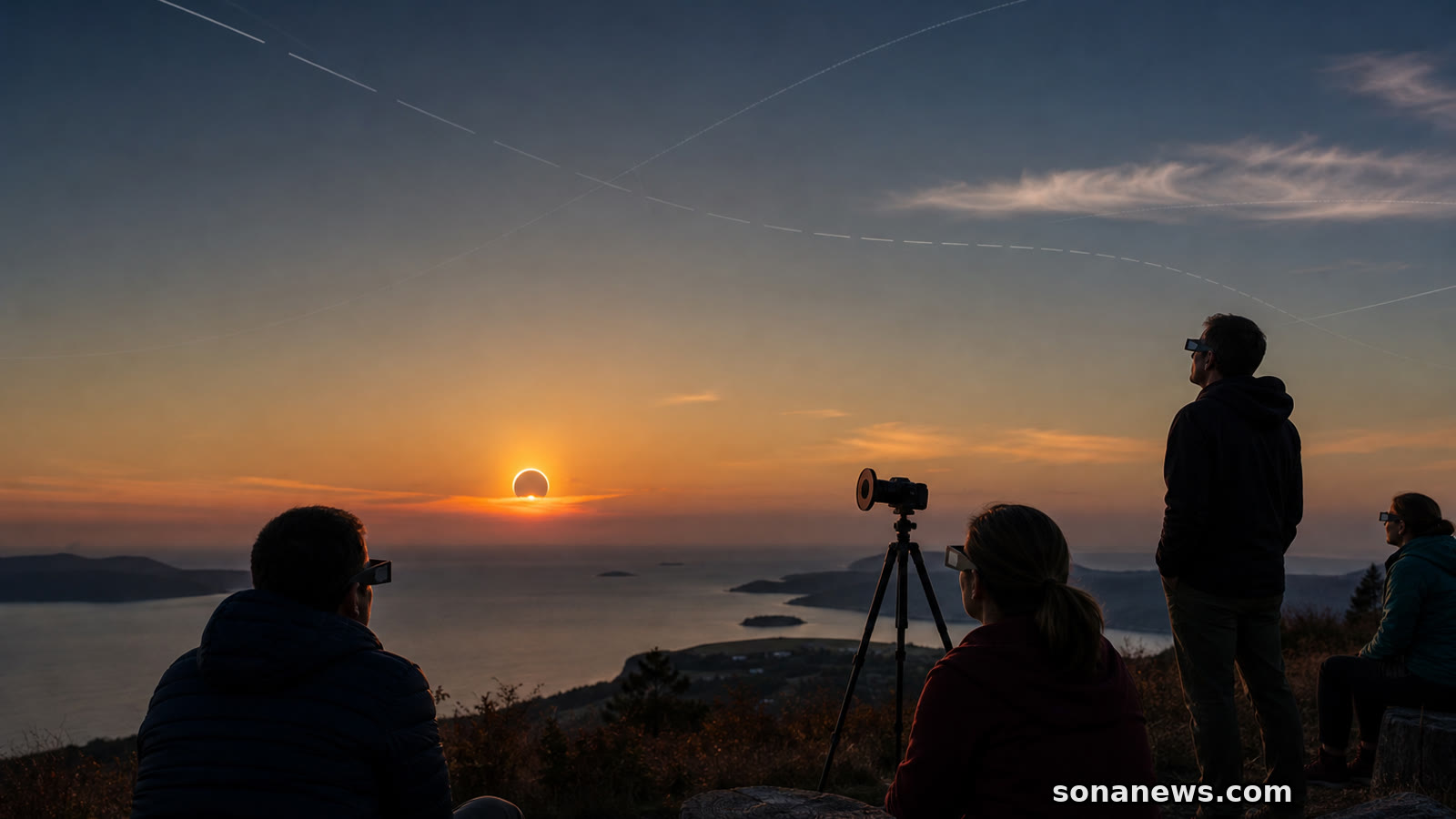
The useful detail is not only where the Moon’s shadow goes. It is when it arrives. NASA says the eclipse reaches the UK, Ireland, mainland Europe and Africa in the evening. In mainland Europe and Africa, the Sun may set while it is still partly eclipsed. For Spain and northwestern Portugal, totality comes in the late evening, shortly before sunset.
That turns the eclipse from a simple map-reading exercise into a low-horizon problem. A place can be inside the path and still have a poor view if buildings, hills, trees, cloud or sea haze block the western sky. A late-day eclipse may be beautiful, but it is less forgiving than one high overhead. The planning question is not only whether a town is on the central line. It is whether the Sun will be visible from the actual spot where people stand.
NASA’s map helps explain why. The red band marks the narrow umbra, where the Sun is completely blocked. Yellow curves show the much broader penumbra, where only a partial eclipse is visible. Green lines mark time, and orange loops near the ends of the path show sunrise and sunset effects. The agency also adds a careful caveat: near the beginning and end of the shadow path, the true situation is messier because terrain, atmospheric refraction and the Sun’s apparent position near the horizon all matter.
This is the kind of sentence that deserves more attention than it usually gets. Eclipses are often sold through clean lines and dramatic photographs. The lived version is more ordinary and more fragile. A ridge in the wrong direction can erase the event. A city-centre hotel can put the western horizon behind a wall. A beach may help with sightline but not with weather. A long drive to chase a few extra seconds may not be worth it if the practical view is worse.
The timing also changes expectations. NASA’s eclipse page says most people in the path of totality will get less than two minutes of darkness. The older NASA Goddard eclipse table lists greatest eclipse at 17:47:05 TD, with a central duration of two minutes and 18 seconds. That is not a long show. It is a short astronomical alignment, surrounded by a much longer partial phase that needs eye protection.
The safety rules are not decoration. NASA’s guidance is blunt: during a partial solar eclipse, it is never safe to look directly at the Sun without proper solar viewing protection. Eclipse glasses are not ordinary sunglasses. Cameras, binoculars and telescopes need their own front-mounted solar filters, and NASA warns against looking through optical devices while wearing eclipse glasses because concentrated sunlight can damage the filter and the eye.
There is a calmer way to think about the event. The August 2026 eclipse is not a once-in-history omen, and it does not need breathless language. It is a predictable piece of celestial geometry that briefly makes the Sun, Moon and a narrow strip of Earth line up. The reason it feels rare is that the strip is narrow, the weather is local and the timing is exact.
For readers outside the totality path, the story is still real but different. A partial eclipse can be striking, especially when the Sun is low, but it is not totality. There is no safe naked-eye moment in a partial eclipse. The Moon covers only part of the Sun, and that uncovered part is still the Sun.
The best public value in NASA’s new material is that it reduces the mystery without removing the wonder. It shows where the shadow is expected to move, explains how to read the map, and reminds people that the horizon is part of the observation. It also makes clear that the safest viewing plan is not something to improvise in the final hour.
By next summer, the eclipse will be a travel story, a weather story and a crowd-management story. For now, it is a space story with a practical edge. The Moon’s shadow has a route. The rest depends on timing, sky and the unglamorous business of finding a clear western horizon.
Editorial note. Solar eclipse viewing can damage eyesight if done incorrectly. This article is general public information, not personal safety advice. Follow current guidance from NASA or a recognised astronomy body for solar viewers, camera filters and supervision of children before observing any partial phase of a solar eclipse.
Sources
- Source: "Total Solar Eclipse on August 12, 2026", Extracted 2026-06-12. Verified: the path includes Greenland, Iceland, northern Russia, the Atlantic Ocean, Spain and a small corner of Portugal; partial eclipse visibility covers much of the Northern Hemisphere; European and African viewing occurs in the evening; totality is brief and safety guidance is included
- Source: "Map of the August 12, 2026, Total Solar Eclipse", Extracted 2026-06-12. Verified: NASA SVS released a 2026 eclipse map on 22 May 2026; red lines show the umbra, yellow curves show the penumbra, green lines show time, orange loops show sunrise and sunset effects, and NASA cautions that terrain and atmospheric refraction complicate horizon viewing
- Source: "Eclipse Viewing Safety", Extracted 2026-06-12. Verified: proper solar viewing protection is required except during totality; ordinary sunglasses are not safe; optical devices need special front filters; NASA does not approve specific viewer brands
- Source: "Solar Eclipses: 2021 - 2030", Extracted 2026-06-12. Verified: the 12 August 2026 event is a total solar eclipse in Saros 126 with magnitude 1.039, greatest eclipse at 17:47:05 TD and central duration of two minutes and 18 seconds; the central path includes Arctic, Greenland, Iceland and Spain
Help us improve
Was this article useful?
One anonymous tap helps Sona improve future reporting, headlines and source context.
Up next
Hubble data trace a 10-sided atmospheric wave from faint 2023 hints to a clearer 2025 pattern. Its slow drift and 32-day wobble do not yet explain why it formed.
Continue readingMore in Space