Smile will watch Earth’s magnetic shield move
ESA and China’s Smile mission launched in May to study how the solar wind presses on Earth’s magnetosphere. The useful promise is not instant aurora alerts, but a wider view of the space weather system around us.
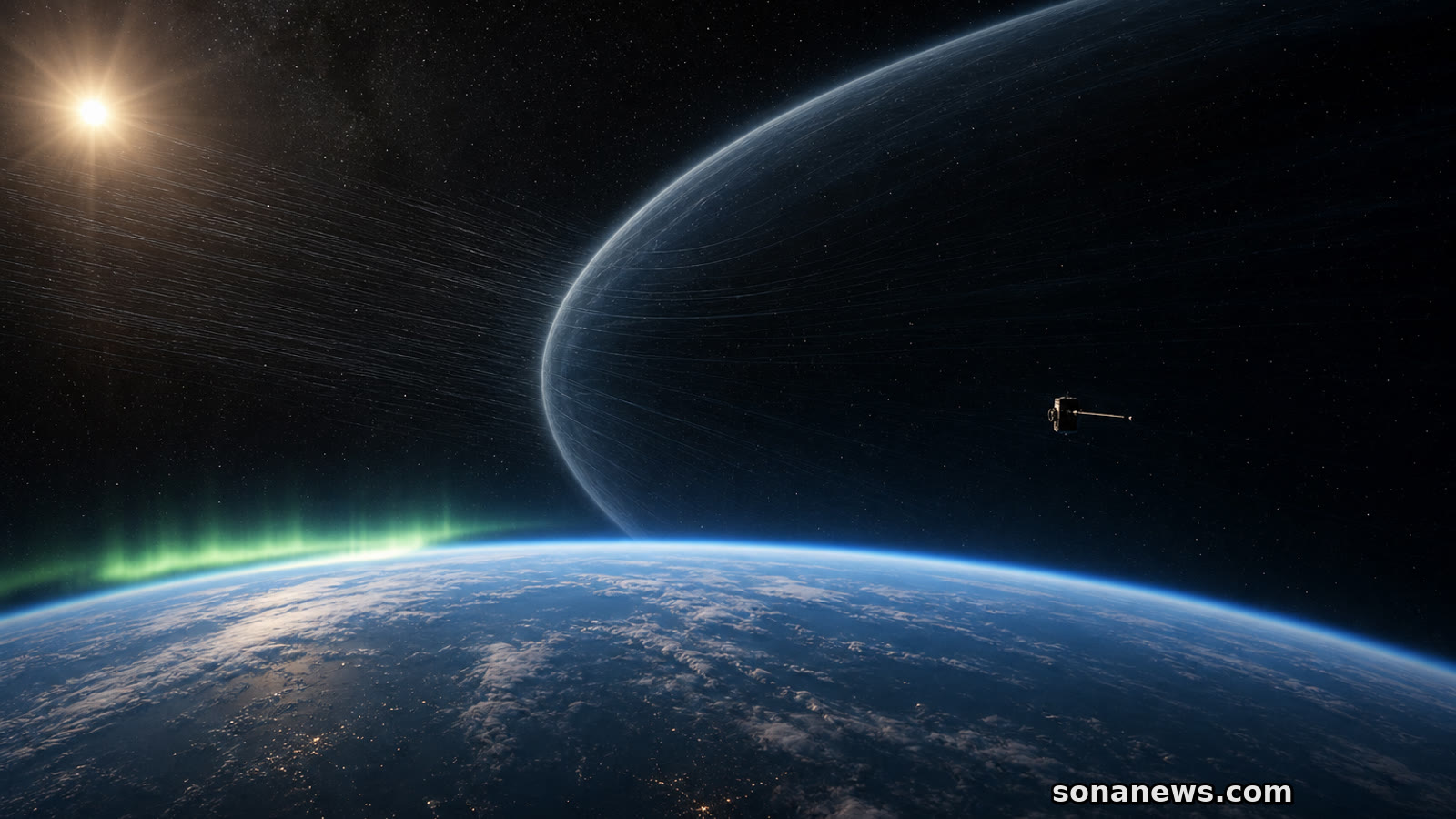

The most useful thing about Smile may be what it refuses to do. It is not a prettier aurora camera, and it is not a magic alarm for the next magnetic storm. It is a spacecraft built to watch a boundary that usually has to be inferred from scattered measurements: the place where the solar wind meets Earth’s magnetic shield.
Smile, short for Solar wind Magnetosphere Ionosphere Link Explorer, launched on 19 May 2026 on a Vega-C rocket from Europe’s Spaceport in French Guiana, according to the European Space Agency. ESA describes it as a joint mission with the Chinese Academy of Sciences, and says science data are expected to begin officially in September after the spacecraft reaches its operational orbit and finishes commissioning.
That delay is worth noting. A launch does not mean an instant stream of discoveries. First come the unglamorous parts: reaching the right orbit, checking instruments, testing pointing, confirming data links and making sure the spacecraft behaves as expected. The story is not that Smile has already solved space weather. The story is that scientists are trying to look at Earth’s near-space environment in a different way.
Earth’s magnetosphere is often described as a protective bubble. That phrase is useful, provided it does not make the system sound solid or tidy. NOAA’s Space Weather Prediction Center describes the solar wind as a constant flow of plasma, mostly protons and electrons, moving outward from the Sun with a magnetic field embedded in it. Its speed, density and magnetic direction change with solar activity.
When those conditions line up badly, energy can transfer into Earth’s magnetosphere. NOAA defines a geomagnetic storm as a major disturbance of that system, often linked to sustained high-speed solar wind and a southward solar wind magnetic field. Storms can produce beautiful aurora, but NOAA also notes possible effects on satellites, radio signals, positioning systems and power infrastructure.
This is where Smile’s promise becomes less abstract. Most spacecraft that have studied the magnetosphere have made local measurements. They can tell scientists what the plasma and magnetic field look like where the spacecraft is, rather like a weather station reporting one hilltop. That is valuable, but it leaves a lot of the larger shape to be reconstructed.
Smile is designed to add a wider view. ESA says the mission will combine wide-field X-ray imaging, ultraviolet aurora observations and in situ measurements of plasma and magnetic fields. Its Soft X-ray Imager is intended to observe X-rays produced when charged solar wind particles interact with neutral particles in Earth’s upper atmosphere, a process known as solar wind charge exchange. Its ultraviolet camera will watch the northern auroral region for long stretches.
The important shift is not simply that the images will look striking, though they may. It is that scientists hope to see how the sun-facing edge of the magnetosphere changes as the solar wind pushes, weakens, rotates or arrives in bursts. A single measurement can say what happened at one point. A global image can help show whether that point was part of a small ripple or a larger reconfiguration.
That matters because space weather is not just a public light show. Aurora are the visible, photogenic end of a chain that begins at the Sun and continues through interplanetary space, Earth’s magnetic environment and the upper atmosphere. NOAA’s aurora material makes a useful correction here: aurora are driven by solar wind energy, but the electrons that light the upper atmosphere mainly come from within Earth’s magnetosphere. The machinery is more indirect than the phrase “solar particles hit the sky” suggests.
Smile should help with that machinery. CAS’s National Space Science Center says the mission will study solar wind and magnetosphere interaction using simultaneous plasma, magnetic field, X-ray and ultraviolet measurements, including long observations from a highly elliptical northern orbit. ESA’s factsheet says the nominal mission is planned for three years.
There are limits. Smile will not stop solar storms. It will not tell every reader when to stand outside for aurora. It will not prove that Earth’s magnetic field is failing. Those claims are tempting because they make a complicated mission feel immediate, but they would overstate what has been launched.
The better point is quieter. Space weather forecasts depend on models, and models improve when scientists can compare local measurements with the bigger picture. If Smile can show the magnetosphere breathing in response to the solar wind, researchers get a cleaner way to test what they think is happening around Earth.
That is enough. A mission does not need apocalypse language to matter. Somewhere above us, after commissioning and a patient route to the right orbit, Smile is meant to turn an invisible boundary into something scientists can watch change. For a planet that depends on that boundary every day, that is a serious piece of public science.
Sources
- European Space Agency - "Smile lifts off on quest to reveal Earth’s invisible shield against the solar wind" - - extracted 2026-06-09. Verified: launch date, Vega-C launch from Europe’s Spaceport, ESA/CAS mission partnership, mission aim, first signal and solar-panel deployment, X-ray and aurora-observation claims
- European Space Agency - "Smile factsheet" - - extracted 2026-06-09. Verified: Smile acronym, travel to operational orbit, expected September 2026 science-data start, mission duration, instrument mix, global X-ray and ultraviolet viewing goal
- ESA Science Programme - "Smile" - - extracted 2026-06-09. Verified: mission tagline, operational status, highly elliptical orbit, heliophysics purpose, four instrument categories and the goal of imaging Earth’s magnetic environment
- NOAA Space Weather Prediction Center - "Solar Wind" - - extracted 2026-06-09. Verified: solar wind composition, embedded solar magnetic field, speed and density variation, and why solar wind conditions matter for space weather
- NOAA Space Weather Prediction Center - "Geomagnetic Storms" - - extracted 2026-06-09. Verified: geomagnetic-storm definition, role of high-speed solar wind and southward magnetic field, aurora and operational impacts
- NOAA Space Weather Prediction Center - "Aurora Tutorial" - - extracted 2026-06-09. Verified: aurora mechanism and the correction that auroral electrons mainly come from within Earth’s magnetosphere rather than directly from the solar wind
- Chinese Academy of Sciences, National Space Science Center - "SMILE Mission" - - extracted 2026-06-09. Verified: CAS/ESA collaboration, simultaneous plasma, magnetic-field, X-ray and ultraviolet measurements, long observations from a highly elliptical northern orbit, and listed payloads
Help us improve
Was this article useful?
One anonymous tap helps Sona improve future reporting, headlines and source context.
Up next
Hubble data trace a 10-sided atmospheric wave from faint 2023 hints to a clearer 2025 pattern. Its slow drift and 32-day wobble do not yet explain why it formed.
Continue readingMore in Space