The space station’s coldest lab just became a better quantum test bench
NASA’s upgraded Cold Atom Lab is not a sci-fi shortcut. It is a minifridge-sized ISS instrument for testing how ultracold atoms behave when gravity gets out of the way.
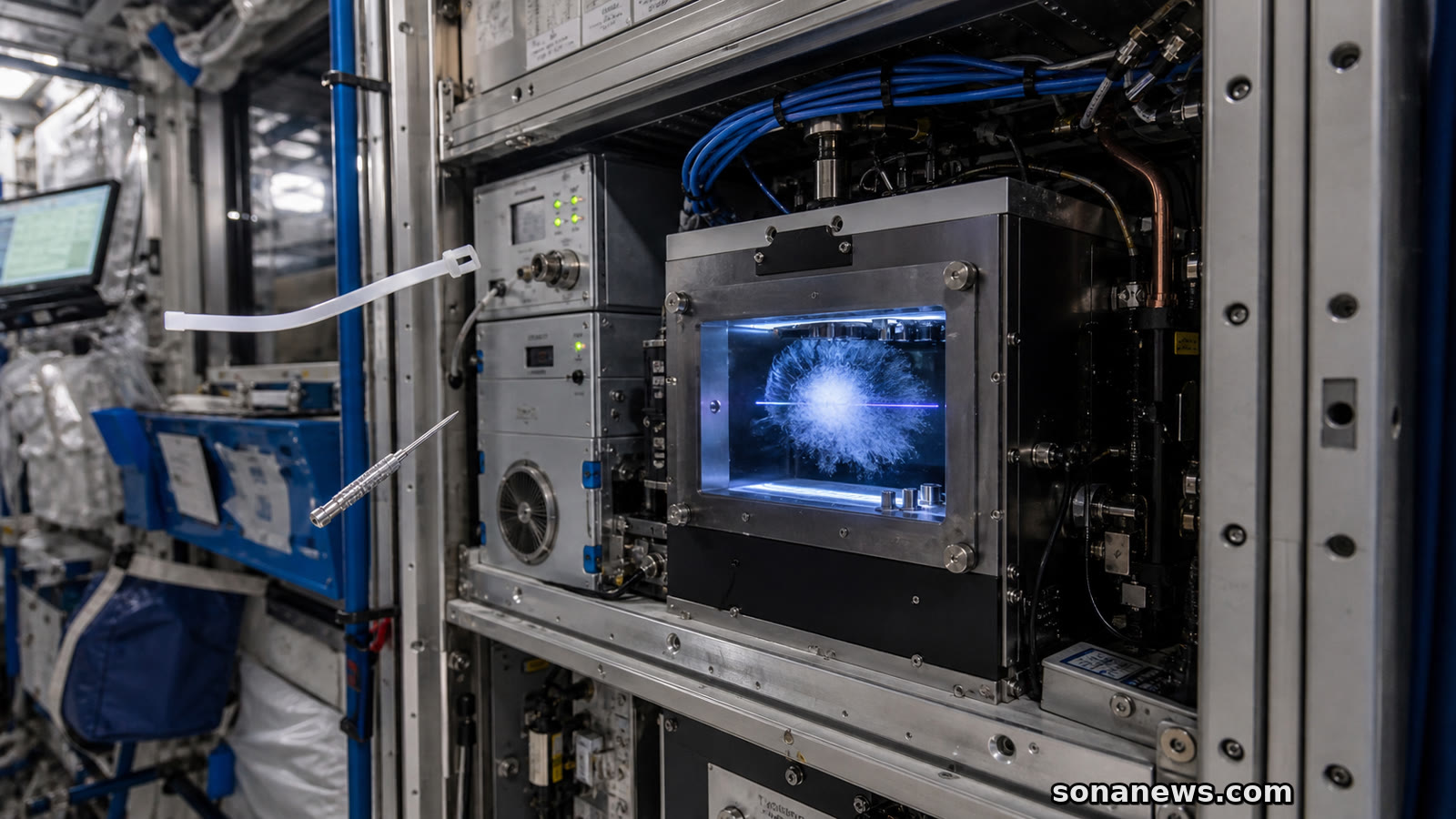

The easiest way to misunderstand NASA’s Cold Atom Lab is to let the word quantum do all the work. It sounds like a shortcut to future gadgets, or a mysterious trick that belongs in the same mental drawer as warp drives. The more interesting version is smaller, colder and more patient: a box about the size of a minifridge on the International Space Station, tuned so carefully that atoms can be slowed almost to stillness.
NASA and JPL said on 16 June that astronauts aboard the station had switched on an upgraded version of the Cold Atom Lab, known as CAL. The new science module reached the ISS on an April 2026 commercial resupply mission, and NASA describes it as the fourth upgrade since the facility arrived in orbit in 2018. That matters because this is not a one-off stunt. It is a piece of orbital laboratory infrastructure that has to be repaired, improved, operated from the ground and kept useful for teams who are asking difficult physics questions.
CAL’s job is not to look out into deep space. It looks inward, at matter itself. The facility uses lasers and magnetic traps to cool atoms to temperatures extremely close to absolute zero. In that condition, atomic motion slows, the wave-like behaviour of matter becomes easier to see and clouds of atoms can form a Bose-Einstein condensate. That is often called a fifth state of matter, but the phrase can make it sound more exotic than it needs to be. In practical terms, it gives physicists a shared quantum system large enough to probe with instruments.
The space station gives the experiment its special advantage. On Earth, gravity quickly pulls cold atom clouds downward and limits how long some measurements can run. In microgravity, the clouds can expand and persist differently, giving researchers a cleaner and longer look at behaviour that is hard to isolate in a ground lab. NASA’s mission page puts it plainly: CAL studies ultra-cold quantum gases in a temperature regime and force-free environment inaccessible to terrestrial laboratories.
The new hardware is meant to widen that range. NASA says the upgrade supports five international research teams and helps test whether future quantum instruments can work reliably in space. The ISS National Lab’s facility page notes that CAL can trap rubidium and potassium atoms and supports techniques used for atom interferometry, where matter waves are split, redirected and recombined to make very precise measurements. This is where the story moves from “cold atoms are strange” to “cold atoms can be useful measuring tools”. It also explains why an upgrade can be newsworthy without a launch spectacle. More species, better trapping and steadier controls give researchers more ways to separate the signal they want from the noise that comes with any real spacecraft.
A 2024 Nature Communications paper shows why scientists take the platform seriously. Researchers reported pathfinder atom-interferometry experiments in CAL, including a photon recoil measurement in orbit, and described the instrument as the first matter-wave quantum sensor operating in space. That is a careful milestone, not a consumer product launch. It means a fragile quantum measurement method has been shown to work remotely on a vibrating, crewed spacecraft that circles Earth roughly every 90 minutes.
The possible uses are broad, which is exactly why they need caveats. NASA’s release mentions future matter-wave interferometers for fundamental physics, positioning, navigation, timing and gravity sensing of Earth, the Moon and beyond. Those are research directions, not promises that a phone will suddenly know its location because an atom cloud floated on the ISS. The sensible reading is that space is becoming a test environment for instruments that may one day measure gravity, motion or time with unusual precision.
There is also a quieter lesson about the space station itself. Public attention often goes to launches, spacewalks and telescope images. CAL is a reminder that some of the most durable station work happens inside racks, through maintenance logs and ground commands. An astronaut installs hardware. Engineers at JPL operate the instrument remotely. Research teams wait for data. The drama is not a fireball or a first footprint. It is whether a complicated laboratory can keep behaving like a laboratory in orbit.
That is why this upgrade is a good space story, even if it resists spectacle. The Cold Atom Lab is not trying to make quantum physics magical. It is making it more measurable. Each improved module buys scientists a little more control over atoms at the edge of stillness, in a place where gravity is less intrusive. For a field that depends on precision, that is a meaningful kind of progress.
Sources
- Source: “NASA’s Quantum Lab Aboard Space Station Gets Chilly Upgrade”, NASA / Jet Propulsion Laboratory, Extracted 2026-06-16. Verified: 16 June 2026 publication, upgraded Cold Atom Lab switched on aboard the ISS, minifridge-sized facility, April 2026 resupply launch, fourth upgrade since 2018, five international research teams and future quantum-instrument context
- Source: “Cold Atom Laboratory”, NASA Science, Extracted 2026-06-16. Verified: active mission status, May 2018 launch to the ISS, JPL remote operations, microgravity purpose, ultra-cold quantum gases and Bose-Einstein condensate context
- Source: “Cold Atom Lab”, ISS National Lab, Extracted 2026-06-16. Verified: CAL facility capabilities, rubidium and potassium atom trapping, laser cooling, atom-interferometry support and ISS internal research-rack context
- Source: “Pathfinder experiments with atom interferometry in the Cold Atom Lab onboard the International Space Station”, Nature Communications, Extracted 2026-06-16. Verified: peer-reviewed atom-interferometry milestone, first matter-wave quantum sensor in space, remote orbital operation and future precision-measurement relevance
- Source: “NASA’s Cold Atom Laboratory: Five Years of Quantum Science Operations in Space”, arXiv, Extracted 2026-06-16. Verified: CAL as a multi-user quantum science facility, continuous ISS operations, first orbital Bose-Einstein condensate and multi-year upgrade context
Help us improve
Was this article useful?
One anonymous tap helps Sona improve future reporting, headlines and source context.
Up next
Hubble data trace a 10-sided atmospheric wave from faint 2023 hints to a clearer 2025 pattern. Its slow drift and 32-day wobble do not yet explain why it formed.
Continue readingMore in Space