Framing a print? The gap behind the glass matters
A picture mount does more than create a border. Conservation guidance explains why paper needs separation from glazing, and what to ask before choosing a frame.
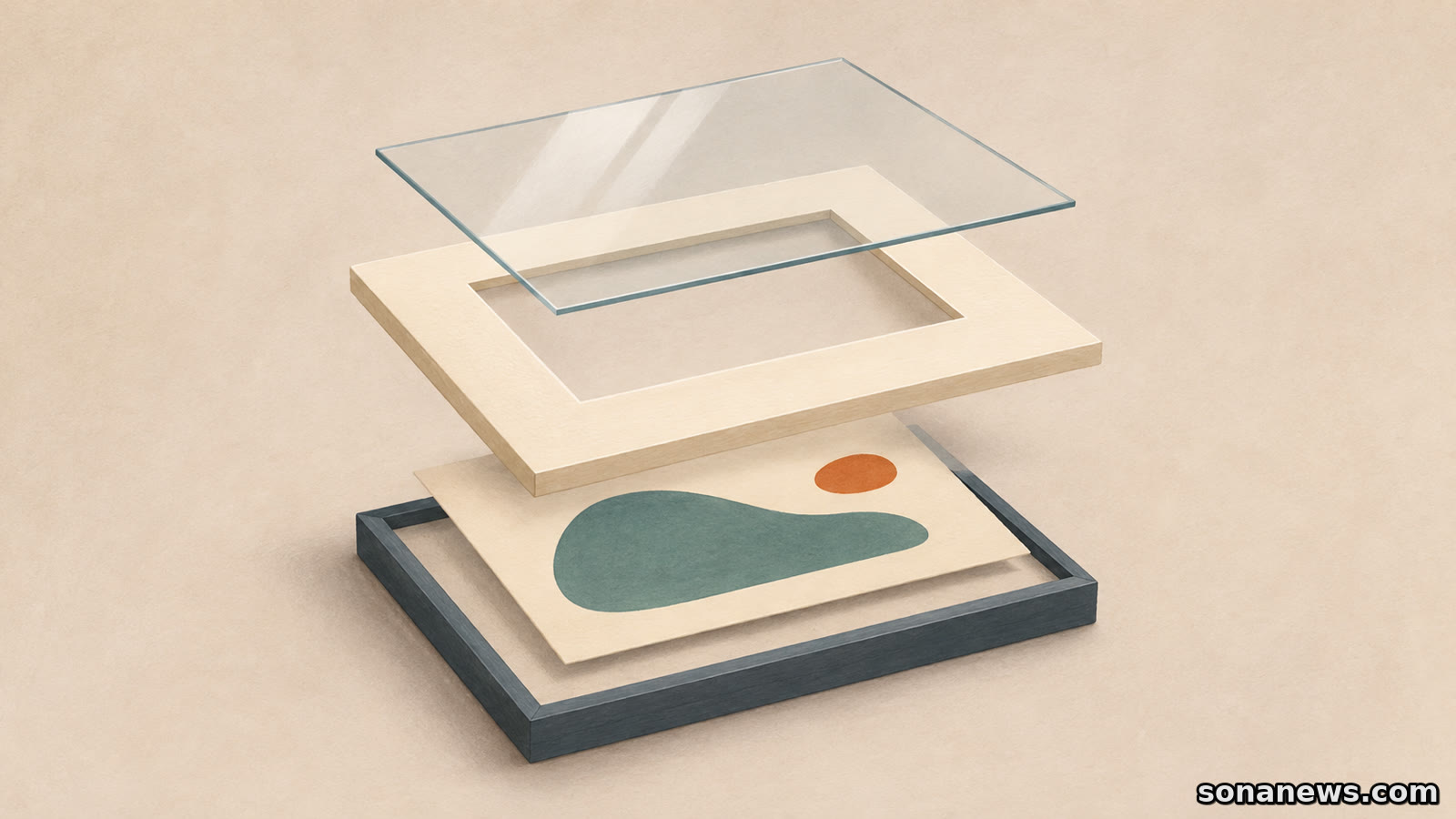

A print fits the frame, the colours work together, and the glass looks clean. There is one more question worth asking before it goes on the wall: is the paper touching the glazing?
The answer matters because the border around a picture is not merely decorative. A sufficiently deep window mount, also called a window mat, helps keep the work away from the glass or acrylic in front of it. Conservation organisations recommend that separation as part of a protective frame package, not as an optional styling flourish.
For someone framing a newly bought print, a drawing or a keepsake, this changes the shopping conversation. The outer dimensions and finish are only part of the purchase. What touches the paper, how it is held, and whether the frame has room for the layers deserve attention too. This is established conservation guidance, not a new rule for domestic decoration.
Why contact with glass is a problem
The Northeast Document Conservation Center, a US conservation organisation, explains the risk directly: if moisture condenses on the inside of the glazing, an object touching it can become stuck. The glazing protects against dirt and unwanted touching, but that does not make its inner surface a suitable support for the artwork.
A window mount has an opening through which the picture is seen. Its thickness creates separation while the surrounding board covers the edges of the sheet. The Library of Congress advises using a sufficiently thick mount or adding spacers around its perimeter so that the object does not touch the glazing.
The qualification is important. A white border is not proof of enough clearance. NEDCC notes that larger sheets, paper that may ripple, and works with raised or sensitive elements can need deeper mounts. The relevant question is whether this particular work will remain clear of the glazing, not simply whether a mount appears on the order.
A borderless look still needs separation
Not every print suits a broad visible border. Conservation framing can use spacers when a traditional window mount is not appropriate or wanted. These create space between the glazing and the work while allowing a different presentation.
That is not the same as squeezing a sheet directly between glass and a backing board. The Canadian Conservation Institute advises against the clip-held sandwich approach: it puts unnecessary pressure on the object and leaves exposed edges through which dust and pollution can enter.
Nor is a spacer a universal answer. The institute limits its described spacer method to flat, stable works. Buckled paper, loose pastel or charcoal, and cracked or flaking paint need particular care because contact can transfer pigment or cause adhesion. For those objects, ask a paper conservator or an experienced conservation framer rather than treating a packet of spacers as a complete solution.
Check what is behind the print
The materials hidden from view matter as much as the visible mount colour. The Library of Congress recommends cotton rag or chemically purified, lignin-free wood-pulp matboard and appropriate stable backing materials. NEDCC recommends cotton rag board for window mats and the primary backing board.
Their specifications are not identical in every detail. They do, however, make the same consumer point: ask what the boards are made from, rather than relying on appearance or a reassuring product name. NEDCC explicitly warns that materials sold as archival may not meet the standard needed for long-term preservation.
A photograph can need a different material choice from a print or drawing. The Library of Congress specifies that board used for photographs should pass the Photographic Activity Test. NEDCC also identifies sensitive photographic processes for which unbuffered board may be needed. A single package labelled acid-free is not an answer to every object.
Attachment is another separate decision. NEDCC says the work should not be adhered directly to its backing board. Appropriate corner supports or edge strips can avoid adhesive on the object; conservation hinges are another approach. These are options to discuss, not instructions to experiment with paste or sticky tape on a valuable original.
Ask about depth before choosing the frame
A frame can fit the width and height of a print yet lack enough depth for its protective layers. Both the Library of Congress and NEDCC say the frame must accommodate the complete package. The Canadian Conservation Institute similarly warns that some metal clip-together frames are not deep enough for the mat, backing and glazing.
A useful request to a framer is therefore specific: explain how the paper will be supported, what keeps it away from the glazing, and which boards sit behind it. Ask whether the chosen frame can hold those components without forcing them together. That is more informative than asking only whether the result will look archival.
There is no universal clearance measurement in this article. Paper condition, size, media and the proposed mounting method affect the choice. A decorative frame suitable for a replaceable reproduction need not be treated as a conservation specification for an irreplaceable drawing.
The wall is part of the decision
Even careful framing cannot make paper immune to its surroundings. The Library of Congress advises keeping framed works out of direct sunlight and away from radiators or working fireplaces. NEDCC says that UV-filtering glazing does not remove the need to limit light exposure.
For valuable paper collections, the Library of Congress recommends good storage and displaying a well-made reproduction as an alternative to permanent display of the original. That is worth considering for a family document or a particularly fragile work, not only for a museum collection.
The practical distinction is modest but useful. A frame is both a visual choice and a small protective structure. Before choosing the colour of its border, establish what that border is doing for the paper behind it.
Editorial note. General information about framing works on paper, not an assessment of a particular object. Consult a qualified paper conservator about valuable, fragile, damaged or unusual materials before changing their mounting or framing.
Sources
Help us improve
Was this article useful?
One anonymous tap helps Sona improve future reporting, headlines and source context.
Up next

No assigned novel, no race to finish it. Silent Book Club separates quiet reading from optional conversation, but the venue and local event details still matter.
Continue readingMore in Lifestyle