Knitting a jumper? Check the gauge after blocking
The needle size on a pattern is a starting point, not a promise of fit. A finished, dry swatch tells you more than a quick count while it is still on the needles.
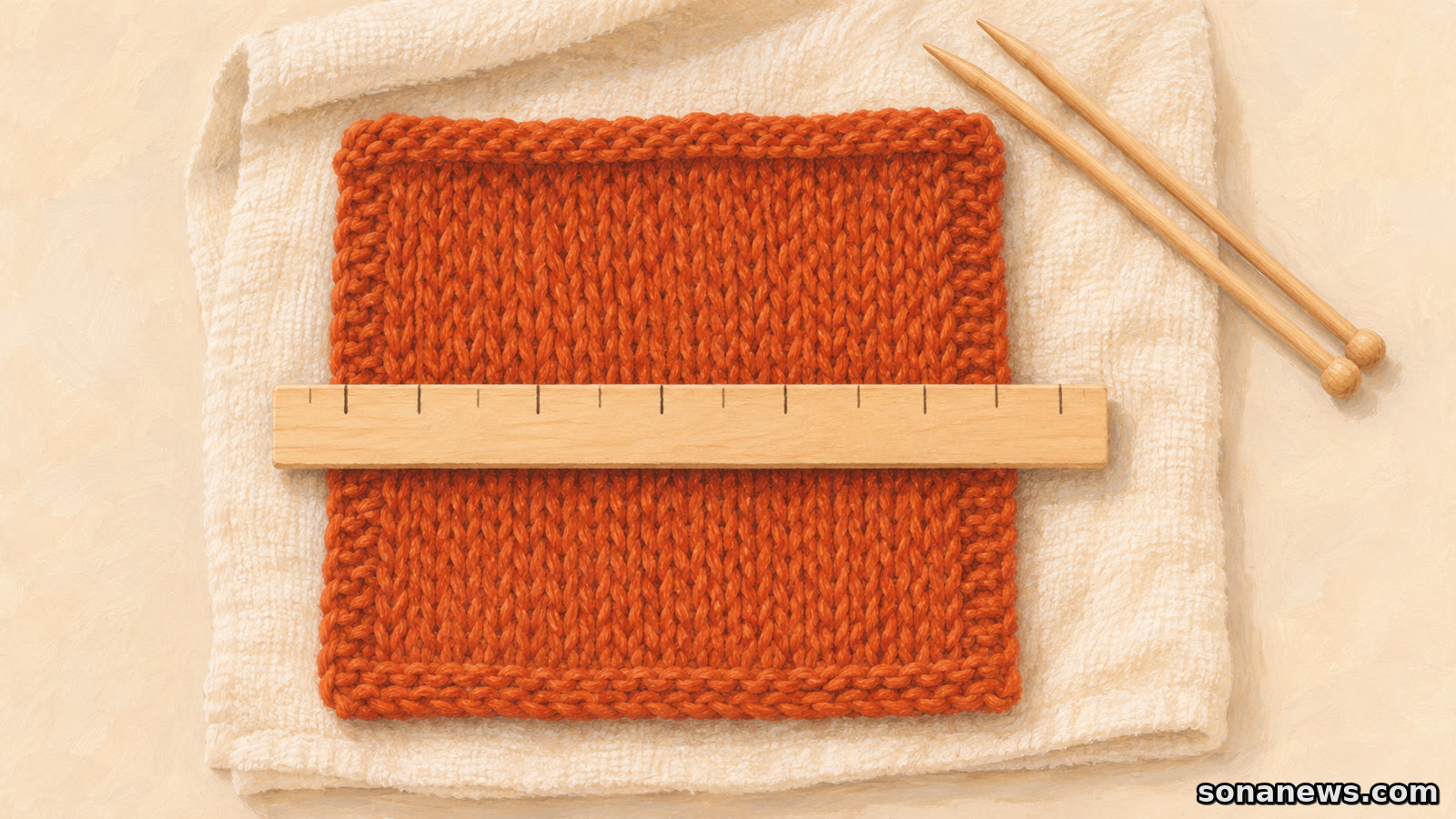

The yarn is right, the needles match the pattern, and the first rows look convincing. That still does not establish whether a knitted jumper will come out at the intended size. The missing check is the fabric itself, after the finishing treatment it will receive as a garment.
A gauge swatch is a small sample used to count stitches across a distance and rows or rounds up it. It connects the instructions on the page to the fabric made by your hands. For a pattern whose gauge is specified after blocking, a quick count on unfinished knitting is not the comparison that matters.
Blocking means finishing and shaping knitted fabric, using a method appropriate to the yarn and project. It can involve washing and laying the work out to dry, or another treatment such as steaming. Established guidance from knitting designers makes a useful distinction: finishing the knitting is not necessarily finishing the test.
The needle size is a suggestion
Tin Can Knits explains why two people using the same yarn and needles can produce different-sized stitches. Their tension differs. The pattern's gauge provides the shared target; its suggested needle size cannot guarantee that every knitter reaches it.
The Craft Yarn Council makes a related point in its standard yarn-weight system. Its gauge and needle-size ranges are guidelines, and it directs knitters to follow the gauge stated in their pattern. A ball band or a weight description helps narrow the choice, but neither replaces the project-specific check.
This matters particularly when buying a different yarn from the one used by the designer. The useful question is not only whether both yarns belong to the same weight category. It is whether the substitute produces the required gauge and a fabric you actually want to wear. A matching count and an appealing fabric are separate things to assess.
Make a sample with room to measure
Brooklyn Tweed recommends making a swatch larger than the area over which gauge will be counted. Its tutorial suggests a six- or eight-inch square for a four-inch measurement, so the edges do not distort the result. A tiny sample with barely enough stitches to count leaves little room for a reliable centre reading.
Use the stitch pattern specified for the gauge check, rather than assuming every project is measured in plain stockinette. Cables and other patterned fabrics can have a different stitch gauge from a plain section of the same garment, as Brooklyn Tweed explains. Follow the pattern's stated measurement span and units rather than switching between them mid-check.
The way the sample is knitted also matters. Both Brooklyn Tweed and Tin Can Knits warn that working flat and working in the round can produce different gauges. A flat sample alternates knit and purl rows for stockinette; circular stockinette is worked with knit stitches. Someone whose knit and purl tension differs may get a misleading answer by testing one method for a project made with the other.
Give the sample the garment's treatment
Brooklyn Tweed advises simulating the finished garment as closely as possible, including the needle size and material and the blocking technique. It also advises binding off before measuring, rather than treating stitches still held on a needle as a finished sample.
For a garment that will be wet-blocked, Tin Can Knits describes recording the unblocked gauge, washing and drying the sample, then measuring again once dry. The first figure is not useless: it can help you check consistency while knitting. The second reveals the fabric after that finishing treatment.
This is not an instruction to wash every fibre in the same way. Use a treatment suitable for the yarn and consistent with the pattern and care instructions. Nor should a swatch be stretched until it happens to match the required number. Brooklyn Tweed says to capture its natural, relaxed gauge unless the pattern specifically calls for stretch blocking.
Allow for drying time before making the decision. Brooklyn Tweed also recommends a rest after drying and unpinning, particularly for springy yarns that may retract slightly. That makes swatching an earlier part of the project, not a last-minute formality immediately before casting on the jumper.
Count the centre, then change one thing
Lay the finished sample flat and count across its centre with a ruler. Brooklyn Tweed favours a rigid ruler over a flexible tape that may have stretched. Check the vertical row gauge as well as the horizontal stitch gauge, and compare both with the pattern's requirements.
If there are more stitches in the same distance than the pattern requires, the stitches are too small. Both designers recommend testing a larger needle. If there are fewer stitches, try a smaller needle. Then make and finish another sample before deciding that the change has worked.
Those directions are easy to reverse in your head, especially when the word bigger might mean either the needle or the finished jumper. Keep the comparison anchored to the count: more stitches packed into the same space means smaller stitches, not a larger piece of fabric from a fixed stitch count.
Matching stitch gauge does not automatically settle row gauge. Brooklyn Tweed suggests trying the same needle size in a different material if the stitch count is right but the row count is not. That is a possible next test, not a promise that a particular needle material will solve every mismatch.
Keep the result, not just the square
Tin Can Knits recommends labelling a completed swatch so it remains useful later. A record of the yarn, needles, finishing method and before-and-after counts makes the sample easier to interpret than an unlabelled square in a project bag.
The point is not to turn an enjoyable hobby into a laboratory exercise. A loose scarf may tolerate a size difference that would be unwelcome in a fitted jumper. A swatch also gives you a chance to feel the fabric and judge its drape before committing to a garment.
For a project where fit matters, the most useful sample is therefore not simply the one that matches the pattern while you are holding the needles. It is the one that has been finished, allowed to settle, and measured in the state the pattern asks you to reproduce.
Sources
Help us improve
Was this article useful?
One anonymous tap helps Sona improve future reporting, headlines and source context.
Up next

No assigned novel, no race to finish it. Silent Book Club separates quiet reading from optional conversation, but the venue and local event details still matter.
Continue readingMore in Lifestyle