Hubble has caught an early galaxy leaking the light that cleared cosmic fog
MXDFz4.4 is not a household name. Its usefulness is sharper than that: Hubble has spotted ultraviolet light escaping a young galaxy, giving astronomers a rare test of how the early universe became transparent.
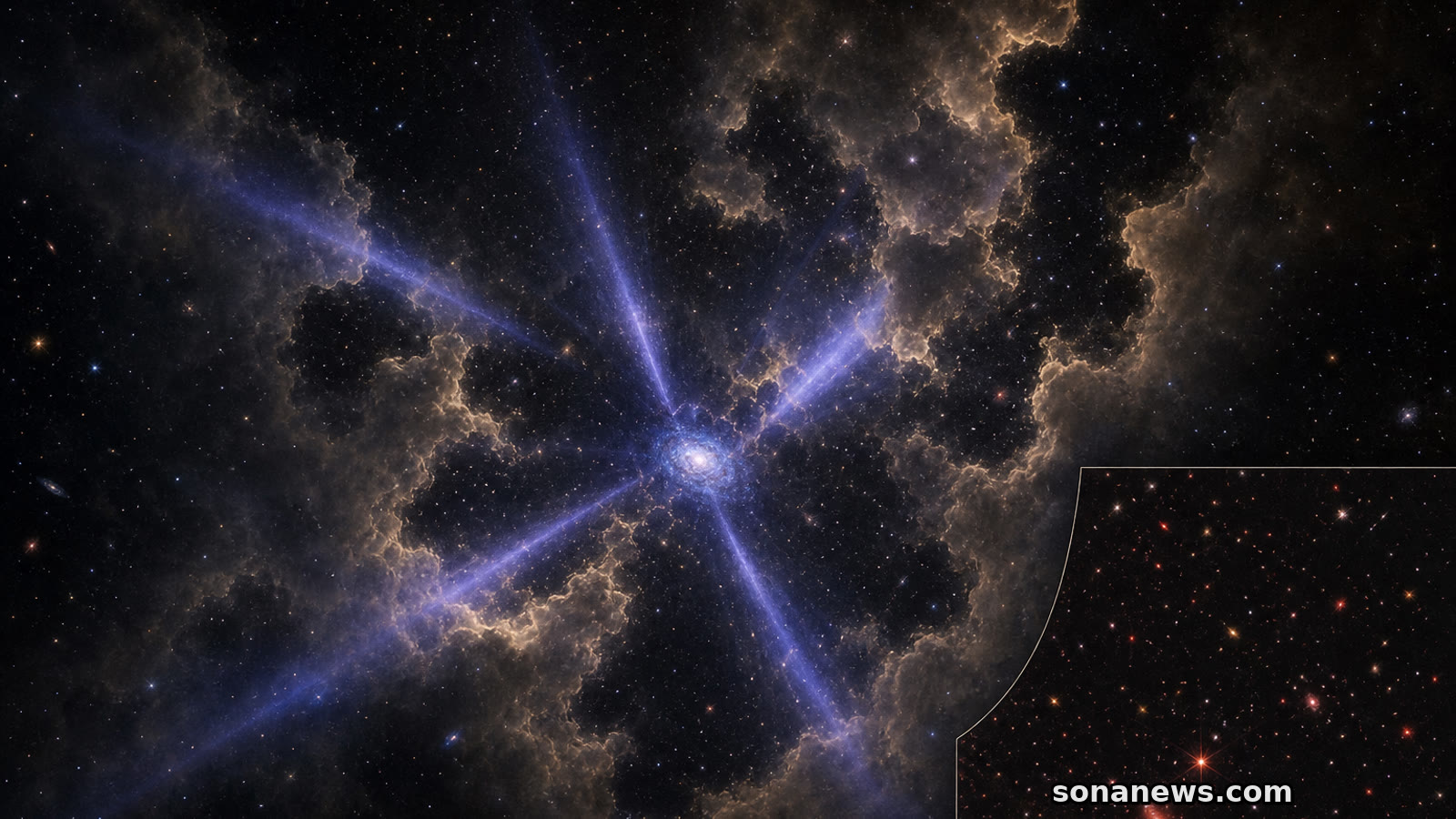

Some space stories arrive with names built for headlines. MXDFz4.4 is not one of them. It is a small, distant galaxy whose label comes from a deep observing field rather than a public relations desk. That awkward name is useful in its own way. It keeps the focus on the measurement: Hubble has detected the kind of escaping ultraviolet light that astronomers have long needed to see more clearly.
NASA said on 23 June that astronomers using the Hubble Space Telescope detected ultraviolet light from MXDFz4.4, a galaxy seen as it was about 1.4 billion years after the big bang. The result matters because the young universe was not always transparent. For a long stretch of cosmic history, neutral hydrogen gas between galaxies acted like fog, absorbing energetic ultraviolet photons. The era when that fog lifted is called reionization, and researchers still debate exactly which galaxies did most of the clearing.
The new object gives them a rare nearby-to-the-era test case. It is not a direct photograph of the first stars switching on. It is a more modest and more useful thing: a galaxy close enough in cosmic time to the end of reionization for astronomers to test whether compact, strongly star-forming systems could let ionizing light escape into the space around them.
The paper, published in The Astrophysical Journal, identifies MXDFz4.4 as a Lyman-continuum emitter at redshift 4.442. In plain language, that means the team detected very energetic ultraviolet light that is capable of ionizing hydrogen. The authors report a 5.2 sigma detection in Hubble's F435W filter and estimate that 50% to 100% of the relevant ionizing photons may be escaping after corrections for production and intergalactic absorption. Those numbers are not a verdict on the whole early universe. They are a rare measurement in a problem where direct evidence is hard to get.
The difficulty is physical, not just technical. During the main epoch of reionization, neutral hydrogen in intergalactic space would have absorbed much of the very light researchers want to measure. By the time that light reaches modern telescopes, cosmic expansion has stretched it into longer wavelengths, but the original escape route is still the key question. If galaxies trapped most of their ionizing radiation, they could not have cleared much fog. If enough radiation leaked out, small galaxies in large numbers may have changed the universe around them.
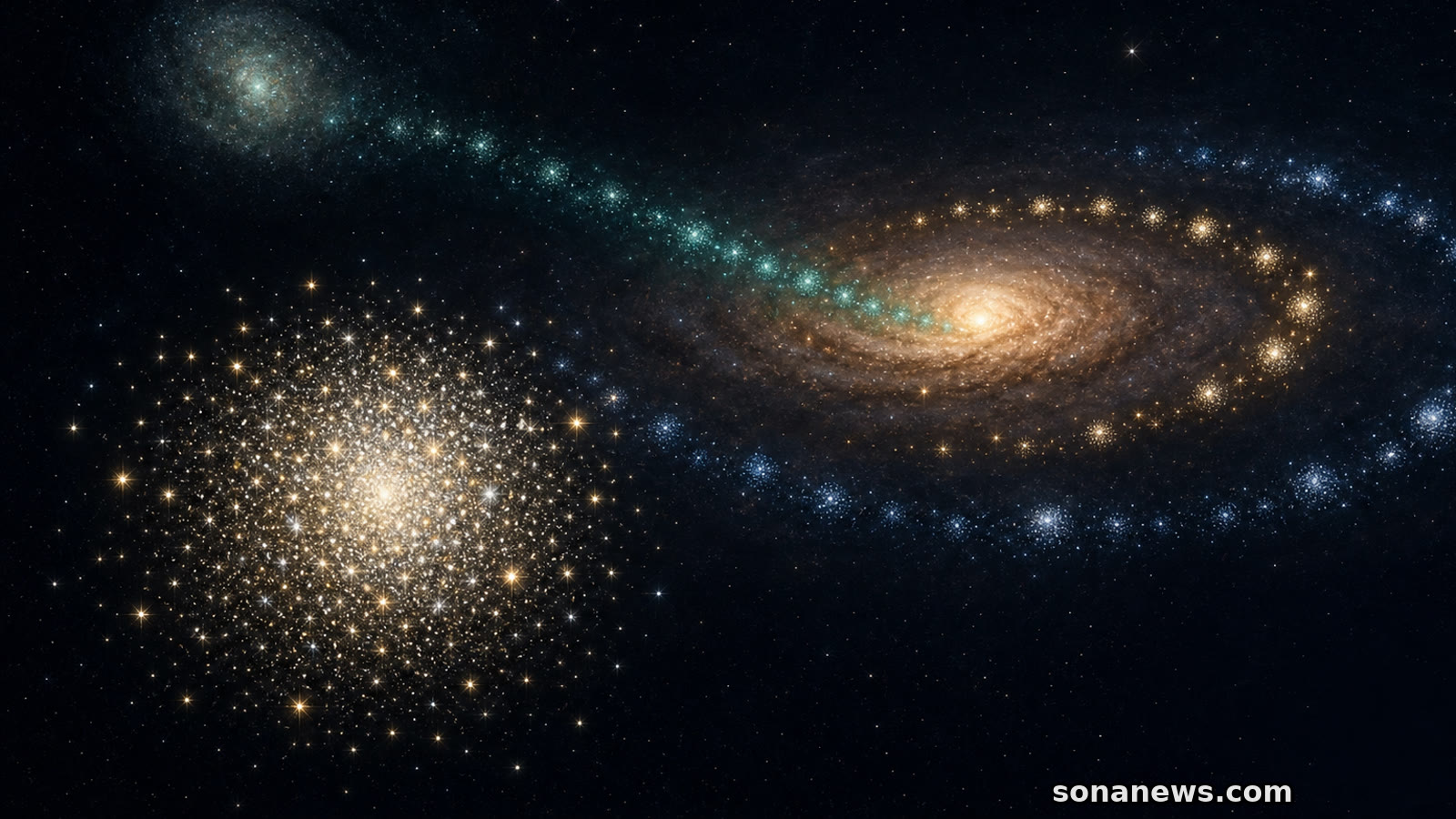
MXDFz4.4 looks like the sort of system that could leak. NASA's summary says it is about 100 times smaller by area than the Milky Way while forming stars about 10 times faster. That combination is important. Young, massive stars packed into a compact region can blast holes through surrounding gas more effectively than the same activity spread thinly across a calm disk. The point is not that one tiny galaxy cleared the cosmos. It is that galaxies with similar conditions may have been efficient contributors.
Hubble supplied the crucial ultraviolet detection, but the result is not a single-telescope story. The peer-reviewed paper uses deep MUSE spectroscopy from the Very Large Telescope and imaging from Hubble and Webb surveys, including JWST NIRCam data for modelling the galaxy's stellar population. NASA also notes that Webb helped clarify what Hubble was seeing. This is how modern astronomy increasingly works: one observatory catches the difficult signal, another constrains the stars and dust, and spectroscopy fixes the distance and context.
There is a useful public lesson in that. The spectacular image is often the easiest part of a space story to share, but this finding depends on filters, redshift, signal strength and corrections for the material between here and there. A faint smudge becomes meaningful only when researchers can say which wavelength was detected, what that wavelength meant in the galaxy's own time, and whether the signal is likely to be local contamination, noise or something genuinely escaping.
The caution should stay in the story. A high escape fraction in MXDFz4.4 does not prove that all early galaxies behaved this way. The paper itself frames the result as cautious support for using the shape of Lyman-alpha emission as a tracer of escaping ionizing light at high redshift. In other words, the discovery may help astronomers choose better candidates and test indirect methods, not close the subject.
That is still a strong result. Reionization is one of the big transitions in cosmic history: the universe went from being hard for ultraviolet light to cross to being broadly transparent. Readers do not need to memorise MXDFz4.4 to see why the measurement matters. Hubble has caught a small galaxy letting some of the right kind of light get out. If astronomers can find more like it, the fog-clearing chapter of the universe may become less of a broad outline and more of a working mechanism.
Sources
- Source: "Hubble Details Early Galaxy Transforming Neighborhood", NASA Science, Extracted 2026-06-24. Verified: 23 June 2026 publication, MXDFz4.4 identification, 1.4 billion years after the big bang, ultraviolet light detection, compact star-forming interpretation, Hubble and Webb context, and cautious reionization framing
- Source: "MXDFz4.4: A LyC Emitter 250 Myr after the Epoch of Reionization and a First Test of Lyα Morphology as a Tracer of LyC Escape at High Redshift", The Astrophysical Journal via DOI, Extracted 2026-06-24. Verified: redshift 4.442, Lyman-continuum emitter classification, 5.2 sigma F435W detection, 50% to 100% escape-fraction estimate, MUSE/HST/JWST data use, and cautious support for Lyα morphology as a tracer
- Source: "Hubble Space Telescope", NASA Science, Extracted 2026-06-24. Verified: Hubble active mission status, 1990 launch, ultraviolet and visible-light observatory context, and listing of the MXDFz4.4 news release in current Hubble coverage
- Source: "James Webb Space Telescope", NASA Science, Extracted 2026-06-24. Verified: Webb active mission status, NASA/ESA/CSA partnership, L2 context, early-universe science role, and NASA's statement that Webb extends Hubble discoveries
Help us improve
Was this article useful?
One anonymous tap helps Sona improve future reporting, headlines and source context.
Up next
Hubble data trace a 10-sided atmospheric wave from faint 2023 hints to a clearer 2025 pattern. Its slow drift and 32-day wobble do not yet explain why it formed.
Continue readingMore in Space