The Jellyfish Nebula may have a stellar sibling
Sixteen years of Fermi data have pulled a faint neighbour out of the glare, turning a pretty nebula into a careful test of how massive stars die in pairs.
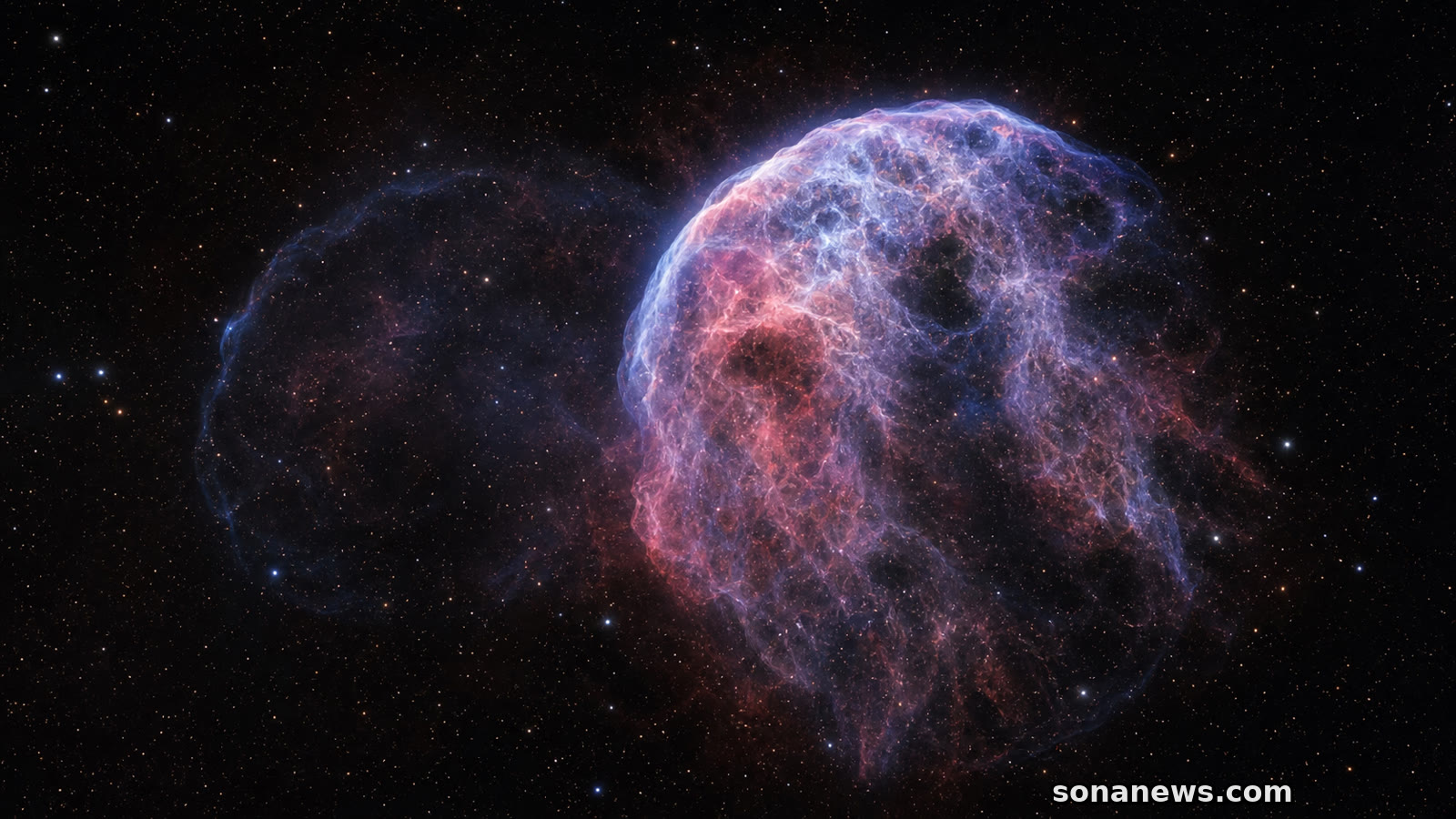

The Jellyfish Nebula is already one of those space objects that can do a lot of work with a photograph. Its filaments are beautiful, its nickname is memorable, and it is bright enough in gamma rays to be scientifically useful. The more interesting news this week is quieter: a faint neighbour may have been hiding in its glare, and together the pair could preserve the aftermath of two massive stars that once orbited each other.
NASA said a new study using the Fermi Gamma-ray Space Telescope points to a possible relationship between IC 443, the Jellyfish Nebula, and a much fainter supernova remnant called G189.6+3.3. Both lie in the direction of Gemini, about 6,000 light-years from Earth. The claim is not that astronomers have watched two stars explode. It is that their remains, mapped long after the fact, may still carry the geometry of a former binary system.
That distinction matters. Supernova remnants are forensic scenes. Astronomers look at expanding gas, shock fronts, X-rays, radio emission and gamma rays, then work backwards toward the explosion that made them. In this case, the Jellyfish Nebula is the obvious object. G189.6+3.3 is harder: discovered in the 1990s by the ROSAT X-ray mission, it is mainly visible in X-rays and sits close enough to IC 443 that the brighter remnant can dominate the view.
Fermi’s contribution is patience as much as power. Researchers used 16 years of observations from the telescope’s Large Area Telescope to find gamma-ray emission associated with the northern part of G189.6+3.3. NASA and Stanford describe that emission as linked to accelerated protons, the kind of particle signature expected when a supernova remnant shock wave runs into interstellar gas. If both remnants are interacting with the same gas structure, they are likely at a shared distance rather than merely lined up by chance.
The proposed story is simple in outline and messy in evidence, which is usually how astronomy works. Two massive stars, perhaps each at least 20 times the Sun’s mass, began as a binary pair. The more massive star exploded first, disrupting the system and sending its companion away. The surviving star travelled for tens of thousands of years before it too exploded. Today, the centres of the two remnants appear about 40 light-years apart in projection on the sky, and their expanding shells partly overlap.
The timing is broad, not tidy. NASA gives an estimated age of about 8,000 to 9,000 years for the Jellyfish Nebula, while G189.6+3.3 may be 20,000 to 110,000 years old. That leaves room for a delay of up to about 100,000 years between the two explosions. Stanford’s summary says the team also used computer simulations of one million massive binary systems to test whether such a sequence was plausible.
None of this turns the Jellyfish into a settled family portrait. NASA’s wording is careful: possible sibling remnants, likely related, a compelling picture. That is the right level of confidence. The evidence includes overlapping remnants, a connecting gas filament, shared distance indicators, multiwavelength observations and simulations. It also depends on reconstructing events that happened thousands of years ago, from objects spread across dozens of light-years.
The larger reason to care is cosmic rays. Supernova remnants are among the places where particles are accelerated to extreme energies. When fast protons hit interstellar gas, they can produce neutral pions that rapidly decay into gamma rays. Fermi is useful because gamma rays can reveal those particle interactions directly, especially in regions where visible light tells only part of the story.
There are about 300 catalogued supernova remnants in the Milky Way, according to the NASA account. If IC 443 and G189.6+3.3 are confirmed as the separate remains of two former binary companions, the pair would offer a rare way to connect stellar partnership, sequential supernova explosions and cosmic-ray acceleration in one patch of sky. It is an unusually human-sounding phrase, sibling supernovas, but the science is less sentimental: long-lived data sets can make faint structures visible enough to test an old relationship.
That may be the real lesson in the Jellyfish’s neighbour. Space discoveries are often sold as sudden reveals. This one is built from accumulation: 16 years of gamma-ray observations, older X-ray surveys, radio and optical context, gas clouds, shock physics and simulations. The spectacle was already there. The new work asks whether the spectacle has a family history. It rewards slow measurement over another pretty picture.
Sources
- Source: “NASA’s Fermi Mission Uncovers Possible Sibling Supernova Remnants”, NASA Science, Extracted 2026-06-19. Verified: 17 June 2026 publication, 16 years of Fermi data, IC 443 and G189.6+3.3 identification, approximate 6,000 light-year distance, 40 light-year projected separation, age estimates, possible binary-origin interpretation and cosmic-ray explanation
- Source: “NASA’s Fermi Mission Reveals Related Supernova Remnants”, NASA Scientific Visualization Studio, Extracted 2026-06-19. Verified: visualisation release date, IC 443 and G189.6+3.3 context, gamma-ray emission associated with accelerated protons, shared gas-cloud interaction, projected separation and cautious sequence of two former companion stars exploding
- Source: “Researchers uncover evidence for sibling supernovas”, Stanford School of Humanities and Sciences, Extracted 2026-06-19. Verified: Stanford and SLAC role in Fermi LAT, AAS presentation date, future Nature Communications paper status, ROSAT discovery context, one-million-binary-system simulation claim and proposed 20,000 to 100,000 year travel interval
Help us improve
Was this article useful?
One anonymous tap helps Sona improve future reporting, headlines and source context.
Up next
Hubble data trace a 10-sided atmospheric wave from faint 2023 hints to a clearer 2025 pattern. Its slow drift and 32-day wobble do not yet explain why it formed.
Continue readingMore in Space