Webb’s little red dots are becoming a black hole test
A deep spectrum of GLIMPSE-17775 points to dense gas around a fast-feeding black hole, a calmer explanation for one of JWST’s odd early-universe puzzles.

The most useful space stories often begin by making a dramatic phrase smaller. “Black hole star” sounds like a comic-book object. In the new Webb result, it is better read as a careful label for a dense, strange environment around a black hole, not as a new kind of ordinary star.
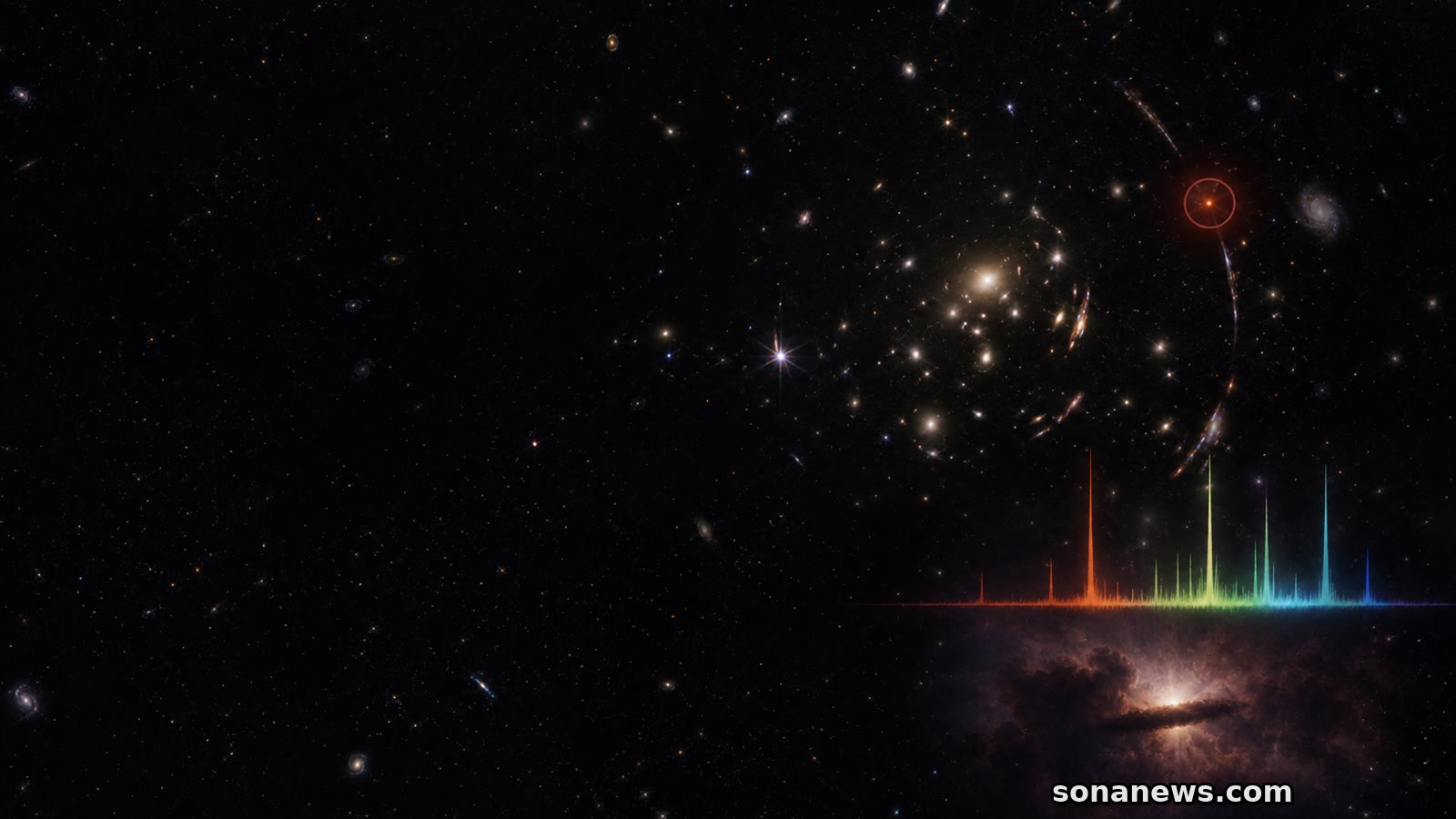
The object in question is GLIMPSE-17775, one of the “little red dots” that the NASA/ESA/CSA James Webb Space Telescope has made hard to ignore. These compact, red sources became one of JWST’s early puzzles after science operations began in 2022. Some looked bright enough, and old enough, to raise awkward questions about whether galaxies in the young Universe had grown too large too fast. That made them tempting material for cosmology panic. The calmer answer may be that at least some are not overgrown galaxies in the usual sense. They may be black holes wrapped in dense gas.
ESA/Webb’s 10 June science release describes the GLIMPSE-17775 spectrum as the strongest evidence yet for that picture. The source sits behind the galaxy cluster Abell S1063, where gravitational lensing acts as a natural magnifying glass. Webb’s deep infrared observations, using NIRCam imaging and NIRSpec spectroscopy, let researchers pull apart its light in unusual detail. The peer-reviewed paper reports a redshift of 3.501, meaning the object is seen as it was when the Universe was roughly 1.8 billion years old.
That is young in cosmic terms, but the important point is not only age. It is detail. The study reports more than 40 emission and absorption features in the spectrum, including hydrogen, helium, oxygen and iron signatures. Those lines are not just decoration. Their shapes carry information about the gas around the source, including whether light is being scattered and reprocessed before it escapes.
The team’s interpretation is that GLIMPSE-17775 contains an actively feeding black hole inside a dense, partially ionised gas cocoon. In that picture, radiation from near the black hole does not fly straight out into space. It passes through thick gas, where electron scattering, fluorescence and absorption reshape the spectrum before Webb sees it. The result can mimic some galaxy-like features while still pointing to an accreting black hole at the centre.
This is where the phrase “black hole star” needs caution. The term is being used as shorthand for a black-hole-powered system surrounded by a dense envelope, sometimes written as BH*. It does not mean astronomers have found a black hole behaving like the Sun, nor does it mean the object is settled science in every detail. The better public translation is less flashy: Webb has found a little red dot whose spectrum fits a dense black-hole cocoon unusually well.
That matters because little red dots have been doing two things at once. They have excited astronomers, and they have muddied simple public explanations of the early Universe. If their light is mostly starlight, then some young galaxies may be extraordinarily massive. If much of their light is reprocessed black-hole radiation, the mass problem changes. The new result does not close the whole case, but it gives researchers a concrete spectrum to test against, rather than a red smudge and a speculative headline.
The numbers help keep the story grounded. The Astrophysical Journal paper estimates a black hole mass of about 10^6.65 solar masses, or a few million times the mass of the Sun, once the line-broadening model is treated carefully. It also points to rapid accretion and very dense gas, with conditions far beyond anything that can be pictured as a normal cloud. These are not domestic scales. They are astrophysical diagnostics, useful because they let scientists compare competing models line by line.
There is also a useful reminder here about why Webb was built. NASA describes Webb as an active astrophysics mission run with ESA and CSA, placed at the Sun-Earth L2 region to make cold, stable infrared observations. That matters for early-universe work because ancient light has been stretched by cosmic expansion into infrared wavelengths. Without that sensitivity, many little red dots would remain faint curiosities rather than testable objects.
The next step is not to declare the puzzle solved. It is to repeat the trick. One object with an exceptional spectrum can anchor a model, but a population needs more spectra, more lensing fields and more checks against X-ray and radio data. Scientists will want to know whether GLIMPSE-17775 is typical, a special case, or one member of a mixed family where some little red dots are black-hole cocoons and others are compact galaxies with different dust and star histories.
That is a better kind of mystery than the inflated version. Webb has not broken cosmology, and GLIMPSE-17775 is not a sci-fi star. It is a small red point whose light has been stretched, magnified, split into lines and argued over with care. For a telescope designed to make the early Universe measurable, that is exactly the sort of progress that counts.
Sources
- Source: “Webb finds strongest evidence yet for black hole stars”, ESA/Webb, Extracted 2026-06-15. Verified: 10 June 2026 release date, little red dot context, GLIMPSE-17775, Abell S1063 lensing, dense gas cocoon interpretation, more than 40 spectral lines and the cautious black-hole-star framing
- Source: “The Deepest GLIMPSE of a Dense Gas Cocoon Enshrouding a Little Red Dot”, The Astrophysical Journal, DOI: Extracted 2026-06-15. Verified: paper title, publication date, JWST/NIRCam and NIRSpec data, redshift 3.501, more than 40 spectral features, dense partially ionised cocoon, black hole mass estimate and rapid-accretion interpretation
- Source: “James Webb Space Telescope”, NASA Science, Extracted 2026-06-15. Verified: Webb as an active NASA/ESA/CSA astrophysics mission, L2 location, infrared early-universe role and the mission context for the GLIMPSE-17775 feature
- Source: “Webb reveals black hole that formed before its galaxy”, ESA/Webb, Extracted 2026-06-15. Verified: wider little-red-dot context, Abell2744-QSO1 as a related early black-hole case and the broader question of rapid black hole growth in the young Universe
Help us improve
Was this article useful?
One anonymous tap helps Sona improve future reporting, headlines and source context.
Up next
Hubble data trace a 10-sided atmospheric wave from faint 2023 hints to a clearer 2025 pattern. Its slow drift and 32-day wobble do not yet explain why it formed.
Continue readingMore in Space