HbA1c is not today's blood sugar reading
The blood test reflects average glucose over roughly three months, not the level at the moment of a finger-prick check. That difference explains both its value and its limits.
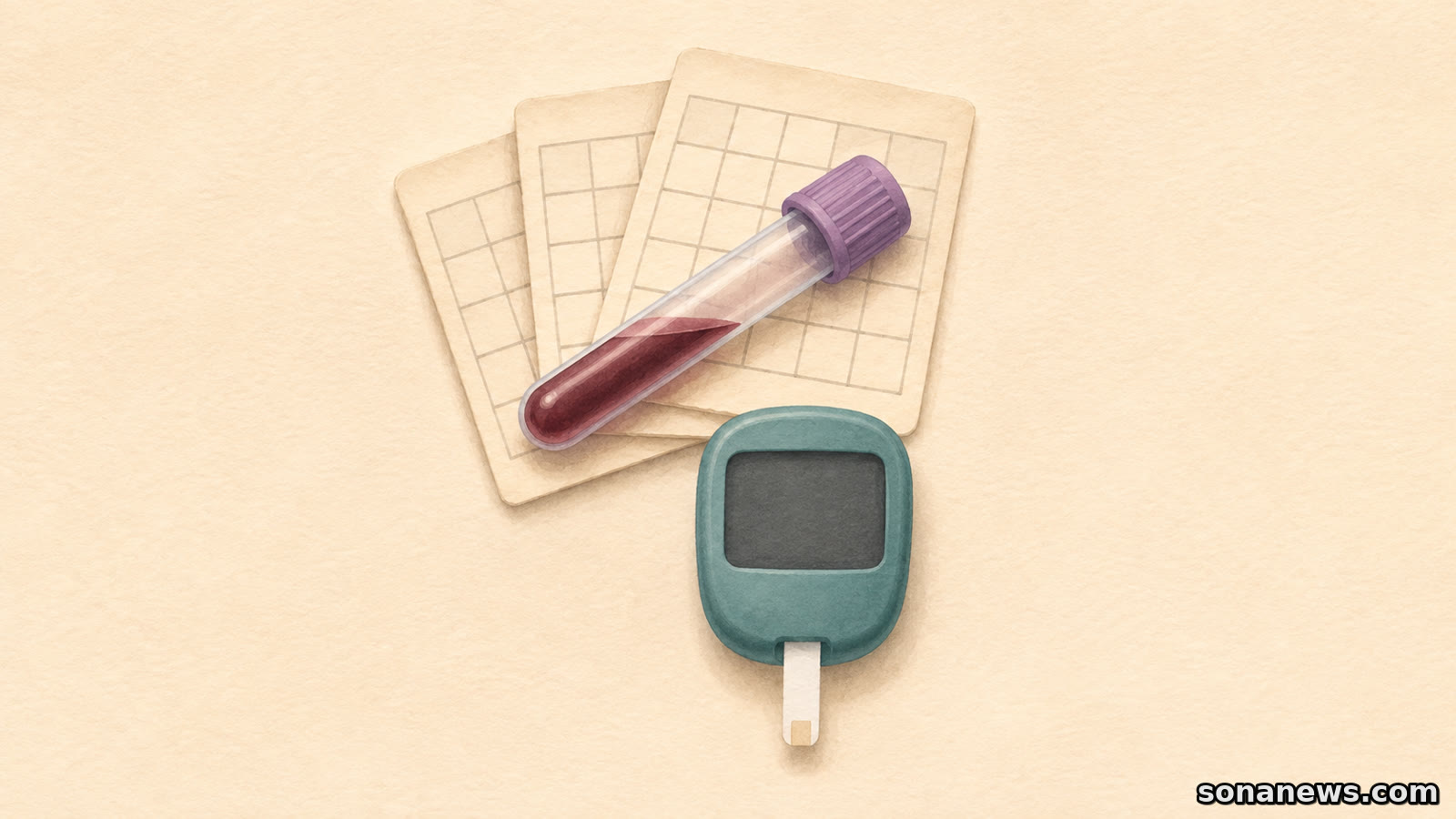

A finger-prick glucose reading and an HbA1c result can arrive on the same day without describing the same period. The meter reading is a snapshot. HbA1c, also called A1C, reflects average blood glucose over roughly the previous three months. Comparing them as though they were two checks of today's level misses what the laboratory test measures.
The distinction matters because a longer view is not a more detailed view of every hour. HbA1c helps clinicians assess patterns over time, but it does not show each rise after a meal or every brief low. The US Centers for Disease Control and Prevention explicitly says it does not replace home glucose monitoring.
This is an explanation of an established test, not a new screening recommendation or a guide to diagnosing diabetes from a number. The underlying measurement is relevant internationally; local testing pathways, laboratory reporting and individual care plans differ.
What the sample carries from earlier weeks
Haemoglobin is the oxygen-carrying protein in red blood cells. Glucose attaches to it. According to the US National Institute of Diabetes and Digestive and Kidney Diseases, the HbA1c test measures haemoglobin with glucose attached, which provides information about average glucose over the preceding months.
That makes it different from measuring the glucose concentration in a sample at one moment. The blood is collected today, but the HbA1c result reflects a longer period. A laboratory sample does not need to have been collected repeatedly over those months to provide that information.
“Three months” is a useful summary, not an evenly weighted diary. NIDDK says glucose levels during the most recent 30 days have a greater effect on the result than those in earlier months. Large changes during the past month can therefore affect HbA1c, even though a sudden, temporary rise or fall is not shown as a separate event.
Why the meter and the average can differ
Blood glucose changes through the day. Eating, exercise, illness and stress can affect a glucose measurement, NIDDK explains. A finger-prick meter is intended to capture a level at that time; HbA1c answers a different question about the longer-term pattern.
An average also leaves out information about variation. The CDC notes that HbA1c may not account for spikes or lows. It cannot reconstruct the time of a particular episode or establish that glucose stayed steady throughout the period. A result that looks reassuring on its own is not proof that no short-lived problem occurred.
Some laboratory reports also include estimated average glucose, or eAG. This is calculated from HbA1c rather than measured as another same-day glucose sample. NIDDK explains that converting the result into glucose units can help relate it to meter readings, but it remains a long-term estimate. It is not expected to match each reading on a home meter.
The useful comparison is therefore between the questions the tests answer, not simply between numbers printed beside them. Neither result, read alone, supplies the full explanation for an unexpected difference.
No fasting for HbA1c is not a rule for every appointment
HbA1c itself does not require fasting. NIDDK says the sample can be taken at any time of day. That is a property of this test, not a general rule covering everything that might be ordered with it.
The CDC adds an important qualification: other tests taken at the same appointment may require fasting. An appointment described informally as a “diabetes blood test” may therefore involve more than one measurement. The instructions supplied by the clinical service apply to the actual tests ordered, not just the best-known name on the request.
This also helps separate convenience from meaning. Having a test that does not require fasting does not turn it into a real-time check of the last meal. Nor does it mean that all other glucose tests work in the same way.
Red blood cells can change the interpretation
Because HbA1c depends on haemoglobin and red blood cells, factors affecting them can alter the result. NIDDK identifies recent blood loss, transfusion and conditions that change red blood cell lifespan among the reasons a reading may be misleading. Very low iron can produce a falsely high result.
Certain haemoglobin variants can interfere with some testing methods. NIDDK stresses that not every HbA1c method is unreliable for someone with a variant. The issue depends on the test as well as the person's circumstances, rather than a blanket assumption that all such results are unusable.
MedlinePlus, the US National Library of Medicine's health information service, also identifies kidney failure, liver disease and some blood disorders as factors that can affect interpretation. These are limits to discuss in clinical assessment, not a checklist for deciding at home that an unwanted result must be wrong.
An HbA1c result and another glucose test can genuinely disagree. NIDDK explains that clinicians may repeat testing to clarify a diagnosis. Choosing whichever number feels preferable does not resolve the difference.
The test's purpose still matters
HbA1c is used in assessing type 2 diabetes and prediabetes, and in monitoring diabetes after diagnosis. Screening, confirming a diagnosis and reviewing ongoing management are different tasks. A number used in one context is not automatically a personal treatment target in another.
For a person without symptoms whose result suggests diabetes or prediabetes, NIDDK describes confirmation with a repeat HbA1c or another diabetes test on a different day. It also notes that treatment targets depend on health and diabetes history. This article does not set a target, a testing interval or a medication change.
The central point is narrower, and more useful: today's HbA1c sample looks backwards. It provides a longer-term estimate, while a meter reading describes a moment. Understanding that difference helps explain why both can be informative without making either one a complete account of someone's health.
Editorial note. This article provides general health information, not medical advice, diagnosis or treatment. It cannot interpret personal symptoms or test results. Discuss your own results, test preparation and care with a qualified healthcare professional. Do not change medication, stop prescribed monitoring or delay medical assessment because of this article.
Sources
Help us improve
Was this article useful?
One anonymous tap helps Sona improve future reporting, headlines and source context.
Up next

In England, cervical screening looks first for high-risk HPV, then checks for cell changes if the virus is found. Those are different findings, with different follow-up steps.
Continue readingMore in Health