Home sleep apnoea tests: breathing data is not a sleep-stage report
A common home test records airflow, breathing effort and oxygen levels. It answers a different question from the more detailed study that also measures brain activity.
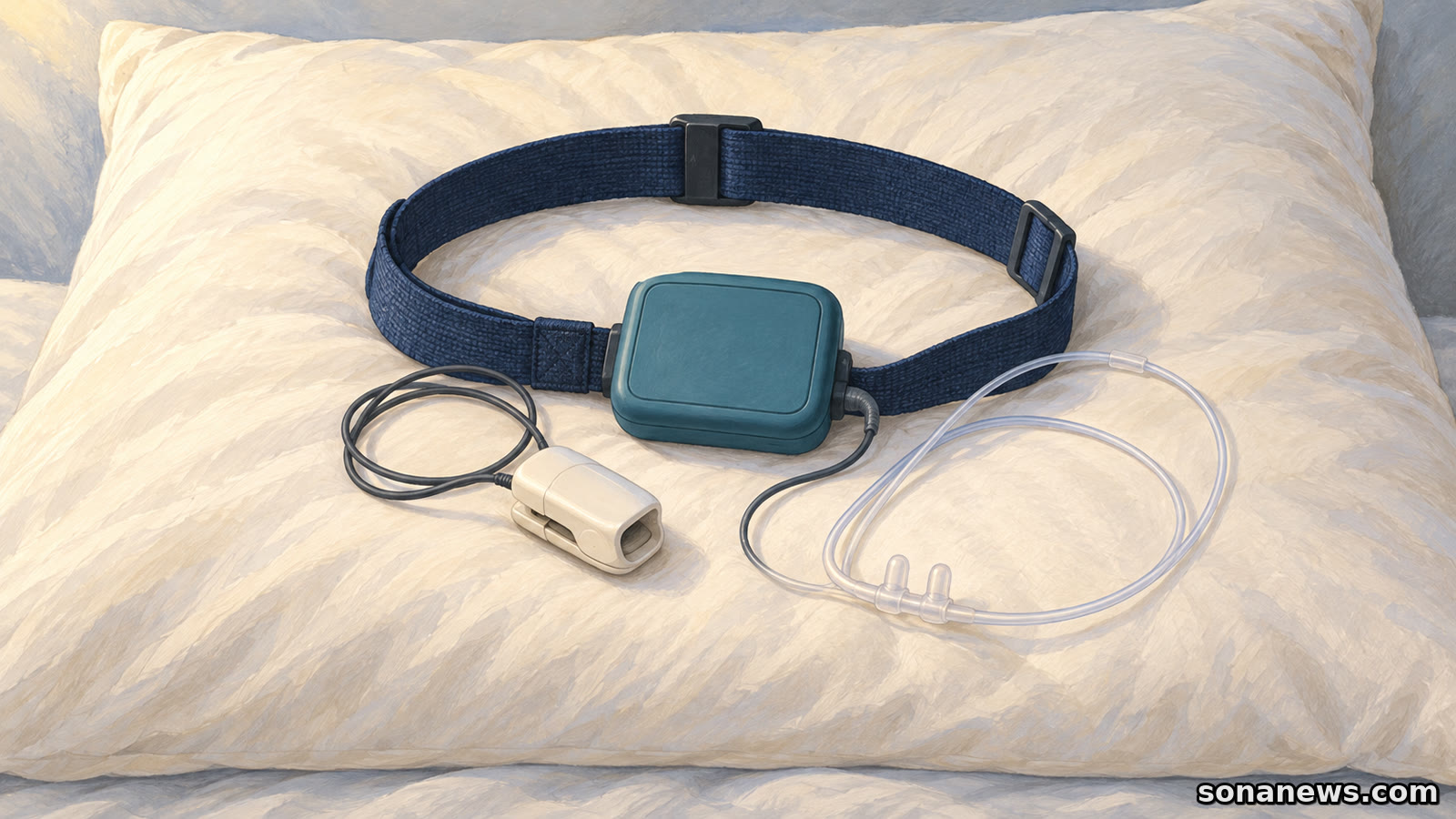

A small recorder, straps, a finger sensor and thin tubing for the nose can look like an elaborate way to find out whether someone slept well. But a common home sleep apnoea test has a narrower job: recording what happens to breathing overnight. It is not necessarily measuring the stages of sleep at all.
That distinction matters when a clinic offers a home test or discusses its results. Respiratory polygraphy, the name used for this type of study, collects several breathing-related signals. A more detailed test called polysomnography adds measurements including brain activity. Both are sleep investigations, but they do not produce the same information.
This is an explanation of established testing methods, not a new diagnostic breakthrough or a guide to choosing a test without a clinician. The examples below draw on England's NICE guidance and NHS patient information, with background from the US National Heart, Lung, and Blood Institute. Equipment and local pathways vary.
A patient leaflet from United Lincolnshire Teaching Hospitals NHS Trust describes a home respiratory polygraphy kit built around a recording device. Straps around the chest and abdomen measure breathing effort. A nasal flow sensor monitors airflow, while a finger probe measures oxygen levels and heart rate.
Each part contributes something different. The finger sensor is not doing the same job as the straps, and neither substitutes for the airflow sensor. Together, the signals help the clinical team assess breathing during sleep rather than relying on a single measurement or a description of snoring.
The equipment is collecting information, not delivering treatment. The nasal tubing in this kind of study is a sensor, not proof that the person is receiving oxygen. Nor does being given a kit mean that sleep apnoea has already been diagnosed. The Lincolnshire leaflet describes testing requested by a consultant to investigate symptoms that may have several explanations.
Its instructions also make the service's role clear: staff show patients how to connect the equipment. A picture of a kit, including the illustration above, cannot replace that demonstration or the instructions supplied with a particular device.
NICE distinguishes three forms of investigation. Oximetry records oxygen saturation and heart rate. Respiratory polygraphy records several channels, which can include breathing-related events, snoring and body position as well as oxygen measurements. Polysomnography adds signals from brain activity, eye movements and muscle tone to assess sleep quality and duration.
Those extra measurements explain why a breathing study should not automatically be expected to provide a breakdown of light, deep and other sleep stages. The question is not simply whether a test happened overnight. It is which signals the equipment was designed to collect.
The US National Heart, Lung, and Blood Institute describes sleep-centre testing with sensors on sites including the scalp, face, chest, limbs and a finger. These can record brain waves, breathing, oxygen levels and movements. It also describes other investigations used for different sleep-related questions, such as daytime tests of sleepiness.
There is therefore no single universal product called a sleep test. The setting alone is not a complete description either. The institute says clinicians determine whether a person needs testing at a sleep centre or can use a portable device at home. The useful distinction is the investigation's purpose and measurements, not simply the address where it happens.
It would be a mistake to conclude that a home breathing study is inadequate because it does not collect every possible signal. In its guidance for people over 16, NICE recommends home respiratory polygraphy for suspected obstructive sleep apnoea/hypopnoea syndrome. The narrower test has an established place in the diagnostic pathway.
Obstructive sleep apnoea involves narrowing or closure of the upper airway during sleep, reducing or interrupting breathing. Recording breathing is therefore central to the question being investigated. More sensors are not automatically necessary for every person, while fewer sensors do not make every investigation interchangeable.
For example, an oxygen-only recording is not the same as respiratory polygraphy. NICE notes that oximetry alone may be inaccurate in distinguishing obstructive sleep apnoea from other causes of low blood oxygen in people with heart failure or chronic lung disease. That is a limitation for clinicians to consider, not a basis for readers to interpret their own oxygen numbers.
NICE also describes what can happen when the first result does not explain the symptoms. It says clinicians should consider polysomnography if respiratory polygraphy is negative but symptoms continue. After negative oximetry with significant symptoms, it advises considering respiratory polygraphy or polysomnography.
These are clinical recommendations, not an instruction for everyone with a negative home test to arrange another test. Their importance is that the result is considered alongside the person's continuing symptoms and the type of recording obtained. A negative result from one investigation does not answer every possible sleep question.
The Lincolnshire service explains that recordings are downloaded after the equipment is returned, a report is sent to the referring consultant, and information about any further investigation or treatment follows. Returning the recorder is not the same as receiving an instant, self-explanatory verdict.
For someone discussing a test with their care team, the useful questions are straightforward: what is this study measuring, what will its report cover, and how will the result be reviewed? A home kit can provide important evidence about breathing. Understanding its scope helps avoid expecting either a complete map of sleep or a diagnosis from the equipment alone.
Editorial note. This article provides general health information, not medical advice, a diagnosis or treatment. It cannot select a sleep test or interpret an individual's symptoms or results. Follow the instructions from your own clinical service and discuss medical concerns with a qualified healthcare professional. Do not delay medical care because of this article or a home-test result.
Sources
Help us improve
Was this article useful?
One anonymous tap helps Sona improve future reporting, headlines and source context.
Up next
The blood test reflects average glucose over roughly three months, not the level at the moment of a finger-prick check. That difference explains both its value and its limits.
Continue readingMore in Health