Liquid medicine: a kitchen teaspoon is not a dose measure
The spoon in the cutlery drawer is not the same as a medicine spoon. Official guidance explains why the measuring device, its units and the bottle's strength belong together.
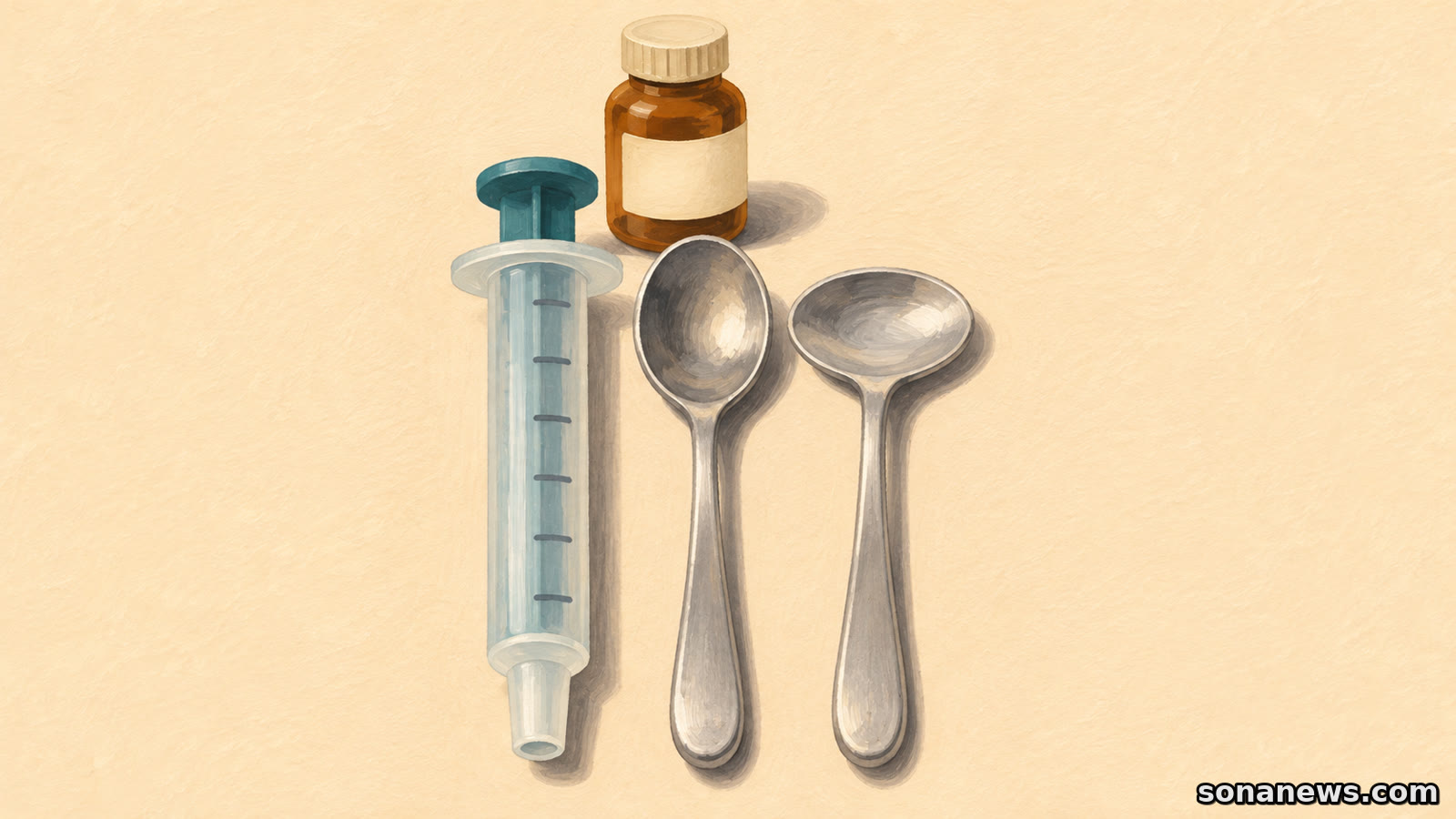

A kitchen teaspoon and a medicine spoon share a name, but not a measuring job. The first is cutlery. The second is made to measure a stated volume. That distinction can disappear in everyday conversation about liquid medicine, where “a spoonful” sounds more precise than it is.
The US National Library of Medicine's MedlinePlus service warns that spoons used for eating are not all the same size. Great Ormond Street Hospital in London gives the same central warning: a household spoon does not provide an accurate medicine dose. These are established instructions, not a newly discovered risk or a new rule taking effect this month.
The useful question is therefore not whether a spoon looks small enough. It is whether the measuring device belongs with the medicine's instructions, and whether its markings mean what the label means. Guidance from US and UK sources agrees on that principle, although particular products, devices and prescribing instructions differ.
The word “teaspoon” hides two different things
A teaspoon can mean an everyday object or a defined unit of volume. A cutlery drawer contains the former. Calling every small spoon a teaspoon does not establish how much liquid each one holds.
MedlinePlus distinguishes ordinary eating spoons from measuring spoons used in cooking. It describes cooking measures as accurate, but notes that they spill easily. That is not an endorsement of treating any kitchen utensil as the right device for a particular medicine.
A medicine spoon supplied with a product is different again. Great Ormond Street Hospital tells families to use the medicine cup or spoon enclosed with the bottle rather than a household spoon. The distinction is about measurement and the product's instructions, not whether the utensil is metal or plastic, expensive or cheap.
This also explains why a familiar-looking spoon is a poor reference for a replacement. Its appearance cannot establish a calibrated volume. Nor can the phrase “the usual spoon” tell a pharmacist which quantity someone has actually been measuring.
A measuring device still needs the right units
An oral syringe is a measuring device for liquid medicine, not an injection syringe. MedlinePlus describes oral syringes as accurate and easy to use. Its guidance also warns that errors have occurred with dosing cups. Replacing cutlery with a marked device removes one problem, but does not settle every question.
The unit printed on the device matters. MedlinePlus says the units on the cup or syringe should match the units of the intended dose. Great Ormond Street Hospital adds a less obvious qualification: some syringes are marked in millilitres and some in milligrams. A number without its unit is incomplete information.
Millilitres describe volume. Milligrams describe an amount by mass, such as the quantity of an active ingredient. They are not interchangeable labels for the same reading. A device marked for a particular medicine cannot be interpreted safely just by remembering where the plunger sat when another medicine was used.
This article supplies no conversion table or dose calculation. The point is to explain why an apparently simple measurement can depend on the actual bottle, label and device. A pharmacist can clarify those specific instructions; a generic illustration cannot.
The same volume can contain a different amount of medicine
Measurement is only one part of the issue. Strength describes how much medicine is contained in a given volume. Medicines for Children, a UK specialist medicines-information service, specifically warns that a new prescription of liquid medicine may differ in strength or in the amount to give from the previous batch.
Great Ormond Street Hospital likewise notes that some medicines are available in different strengths. An unchanged volume is therefore not, by itself, proof of an unchanged amount of active ingredient. Remembering a fill line from an earlier bottle leaves out a piece of information that can matter.
That is a reason to keep the explanation tied to the current medicine, rather than to publish a universal chart telling readers which volume is right. No single syringe position or spoon size can determine the appropriate dose for an unidentified product or person.
It also separates a packaging change from a treatment decision. This article cannot establish why a particular bottle or prescription has changed, whether two products are equivalent, or whether a prescribed amount should be altered.
The scale is part of the device, not decoration
A syringe or cup is useful because its markings can be read and related to the instructions. Great Ormond Street Hospital warns that some cleaning fluids can remove syringe markings. A device that remains physically intact may no longer provide a usable scale.
The hospital's guidance includes cleaning instructions, but those are not a universal recipe for every product. It repeatedly qualifies care instructions with the label's directions. The broader lesson is that a measuring device has its own instructions as well as a shape and a capacity.
What this distinction does, and does not, establish
The sources concern medicine measurement, with much of the patient guidance written for parents and carers. They do not establish that one device is best for every medicine, person or volume. Nor do they make a correctly measured volume proof that the medicine or dose is appropriate.
For questions about an actual prescription, the useful reference is the current label and the supplied device, not an estimate based on cutlery. Unclear units, a missing measure or a changed strength are matters for the dispensing pharmacist or another qualified healthcare professional.
The central distinction remains modest: a household teaspoon is an object, not a reliable medicine measure. The right measurement depends on the device, the units and the medicine's instructions together. Understanding that difference does not require calculating or changing a dose.
Editorial note. This article provides general health information, not medical advice, diagnosis or treatment. It does not establish a dose or explain how to administer a particular medicine. Ask a qualified healthcare professional about your own medicine, its strength and the correct measuring device. Do not change prescribed treatment or delay medical care because of this article.
Sources
Help us improve
Was this article useful?
One anonymous tap helps Sona improve future reporting, headlines and source context.
Up next
In England, cervical screening looks first for high-risk HPV, then checks for cell changes if the virus is found. Those are different findings, with different follow-up steps.
Continue readingMore in Health