Why some radio telescope dishes have holes
A metal mesh can be see-through to your eyes and still reflect radio waves. The wavelength, not a mirror-like shine, determines what the telescope needs.
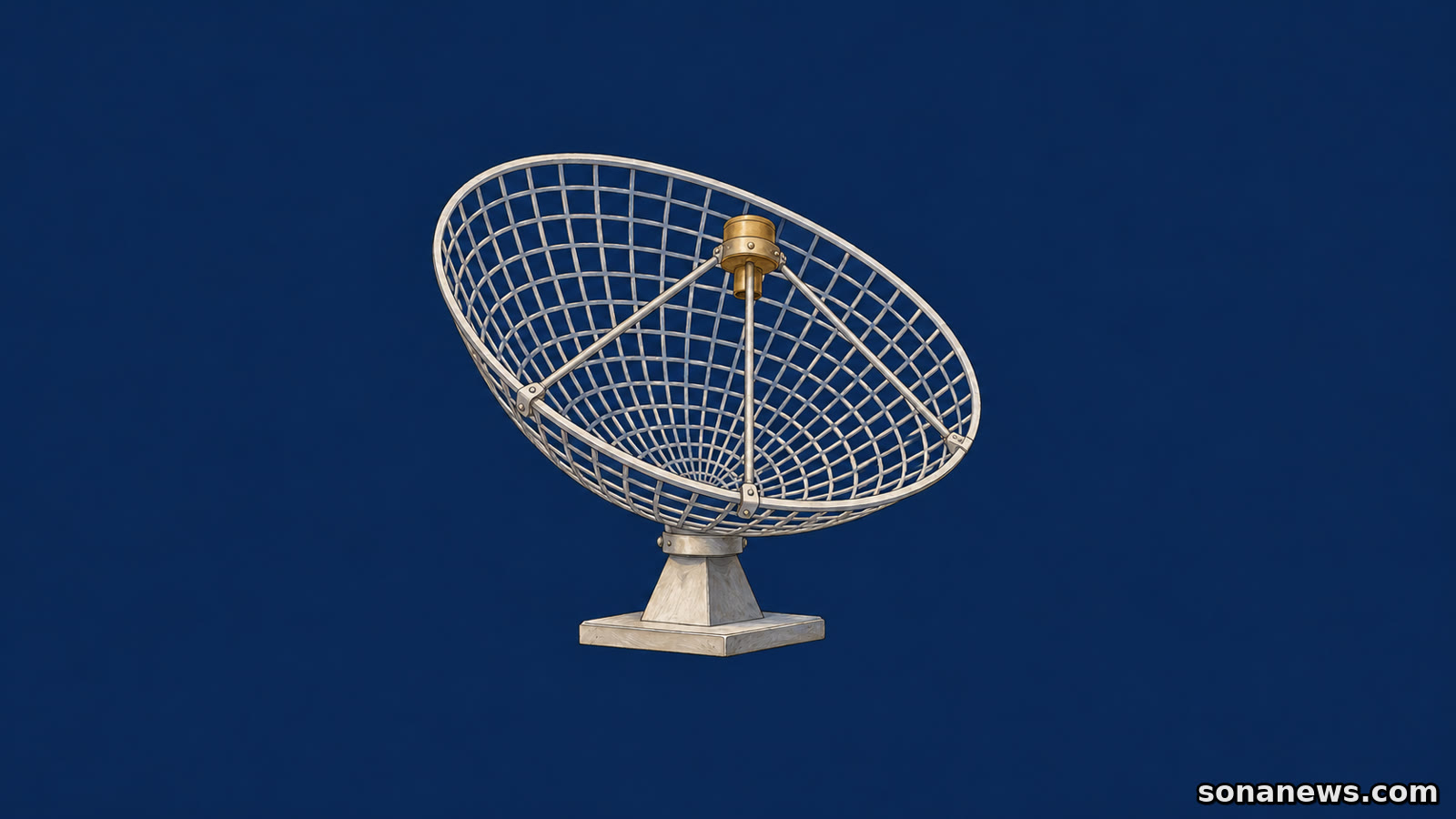

Look through the surface of a mesh radio telescope and you may see the sky. That seems an odd property for an instrument whose job is to collect faint light from space. An optical telescope with comparable gaps in its mirror would lose much of the light it was meant to gather.
But a radio telescope is working with a different part of the electromagnetic spectrum. A metal grid that lets visible light through can still act as a reflector for much longer radio waves. The apparent holes are not necessarily a fault or an unfinished stage of construction. They can be part of the design.
This is established telescope engineering, not a new discovery. It explains why astronomical instruments can look so different while sharing the same basic task: collect radiation, direct it to a detector and turn the measurement into useful information. A polished appearance is not a universal measure of how well a telescope works.
The important size is the wavelength
Visible light and radio waves are both electromagnetic radiation. Their wavelengths differ enormously. The US National Radio Astronomy Observatory describes radio observations spanning wavelengths from about a millimetre to more than ten metres, compared with the few hundred nanometres of visible light.
That difference changes what counts as a suitable reflecting surface. Nick Strobel's Astronomy Notes illustrates the point with mesh from the former 100-metre radio telescope at Green Bank in West Virginia. A person can see clouds through a mesh reflector, it explains, while the much longer radio waves are reflected.
The useful comparison is between the structure of the mesh and the wavelength being observed. It is not enough simply to call an object a metal net. Nor should the holes be imagined as a sieve mechanically catching radio waves like stones. Reflection is an electromagnetic interaction with the conducting material, not a sorting process based on the size of a solid object.
For readers looking at an observatory photograph, that is the first question to ask: what wavelengths was this instrument designed to collect? Without that information, a solid dish and a mesh one cannot sensibly be ranked by appearance alone.
The bowl still has a precise job
Using mesh does not make the reflector's overall shape optional. In a basic parabolic dish, incoming waves from a distant source are brought towards a focus. A feed and receiver system collects the signal for amplification and recording.
NRAO describes several arrangements. Equipment may sit above the main dish, near the focus, or a secondary reflector may redirect the signal towards receivers in a more convenient position. The visible bowl is therefore only part of the telescope, not the complete detecting instrument.
The shape must remain appropriate as the telescope moves and its surroundings change. Wind, temperature differences and gravity can deform a dish. The allowed departures from the intended surface depend on the wavelengths involved.
At shorter radio wavelengths, that becomes especially demanding. NRAO explains that bumps or distortion in a dish observing millimetre waves can scatter the signal away from the focus. The dishes of the Atacama Large Millimeter/submillimeter Array, ALMA, need particularly accurate surfaces. They are not evidence that all radio telescopes must resemble optical mirrors, but that different observing bands impose different engineering requirements.
A mesh reflector is therefore not an excuse for a badly shaped telescope. The surface can be open to visible light while still needing careful control of its radio-reflecting geometry.
The same idea travels into space
Mesh reflectors also appear on spacecraft, where fitting a large antenna into a rocket creates a separate problem. NASA's description of the Soil Moisture Active Passive mission, SMAP, identifies a six-metre mesh reflector that directs radio waves towards a feed horn.
SMAP is an Earth-observing example, not a radio astronomy observatory. Its antenna illustrates the use of mesh, rather than proving that all such reflectors observe distant galaxies. The mission's archived hardware description should also not be read as a current report on the operating state of every instrument aboard it.
An ESA development project shows how much the geometry can matter. In September 2020, the agency described a 2.6-metre metal-mesh prototype made to reproduce a deliberately shaped reflector surface. Peaks and valleys could tailor a satellite's radio beam, concentrating coverage over selected regions rather than simply producing the pattern of an ordinary parabolic dish.
ESA reported that this prototype demonstrated the concept at C-band frequencies, with measurements agreeing well with predictions. It was a ground-tested prototype in that announcement. The article did not establish that the same hardware was already deployed in orbit.
That example also supplies a useful caution: not every irregular surface is a manufacturing mistake. In a communications antenna, some departures from a simple bowl are intentional. The mission and the required beam determine the shape.
A photograph cannot tell you the whole specification
There are two easy visual traps. One is to assume a mesh dish must let the useful signal escape because daylight passes through it. The other is to assume the framework visible beneath a telescope is necessarily its reflecting mesh. Supporting structures and the actual radio-reflecting surface do different jobs.
Some radio telescopes do not use dishes at all. NRAO describes dipole antennas and arrays of metal elements suited to other observing requirements. The familiar bowl is an important design, not the definition of radio astronomy.
The next time a telescope looks surprisingly skeletal, the revealing detail may be what your eyes cannot see: the wavelength it was built for. An instrument can be transparent to daylight and still provide an effective collecting surface for another part of the sky's radiation.
Sources
Help us improve
Was this article useful?
One anonymous tap helps Sona improve future reporting, headlines and source context.
Up next
NASA has finished integrating solar cells onto the asteroid telescope's sunshade. The milestone is on the ground, with launch still no earlier than September 2027.
Continue readingMore in Space