All-in-one dishwasher tablets do not settle the salt question
For dishwashers with a built-in water softener, local water hardness and the model's settings still matter. The tablet packet is only part of the check.

The dishwasher tablet promises several jobs in one. That does not necessarily mean the salt reservoir beneath the lower basket can be forgotten. For a machine with a built-in water softener, the answer depends on the water coming into it and the instructions for that model, not just the wording on the detergent packet.
This is a maintenance question, not a new rule or a reason to replace a working appliance. Bosch's US guidance makes an important distinction at the outset: only some dishwasher models use softener salt. Owners of machines without that system should not improvise by adding salt elsewhere.
For those with a salt reservoir, the useful check has three parts: establish the water hardness, match it to the dishwasher's own settings, then read what the tablet maker says its product can handle. UK and US manufacturer guidance supplies the examples here. Its settings and product instructions are not universal specifications for every market.
Hardness describes the mineral content of the water. AEG explains that its dishwasher softener removes minerals that would otherwise affect washing results and appliance performance. The higher the mineral content, the harder the water.
The company says the softener level should be adjusted to the hardness of the supply regardless of the detergent type. It also warns that multi-tablets containing a softening agent have limited effectiveness in softening water, and directs users to the product packaging.
That is the missing qualification in the phrase all-in-one. A tablet can contain ingredients intended to help with hard water without making the incoming supply irrelevant. The pack describes the detergent; the appliance manual describes the softener and how it is meant to be set.
Bosch's US advice similarly distinguishes hard water from moderately soft water. It says separate dishwasher salt is needed in hard water for the models concerned, while all-in-one tablets can suffice in moderately soft conditions. It also says salt is not necessary with soft water. Those broad categories are a starting point, not a replacement for the model's hardness table.
Both manufacturers point owners towards the local water supplier or a water-hardness test. Bosch also notes that a water bill may carry the information. A description such as hard or soft is less useful for selecting a setting than a value that can be matched to the manual.
The unit matters. AEG's support table presents German degrees, French degrees, millimoles per litre and Clarke degrees alongside its softener levels. A number copied from one column is not automatically the same value in another. Nor is the machine's setting number a measurement of water hardness.
There is no single setting to reproduce from an online article. AEG explicitly says the controls and procedure pictured on its support page belong to a specific model and may differ on others. The sensible comparison is between the household's water information and the table in the exact appliance manual.
This also explains why a factory setting is not proof that a dishwasher is correctly configured for its new home. It is a default, not a local water test. If the supplied value and the manual use different units, ask the supplier or appliance support team to clarify the match rather than guessing from a similar-looking number.
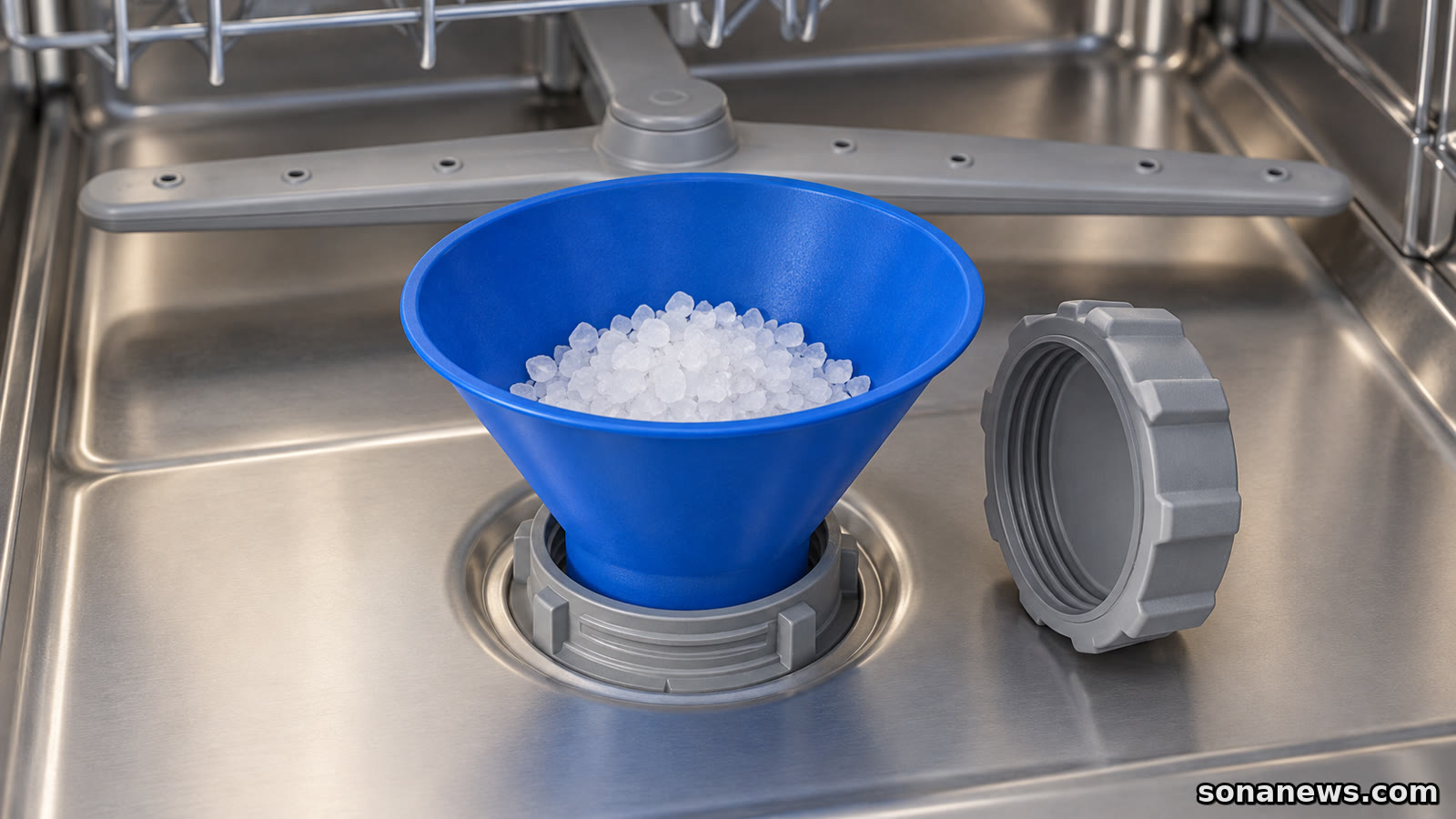
Bosch locates the salt tank in the floor of the dishwasher, accessed by removing its cap. Its guidance shows a dedicated funnel for adding dishwasher salt. This is separate from placing a detergent tablet in its dispenser: the two products are not interchangeable.
Use only the type of salt specified for the dishwasher. Bosch's UK guidance rules out table salt, sea salt and kosher salt as substitutes. Its US page describes dishwasher salt as coarse granules and warns that ordinary table salt could damage the softening system. A kitchen salt container is not an emergency replacement.
Refilling also has model-specific steps. Bosch's UK instructions say water is added to the reservoir before salt on first use, and that the cap must be properly closed before a cycle. Its US guidance calls for a load immediately after filling so residual salt does not corrode the metal interior. Follow the manual's filling and post-refill instructions, rather than treating this summary or an illustration as a universal sequence.
For the same reason, do not turn a salt warning into a reason to scatter granules inside the tub or add them to the detergent dispenser. The relevant part is the dedicated reservoir identified in the appliance instructions. If its location or the warning symbol is unclear, the manufacturer can identify it from the model reference.
Bosch says the salt refill indicator is the prompt to top up the reservoir. AEG's hardness guidance also links correct adjustment with keeping the salt indicator active. A warning light and the detergent packet therefore answer different questions: one concerns the appliance's system, the other the product being used.
Neither establishes the cause of every disappointing wash. Manufacturer guidance describes hardness as one influence on results, not a diagnosis of every mark on a glass. This article has not tested a detergent, inspected an appliance or established that changing the salt setting will cure an individual problem.
Before buying a different tablet or changing a setting, gather the exact model reference, the water-hardness value with its unit, and the current detergent's instructions. That small set of details makes a support enquiry more useful than saying the dishwasher uses all-in-one tablets.
The practical conclusion is conditional, but straightforward. Some dishwashers have no salt system; some water supplies do not require salt under the model's instructions. Where a softener does need it, the all-in-one claim is not permission to ignore the reservoir. Let the water information, manual and detergent instructions answer the question together.
Editorial note. General household information, not an appliance repair, installation or fault-diagnosis guide. Follow the instructions for the exact dishwasher and cleaning products. Do not add salt to a machine without a designated salt system, substitute cooking salt, or put detergent in the salt reservoir. Ask the manufacturer or an authorised service provider about unclear controls, warnings or persistent problems. The illustration does not specify a refill procedure for any model.
Sources
- Source: Bosch US, Do I need dishwasher salt if I use tablets?, Accessed 14 October 2026. Verifies that only some models use salt, hardness-dependent tablet guidance, sources of hardness information, model-manual settings, coarse granules, reservoir/funnel location, refill indicator and immediate post-refill washing to clear residual salt. Marketing guarantees and recommended branded cleaning products are excluded
- Source: AEG UK, How to adjust water hardness level in dishwasher, Accessed 14 October 2026. Verifies mineral removal, adjustment regardless of detergent type, limited multi-tablet softening effectiveness, different hardness units and the explicit model-specific limitation. No button sequence, universal setting or numerical hardness threshold is reproduced
- Source: Bosch UK, What does dishwasher salt do?, Accessed 14 October 2026. Verifies the separate reservoir at the base, first-use water instruction, closing the cap, refill warning and exclusion of cooking-salt substitutes. The page's broad chemical explanation of cooking salts is not adopted
Help us improve
Was this article useful?
One anonymous tap helps Sona improve future reporting, headlines and source context.
Up next
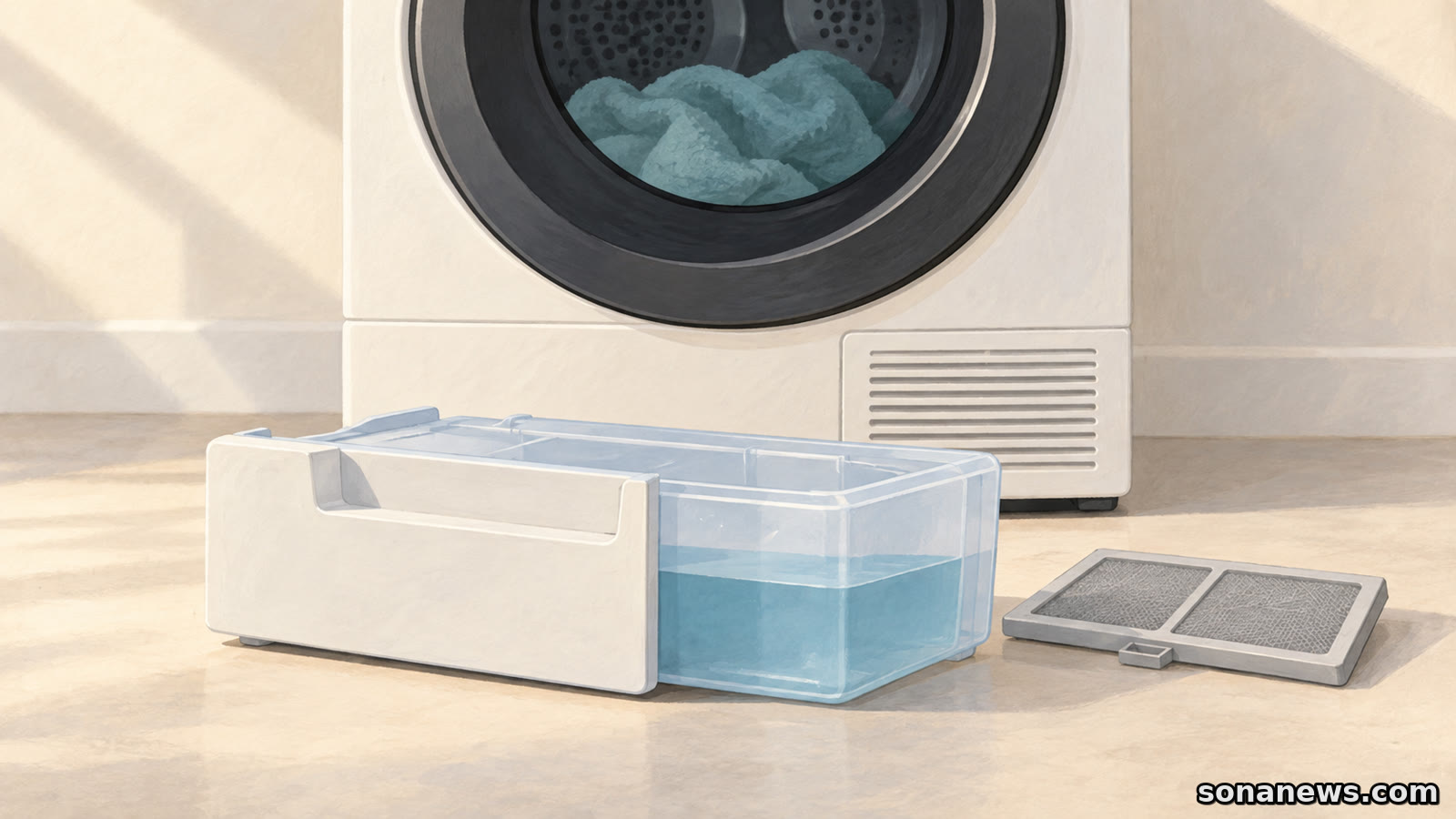
Heat-pump tumble dryers do not need an exhaust hose through an outside wall. Their water tank, drainage options and installation instructions still deserve a check before delivery.
Continue readingMore in Home & Living