France's free-flow tolls: no booth does not mean no bill
On the A13-A14 Paris-Normandy route, drivers without automatic payment have 72 hours to settle the toll. Rental cars need a separate check.
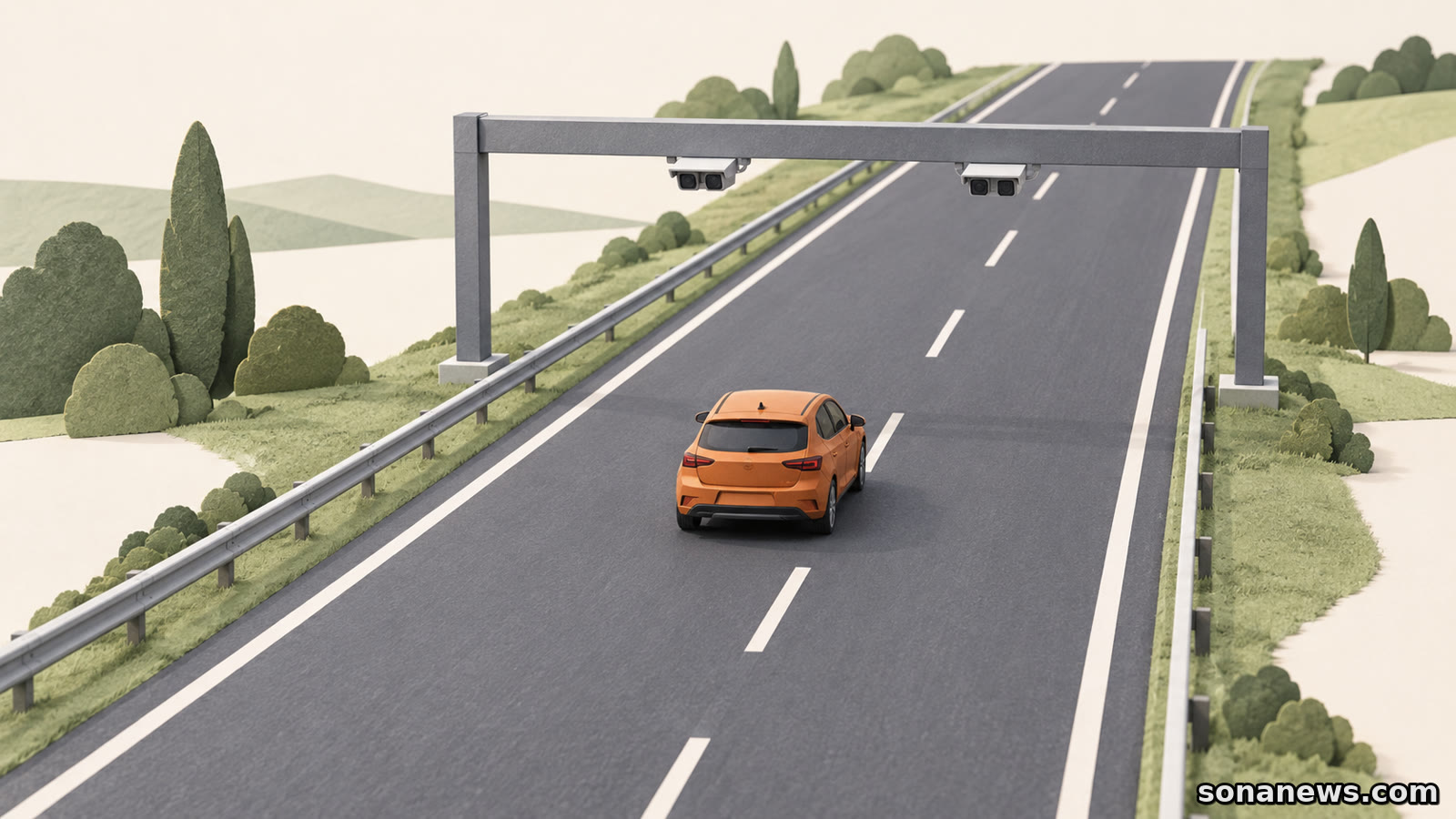

A drive from Paris towards Normandy can include a motorway toll without the familiar pause at a booth. Cameras and sensors on overhead gantries record the vehicle as it passes. There is no ticket to collect and no cashier to remind an occasional visitor that the journey still has a price.
For drivers without an electronic toll subscription or an active automatic-payment arrangement, the important part comes afterwards: **the toll must be paid within 72 hours of travel**. France's transport ministry says an occasional user who has not signed up for a payment or alert service should not expect a routine bill or reminder before that deadline.
This is an explanation of the existing system, checked on 12 October 2026, not a new charge announced today. Its practical consequence is easy to miss: a road can be free-flowing without being free of charge.
The official guidance identifies the A13-A14 corridor between Paris and Normandy, the A79 in the Allier department and the Boulay interchange, exit 36 on the A4, as free-flow toll locations. The A4 reference is to that interchange, not a claim that the entire motorway uses this system.
The payment destination depends on the route. **Sanef** handles the A13-A14 and the Boulay toll; **Aliaé** handles the A79. A traveller using both networks should not assume that a web payment or a plate-based account with one operator settles journeys on the other.
The ministry describes signs bearing the word “PÉAGE”, with “flux libre” underneath. Overhead equipment reads a registration plate or detects a toll tag and identifies the vehicle category. This replaces the stop for payment, not the normal obligation to follow road signs and speed limits.
For a visitor, the useful distinction is between the road's detection system and the driver's payment arrangement. A camera recording a car does not, by itself, establish that an operator has a bank card authorised to pay for it.
A compatible electronic toll tag, correctly fitted to the vehicle and covered by an active subscription, allows payment to be handled automatically. The ministry stresses correct installation. The fact that a tag is somewhere inside the car is not the same assurance as having it mounted and functioning as required.
Without that arrangement, drivers can use the relevant operator's official website and enter the vehicle registration to find the amount due. An online account is optional for a one-off payment. Sanef's English homepage offers separate routes for paying from an account and paying without logging in.
Automatic card payment is another option within an operator account, but it must actually be enabled. Registering for an email notification is not the same as authorising a payment. Sanef presents these as distinct services: alerts for a pending toll, or a registered card for automatic settlement.
There is also an offline option. Participating tobacconists and newsagents in the **Nirio** network accept payment by cash or card. This means a driver does not have to buy a toll tag or create an online account simply to use a free-flow road. The 72-hour deadline still applies.
The sensible record to keep is confirmation of the payment, rather than an assumption that passing a gantry completed it. The ministry says a standard receipt is issued for online payments without an account and for Nirio payments.
A rental booking does not explain, on its own, how that vehicle's tolls will be paid. Before relying on an automatic service, the point to establish with the hire company is whether one is active for that car and what the rental contract says about its use.
For a hire car without a subscription or account arrangement, the ministry says the payment methods are the same as for a privately owned vehicle. When entering the registration, the driver can select the period during which the car was hired so that only tolls from that period appear.
That makes the registration and hire dates useful details to retain alongside the rental agreement. It also gives a reason to check the journey list rather than paying every item associated with a vehicle that other customers use. This is not a claim that all rental companies include tolls in their advertised price or operate the same service.
The ministry's online-payment guidance does not settle a particular rental contract, an administration fee or a disputed journey. Those questions belong with the hire company and the motorway operator, using the actual booking and payment records.
The absence of a routine reminder does not extend the payment window. Service Public says that after non-payment within 72 hours, the operator sends a payment notice to the vehicle's registered keeper. That notice includes the unpaid toll and a €90 fixed indemnity, reduced to €10 if paid within 15 days. It also describes a €375 increased fixed fine if payment is not made within two months.
Those later procedures are not an alternative deadline for paying the ordinary toll. Anyone dealing with a notice needs the instructions and dates on that notice, rather than a general travel article used as personal legal advice.
There is a second reason not to let an incoming message dictate the process. France's national gendarmerie warns that fraudsters impersonate toll services in texts and emails, directing motorists to fake sites that request personal and bank details. Its guidance is not to reply to those fraudulent messages or open their links and attachments.
A payment check can instead start from the official operator website identified by the road used. For a Paris-Normandy trip, that is Sanef; for the A79, it is Aliaé. The missing booth changes when the payment happens. It does not make an unsolicited demand a trustworthy route to it.
Editorial note. This is general travel information, not personalised legal, financial or road-safety advice. Check current official operator instructions and any rental agreement for the actual vehicle and journey. A payment dispute or notice requires its own dates, records and applicable procedure.
Sources
- French transport ministry, Free-flow tolling, English guide and FAQ: Accessed 12 October 2026. Verifies the existing system, 72-hour rule, signs, registration reading, operator distinction, optional accounts, correctly installed tags, Nirio cash/card payments, lack of routine reminders for unenrolled users, rental-period selection and payment receipts. The page includes legacy rollout wording in its FAQ; current introductory wording and Service Public confirm operation, so the article does not present the rollout as a new announcement
- Service Public, Péage en flux libre: comment ça marche?: Accessed 12 October 2026. Confirms road scope, specifically A4 exit 36 rather than the whole A4, the 72-hour period, official payment destinations and notice amounts of €90, €10 within 15 days and €375 after two months. Amounts are attributed general information, not a personal liability assessment
- Sanef, English payment homepage: Accessed 12 October 2026. Operator confirmation of the 72-hour payment period, account and no-login payment options, plate/card automatic payment, separate notifications and A13/A14/Boulay coverage. Payment was not attempted. The extracted page contains a service-issue notice and stale rollout marketing; neither is used to claim live checkout availability or a current network outage. A deeper support URL encountered an anti-bot block and is not relied upon
- Gendarmerie nationale, Péages autoroutiers en flux libre: attention aux arnaques par SMS et e-mails: Accessed 12 October 2026. Primary warning about impersonation, fake payment links and collection of personal/bank data. Used for fraud prevention, not to define the coverage of particular subscription brands
Help us improve
Was this article useful?
One anonymous tap helps Sona improve future reporting, headlines and source context.
Up next
Some train-deck storage is available without a reservation, but a suitcase over 160 cm in total dimensions still needs the right seat on the Tokaido-Sanyo-Kyushu route.
Continue readingMore in Travel