A plate can fit your dishwasher and still block its spray arm
Before choosing a stronger cycle, check the space above tall dishes and in front of the detergent dispenser. Rack position can change what actually fits.
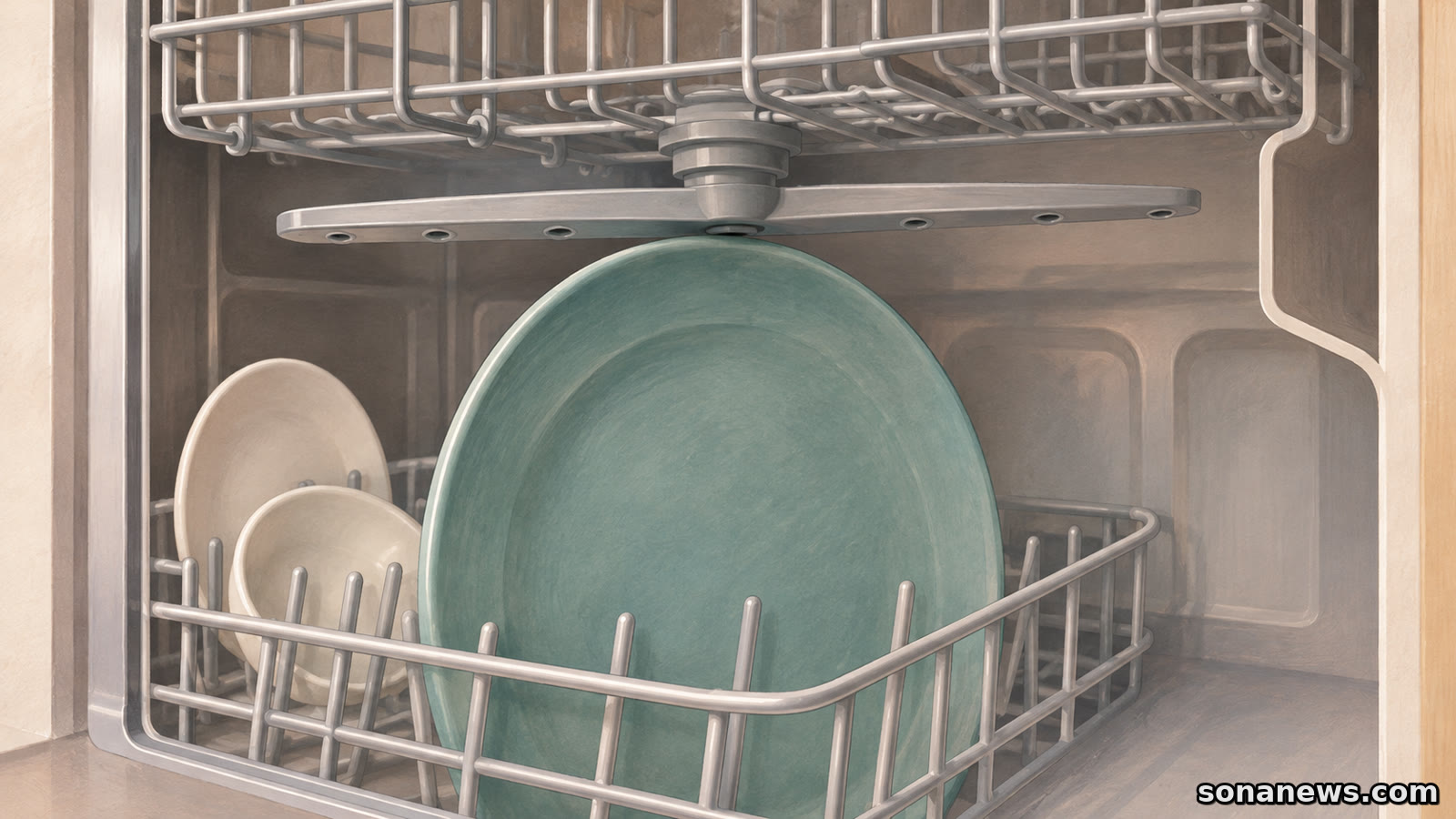

The large plate slides into the rack. The basket rolls back. The door shuts. None of those checks, on its own, proves that a dishwasher has enough room to wash the load properly. A tall dish can still obstruct a spray arm, while something at the front can get in the way of the detergent dispenser.
That makes clearance worth checking before blaming the tablet or choosing a more intensive programme. Whirlpool's quick-start guidance puts a separate step between loading and starting: check that all arms spin freely. Its loading advice also warns that large pots and pans can obstruct the spray arm and prevent water reaching every area.
This is established appliance guidance, not a new fault alert or recall. The sources here are Whirlpool's North American instructions and Bosch's US loading guide. The principle is useful beyond those markets, but rack layouts, adjustment mechanisms and permitted loads vary. The manual for the actual dishwasher remains the reference.
The space above the plate matters
A rack can hold an item securely without leaving the moving parts enough clearance. That is the distinction behind Whirlpool's instruction to check the arms, rather than simply check that the load fits inside the cabinet. The relevant space includes the sweep of the arm, not just its position when the door opens.
Before starting a cool, idle machine, follow its loading instructions and check that no dish or utensil obstructs the spray arms. Do not force an arm past an object. If there is contact, reposition or remove the item and check again with the racks returned to their normal washing positions.
The culprit need not be a full load. One unusually tall plate or awkward pan can be enough to create a clearance problem. Equally, a crowded rack is not proof that an arm is blocked. The useful check is what the loaded objects actually obstruct, rather than a judgement about how full the machine looks.
Whirlpool advises placing larger dishes, pots and pans at the back and sides of the bottom rack, angled towards the spray. That is a starting point for the layouts it describes, not permission to put any oversized object there. Placement still has to satisfy the particular machine's loading diagram and clearances.
Moving a rack changes the calculation
Some dishwashers offer an adjustable upper rack. Bosch explains that raising it creates room for tall dishes below, while lowering it accommodates taller items, such as wine glasses, in the upper basket. That is a trade-off in space between levels, not an increase in the cabinet's overall height.
It also explains why a plate that fitted yesterday may need checking today. If the rack position has changed to make room above, the clearance below can change too. Remembering that an item has been through the machine before is not quite the same as checking the current arrangement.
Do not assume that every basket adjusts, or that every adjustment uses the same levers. The Whirlpool guide describes adjusters on some models and requires its top rack to remain level. Bosch describes its own lifting and lowering method. Use the instructions for your model rather than borrowing another manufacturer's mechanism or forcing the basket.
After an approved adjustment, return the rack to its washing position and recheck the loaded space. If a dish still cannot fit without obstruction, leave it out. Bending rack parts or removing components to create extra height is not a loading solution offered by these sources.
The dispenser needs room as well
Free-moving spray arms are only one part of the check. Whirlpool's quick-start guide separately says that items must not block the detergent dispenser when the door is closed. A loading arrangement can therefore pass the arm check but still be unsuitable at the front of the machine.
Look at the dispenser's position and the load in relation to it, using the manual's diagram. The question is not merely whether the tablet fitted into its compartment before loading. It is whether the arrangement leaves that compartment unobstructed when the appliance is ready to run.
This is why adding a final large item deserves a fresh look. A tray or dish placed in an otherwise convenient gap can change the space available to the dispenser or spray system. A stronger cycle does not move that object out of the way.
Water also needs a route to the surfaces
Clearance is not the whole of good loading. Whirlpool advises against overlapping bowls and plates, and asks owners to face soiled surfaces downwards and inwards towards the spray. Cups and glasses should be positioned so that water can drain rather than pool. Spacing allows water and detergent to reach the surfaces that need cleaning.
Those instructions describe different problems. An arm may turn freely while overlapping dishes shelter one another. Conversely, well-separated plates may still include one tall item in the arm's path. Treating both as simply “overloading” can hide the particular change a load needs.
Only put items in the machine when their own care guidance permits dishwasher use. Solving a space problem does not make an unsuitable material dishwasher-safe. Nor does a successful clearance check diagnose every cause of poor washing: persistent problems still need the model's troubleshooting guidance or service support.
A practical final check is therefore narrow: the racks are correctly positioned, the arms are unobstructed, the dispenser has room and the dishes are not shielding one another. It will not guarantee a perfect result. It does establish something more useful than a closed door: the load has left space for the machine to do its job.
Editorial note. General household information, not personalised appliance-repair or safety advice. Make loading checks before a cycle on a cool, idle machine and follow its manual. Do not force moving parts, lean on an open door, bypass safety features or dismantle components. Seek manufacturer or qualified service support for persistent faults or uncertain procedures.
Sources
- Source: Whirlpool, Dishwasher Quick Start Guide W11834610A, Accessed 8 November 2026. The English instructions explicitly require free-spinning arms before starting, an unobstructed detergent dispenser with the door closed, soiled surfaces facing down and inward, no overlapping items, dishwasher-safe items and a level adjustable top rack on applicable models. North American multi-model guidance, not specifications for every appliance. Cycle durations, performance marketing and detergent comparisons are not generalised
- Source: Whirlpool Product Help, Properly Loading a Dishwasher, Accessed 8 November 2026. Supports large pots or pans obstructing the arm, bottom-rack placement, spacing, drainage and consulting model instructions. The page contains inconsistent fork-orientation wording; no fork-orientation instruction is carried into this article. Pre-rinsing claims and marketing language are excluded
- Source: Bosch US, How to Load your Bosch Dishwasher, Accessed 8 November 2026. Supports the adjustable-upper-rack trade-off: raising creates lower-rack space, lowering creates upper-rack space. Bosch-specific adjustment methods are not presented as universal. Linked images were considered as reference material, not reused without an established licence
Help us improve
Was this article useful?
One anonymous tap helps Sona improve future reporting, headlines and source context.
Up next
The valve responds to nearby air, not the temperature at your sofa. UK guidance explains why covers, curtains and furniture deserve a check before changing the setting.
Continue readingMore in Home & Living