A garage can be too cold for your fridge-freezer
The temperature outside the appliance matters too. Climate-class limits and compartment-specific exceptions decide whether a spare fridge-freezer belongs in an unheated garage.
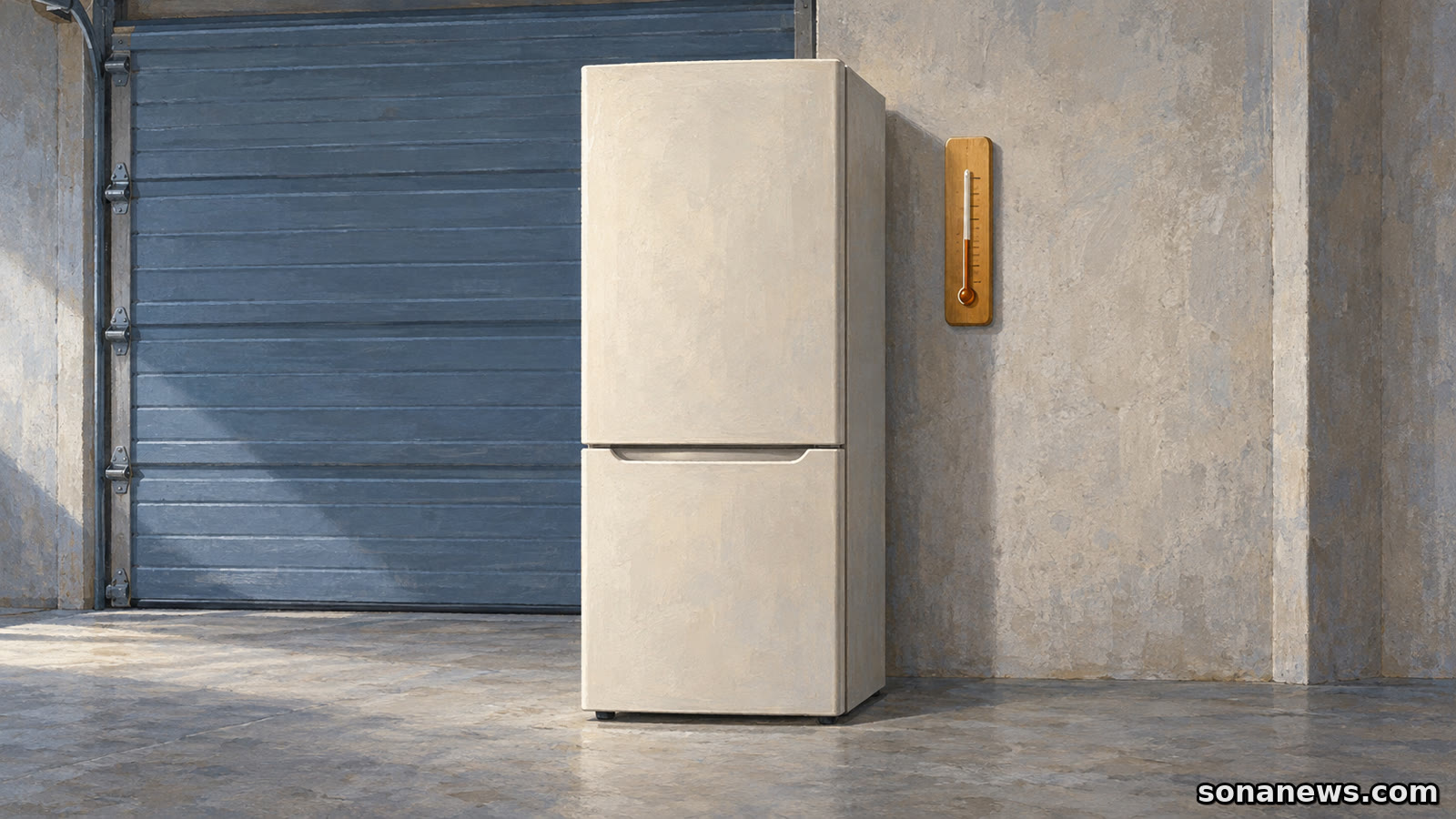

Moving an old fridge-freezer into the garage can look like an easy way to gain food storage. As the room cools in winter, it may even seem that the appliance has less work to do. But colder surroundings are not automatically better: a fridge-freezer has a permitted operating range for the air around it, as well as a target temperature inside.
The useful check is the model's climate class and installation instructions. An unheated garage can fall below that range even when it is nowhere near freezing. And a freezer advertised for low-temperature use does not necessarily make the fridge compartment beside it suitable for the same conditions.
This is an established installation issue, not a new appliance rule or a warning that every garage freezer will fail. The examples here come from Bosch, Beko and Liebherr's UK guidance. Product ranges and exceptions vary by model and market, so the local manual matters more than a familiar badge on the door.
The climate class describes ambient temperature: the air at the installation site, not the setting selected on the fridge's controls. Bosch directs owners to the rating plate or instruction manual to find it. Liebherr likewise identifies the serial tag as the place to look.
Both companies list SN as covering +10°C to +32°C, and N as +16°C to +32°C. Their ST and T examples have higher upper limits but still start at +16°C. Those lower boundaries explain why a garage can be too cold for an appliance before frost appears outside.
Combined classes need careful reading too. Liebherr gives SN-T as an example spanning +10°C to +43°C. The wider range at the hot end does not remove the +10°C lower limit. A label suggesting suitability for warm climates is not, by itself, a promise of winter-garage operation.
There can be additional model-specific qualifications. Bosch's general guidance distinguishes full function within the stated climate range from an SN appliance not being damaged down to +5°C. Those are different assurances. Avoid turning a statement about avoiding appliance damage into a guarantee that stored food will remain at the required temperature.
Beko describes a counterintuitive problem in some fridge-freezers: when the surrounding temperature falls sufficiently, the fridge thermostat can judge that cooling is no longer needed and switch off the compressor. The freezer contents may then begin to thaw.
The company also warns that contents can thaw and refreeze as the outside temperature changes. That explanation concerns a possible behaviour of affected appliances, not a diagnosis of every quiet compressor or every cold garage. It does, however, show why the room and freezer cannot be treated as one temperature.
A cold-feeling garage is not evidence that the freezer is maintaining its intended conditions. Nor does turning the control to a colder setting establish that the appliance is now approved for a room below its operating limit. The installation range remains a separate specification.
There is another side to the problem. Beko warns that the fridge compartment will not work properly in low ambient temperatures and that its food can freeze when the surroundings reach 0°C or below. Keeping chilled food and keeping frozen food are different jobs, even when the compartments share one cabinet.
Specially designed products are an important exception. Beko says its Freezer Guard technology allows the freezer to work at ambient temperatures as low as -15°C. On the same page, it explicitly recommends using only the freezer compartment, not the fridge compartment, in low ambient temperatures.
That qualification is more useful than the headline feature name. For a combined appliance, the question is not simply whether it has a cold-weather feature, but which compartment the manufacturer says can be used, at what room temperature and under what installation conditions.
Liebherr's UK FAQ similarly says proper functioning is no longer guaranteed below +10°C for its general appliance guidance, then identifies FrostProtect-equipped appliances as an exception operating down to -15°C. This is not a comparison test or a recommendation to choose one brand. It shows why exceptions have to be matched to the exact model rather than extended to everything a manufacturer sells.
For a purchase or a move, ask for the permitted ambient range in writing and confirm that it covers the intended compartment. A garage-use claim does not replace the rest of the installation instructions, including ventilation requirements. Do not read it as permission to place an indoor appliance outdoors.
A room thermometer helps answer whether the proposed location falls within the manufacturer's range. A fridge thermometer answers a different question: what is happening inside the food compartment. One reading cannot stand in for the other, and a mild afternoon does not establish the garage's overnight conditions.
The Food Standards Agency's household guidance for England, Northern Ireland and Wales recommends a fridge between 0°C and 5°C and a freezer around -18°C. It recommends using a fridge thermometer and checking weekly. These are food-storage recommendations, not climate-class limits for the room. Follow local food-safety guidance and the storage instructions on food packaging where you live.
If food may have thawed unexpectedly or its temperature history is uncertain, an appliance specification cannot tell you whether it is safe to eat. Seek the relevant food-safety authority's guidance rather than using the garage's coldness as reassurance. An unresolved cooling problem belongs with the manufacturer or an authorised service provider, not an improvised heater or thermostat modification.
Before filling the spare appliance, establish three things separately: the room's conditions, the model's permitted operating range and the temperatures required for its contents. The extra storage is useful only if those conditions fit together. In a garage, the temperature that is easiest to overlook is the one outside the door.
Editorial note. General household information, not personalised food-safety advice or an appliance installation or repair guide. Follow the instructions for the exact model and local food-safety guidance. Do not bypass controls, add improvised heaters or modify a thermostat to force operation outside the specified conditions. If food may have thawed or its storage history is uncertain, seek official food-safety guidance; this article cannot determine whether it is safe to eat.
Sources
- Source: Bosch UK, What temperature should a freezer be?, Accessed 21 October 2026. Supports climate class on the rating plate/manual, ambient ranges, ventilation and the distinction between full function within the range and a separate no-damage statement at +5°C. Button sequences and model-dependent setting ranges are not generalised
- Source: Beko UK, Freezer For Your Garage, Accessed 21 October 2026. Supports possible thermostat/compressor behaviour in cold surroundings, thaw/refreeze risk, a -15°C Freezer Guard claim and the explicit fridge-compartment limitation. Brand-wide promotional availability and reliability claims are not adopted; readers must check the exact model
- Source: Liebherr UK, Appliance FAQs, Accessed 21 October 2026. Supports serial-tag location, climate-class ranges, combined SN-T meaning, the general below-10°C limitation and FrostProtect exception down to -15°C. Unrelated food-disposal thresholds, universal clearance measurements and energy-saving claims are not reproduced
- Source: Food Standards Agency, How to chill, freeze and defrost food safely, Accessed 21 October 2026. Official household guidance applying to England, Northern Ireland and Wales: fridge 0-5°C, freezer around -18°C, fridge thermometer and weekly check, food-label instructions. This is distinct from installation ambient limits and is not presented as a worldwide legal standard
Help us improve
Was this article useful?
One anonymous tap helps Sona improve future reporting, headlines and source context.
Up next
The valve responds to nearby air, not the temperature at your sofa. UK guidance explains why covers, curtains and furniture deserve a check before changing the setting.
Continue readingMore in Home & Living