An induction-ready pan can still be too small for your hob
The rim size is not the whole story. A pan's magnetic base, the chosen cooking zone and the hob's own instructions determine whether they are a useful match.
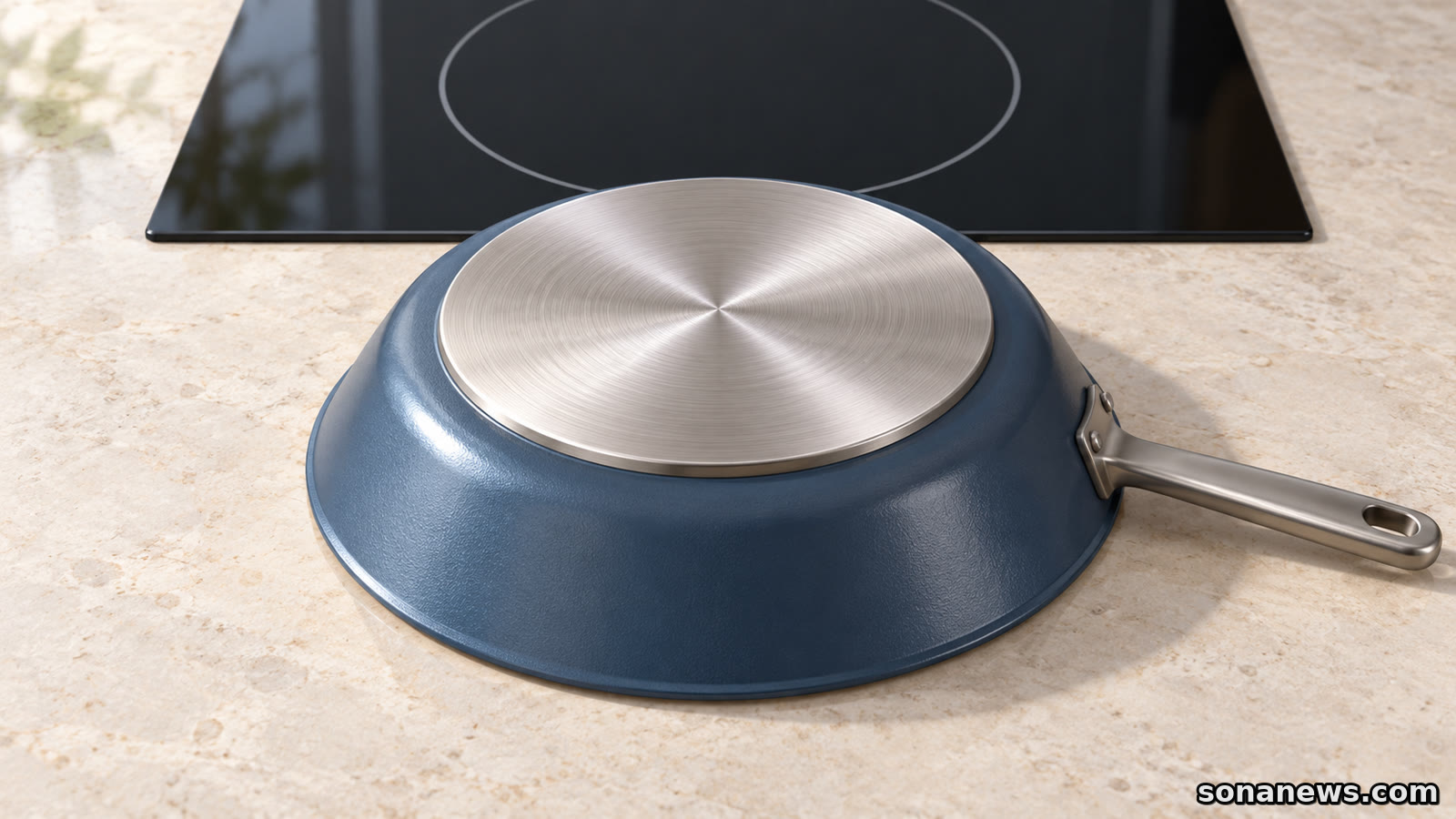

The new pan says it works on induction. It looks wide enough for the cooking zone. Yet the hob does not recognise it. Before treating that as proof of a faulty appliance, there is a less obvious measurement to check: the bottom of the pan, rather than its rim.
Induction compatibility and a suitable size are separate questions. A pan can contain the right magnetic material but have too small a base for a particular zone to detect. Equally, a broad, flared frying pan can occupy plenty of space above the glass while presenting a much smaller base underneath.
This is an established cookware-matching issue, not a new restriction on induction cooking. Guidance from CATA, Novy and AEG provides the examples here. The UK and international support pages describe particular products and systems, so their placement rules should not be exported unchanged to every hob sold elsewhere.
CATA's explanation of pan detection distinguishes the visible rim from the magnetic area in the base. Sloping sides can make the top substantially wider than the bottom. Some induction-compatible pans also use a magnetic insert that covers only the central part of the base, rather than its full width.
That makes a product listing's single diameter an incomplete buying guide. The useful question is what it measures. A rim diameter describes the width at the top; it does not necessarily describe either the flat bottom or the extent of its magnetic material.
For someone choosing cookware, the practical comparison is between the pan maker's base specifications and the hob manual's requirements for the intended zone. If a listing gives only an overall size, ask the seller or manufacturer for the base diameter and induction specification. Do not assume a visible metal disc proves how much of the base is magnetically suitable.
This is particularly relevant when buying a small saucepan for an existing hob, or keeping favourite pans after changing appliances. The label can establish the intended cooking technology without promising that every pan will suit every zone.
CATA suggests a magnet check as a way to identify an induction-suitable base. Magnetic attraction is useful information about the material, but it does not measure whether that base meets a particular zone's size requirement.
The company's own troubleshooting guidance treats these as separate checks: first material compatibility, then base size and positioning. Its broad reassurance about a magnet sticking therefore needs to be read alongside those other conditions, not as a guarantee that any magnetic pan will work anywhere.
Novy's guidance likewise says cooking zones adjust to pan diameter only to an extent. It specifies a minimum base size in relation to the chosen zone and recommends centring the pan. That supports the principle of matching base and zone, not a single minimum diameter that readers should apply to all brands.
If a small pan is not recognised on a large zone, the manual may identify a smaller suitable zone. Check its cookware table rather than assuming that selecting more power will solve a size mismatch. Any comparison or inspection should begin with a cool pan and a switched-off, cool hob.
A flexible induction surface changes the layout question, but does not remove it. AEG's guidance for its 8000 TotalFlex system describes triangular areas that combine to recognise cookware and create cooking zones.
The support page shows different placements for smaller pans and larger cookware. It also gives specific rules for bridging and oval pans, including arrangements it says are incorrect. Those diagrams belong to that system; they are not instructions for an ordinary circular zone or every flexible hob.
The broader lesson is to open the placement diagram for the exact model. A large printed area, a bridge function and an automatically detecting surface are not interchangeable promises. A pan that seems to fit the glass may still be in the wrong position for the system underneath.
AEG also calls for thick, flat cookware bases and clean, dry surfaces. These are additional suitability checks, not evidence that every detection problem is caused by the pan. A photograph of a saucepan cannot establish its magnetic properties, flatness or compatibility with a named hob.
A refused pan does not, by itself, tell you which component is at fault. CATA's troubleshooting page also discusses control locks, demonstration settings and faults requiring professional attention. AEG directs users to authorised service if its prescribed checks do not resolve the problem.
That is a reason to avoid buying a whole replacement pan set on the strength of one failed attempt. Start with the information that can be verified without opening the appliance: the hob's model, the cookware specification, the selected zone and the manual's placement requirements.
For a support enquiry, note whether the issue concerns one pan or several and which zone is involved. Describe any displayed message exactly, rather than interpreting an unfamiliar symbol as a particular fault. Follow the manufacturer's troubleshooting sequence, not a generic button combination found for another model.
For shopping, the conclusion is simpler. Ask for the base measurement before comparing the price. An induction label is a useful starting point, but the fit is between the pan's usable base and the hob's specified cooking zone. The widest part of the pan is not necessarily the part that settles it.
Editorial note. General household information, not an appliance installation or repair guide. Inspect cookware only when cool and with the hob switched off and cool. Follow the instructions for the exact hob and pan. Do not open the appliance, bypass pan detection or improvise an adapter to force an unsuitable pan to work. Refer persistent faults or unclear warnings to the manufacturer or an authorised service provider.
Sources
- Source: CATA Appliances, Why Your Induction Hob Detects the Wrong Pan Size, Accessed 18 October 2026. Supports the distinction between rim diameter, tapered sides, base diameter and partial magnetic inserts. Numerical examples, frequency claims about faults, material rankings and simplified explanations of heating patterns are not adopted
- Source: CATA Appliances, Why Won't My Induction Hob Recognise the Pan?, Accessed 18 October 2026. Separately identifies magnetic compatibility, minimum base size, position, control settings and professional-service issues. The article deliberately qualifies the page's blanket magnet reassurance using its own additional conditions; no universal minimum, mat recommendation, reset sequence or component diagnosis is reproduced
- Source: Novy, How to determine the dimensions of your pots and pans for induction, Accessed 18 October 2026. Supports limited automatic adaptation, a minimum base size relative to the chosen zone and central placement. The page's approximate ratio and temperature claims are not generalised or repeated
- Source: AEG UK, TotalFlex Hob will not detect pans and cookware, Accessed 18 October 2026. Supports model-scoped triangular areas, bridging/placement limits, flat and clean dry bases, and escalation to authorised service. Exact sizes, control timing and diagrams are not republished as universal instructions
Help us improve
Was this article useful?
One anonymous tap helps Sona improve future reporting, headlines and source context.
Up next

A matching base and the right brightness are only part of an LED replacement. Dimmable bulbs and compatible controls need to be checked as a pair.
Continue readingMore in Home & Living