LISA's next test telescope has a job: keep its shape
NASA is moving towards a final pre-flight telescope for the ESA-led gravitational-wave mission. Its amber glass-ceramic structure matters as much as its gold mirror.

A telescope being developed for LISA will not earn its place in space by producing a sharper photograph. Its task is to help measure extraordinarily small changes in distance between spacecraft millions of kilometres apart. For that, the structure holding the optics must be exceptionally reluctant to change shape.
NASA said on 8 October that L3Harris Technologies will design, assemble and integrate a new Engineering Test Unit for the mission. The agency describes it as the last pre-flight telescope unit and its first optical telescope delivery to the European Space Agency. That is a development step towards flight hardware, not an announcement that the observatory is ready to launch.
LISA, the Laser Interferometer Space Antenna, is led by ESA with NASA as a partner. Launch is planned for the mid-2030s. The immediate news concerns a telescope on the ground; the reason it matters lies in an unusual observatory that will spread across a triangle in space.
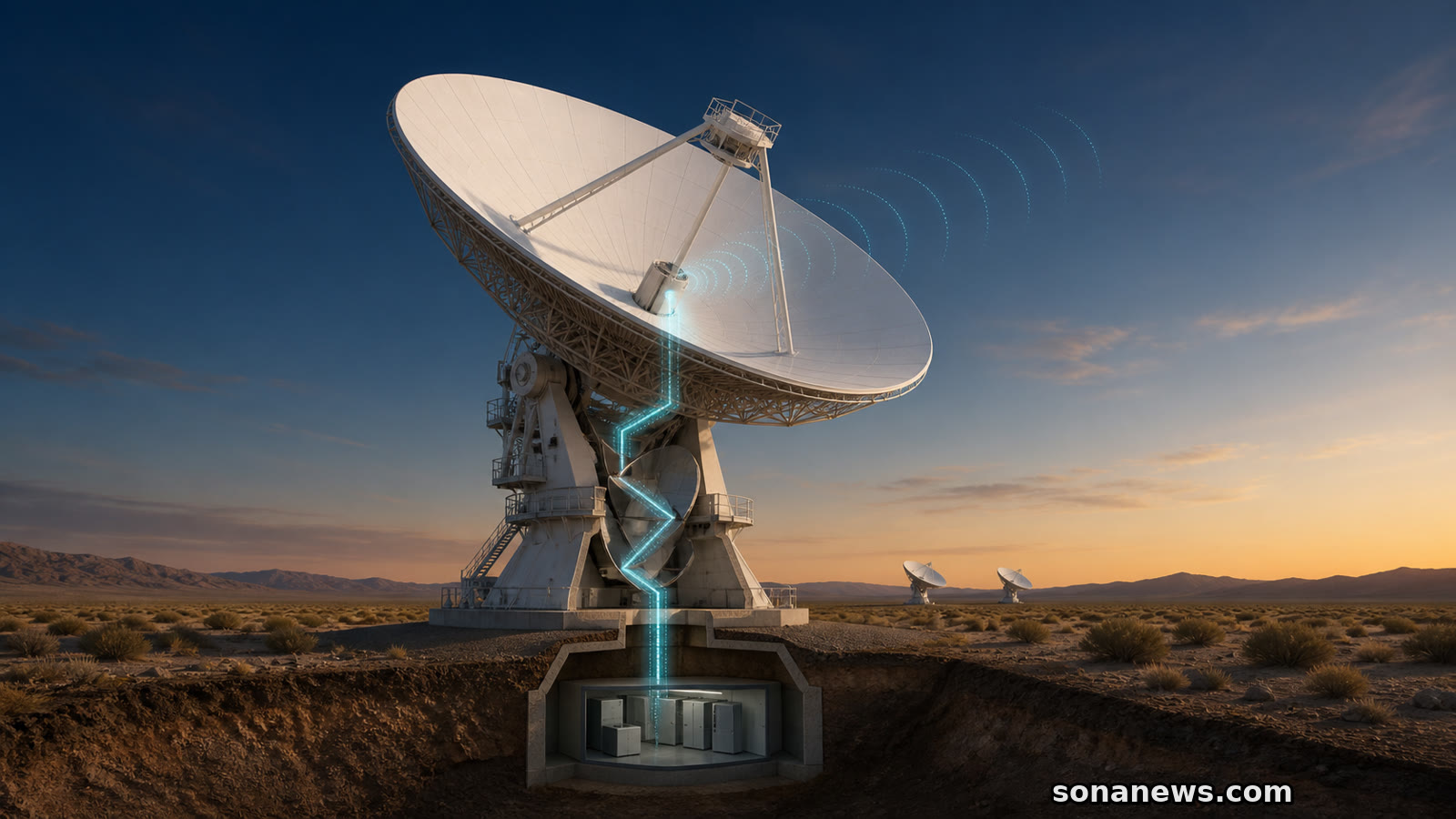
The planned constellation consists of three spacecraft following Earth around the Sun. Each side of the triangle will be about 2.5 million kilometres long. Two telescopes on each spacecraft will transmit and receive infrared laser light to and from its neighbours.
Those links are part of a measurement system designed to detect gravitational waves, ripples in space-time produced by systems such as orbiting compact stars and merging massive black holes. A passing wave slightly changes the relative distances being measured. LISA's job is to extract that signal from the many other things that can disturb a precision instrument.
The reference points are free-floating proof masses inside the spacecraft. NASA's mission overview specifies two small cubes per spacecraft. The surrounding spacecraft must manage their environment so that non-gravitational disturbances are kept extremely low. The telescopes carry the light between spacecraft; the cubes provide the freely falling references. Neither does the whole job alone.
This distinction helps explain why the telescope's material is part of the science story. An instrument searching for a minute change in distance cannot casually introduce changes of its own. Stable optics and structures support the measurement, alongside the lasers, proof masses, spacecraft controls and data analysis.
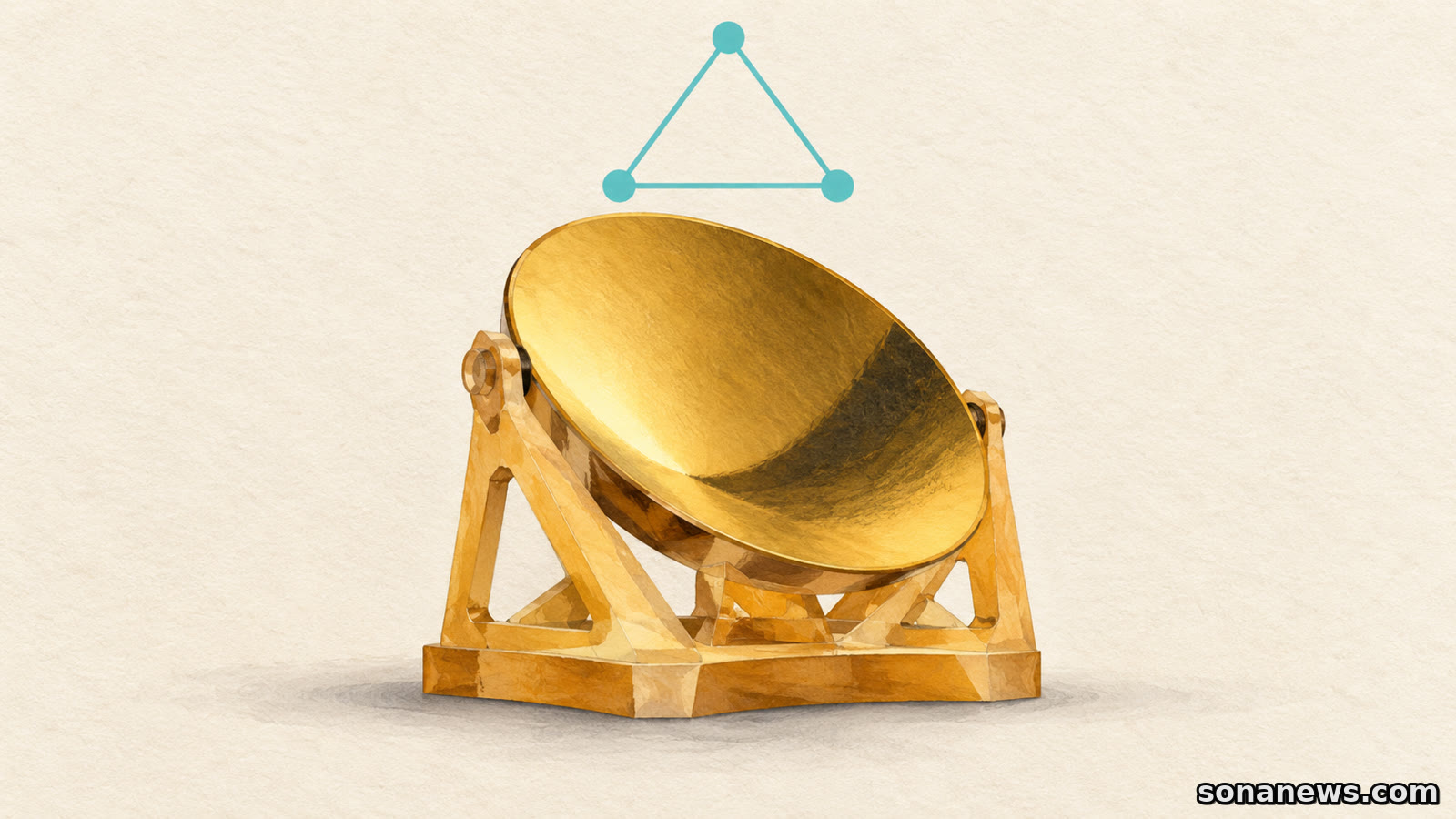
NASA says the telescope will be made from Zerodur, an amber-coloured glass-ceramic chosen because its shape changes very little across a wide range of temperatures. The point is not that it is transparent or decorative. The useful property is dimensional stability.
The mission's earlier prototype makes that choice visible. Delivered to NASA's Goddard Space Flight Center in May 2024, it has a gold-coated primary mirror held within the distinctive pale amber structure. In its 2024 account, NASA explained that the gold coating improves reflection of the infrared laser light and reduces heat loss from the surface facing cold space. The telescope works best close to room temperature.
Glass-ceramic structure and mirror coating therefore solve different problems. The former helps retain geometry; the latter handles the light and thermal behaviour of the reflecting surface. Calling it a gold telescope misses the less conspicuous engineering choice supporting the mirror.
The public photographs accompanying the latest announcement show that 2024 prototype. They do not document a newly completed Engineering Test Unit. Keeping those stages separate matters when the same striking image can illustrate several years of development.
The sequence in NASA's report is useful to follow. First came the glass-ceramic engineering development telescope delivered in 2024. The team tested that prototype and is carrying the lessons into the next optical unit.
A different delivery followed in June 2026: a structural model made from metal rather than glass. NASA identifies that model separately from the optical telescope now being developed. It should not be mistaken for evidence that the flight telescope has switched materials.
The new Engineering Test Unit is the next pre-flight optical step. NASA's report does not supply a delivery date for it or say that it has passed its tests. The milestone is the move into developing that unit, with production of flight hardware still ahead.
That may sound modest beside the ambition of detecting distant black-hole mergers. It is nevertheless the kind of distinction that makes a mission update useful: a prototype, structural model, test unit and flight instrument are related, but they are not interchangeable descriptions of readiness.
Ground-based observatories have already detected gravitational waves. LISA is not being built to claim that discovery again. Its enormous scale is intended to open a different, lower-frequency part of the gravitational-wave spectrum.
ESA's mission factsheet explains that this would let researchers study sources ranging from interacting compact stars to merging supermassive black holes. The space mission complements ground-based facilities such as LIGO and Virgo rather than simply replacing them with a more distant version of the same instrument.
NASA's contributions also extend beyond the telescopes. They include laser systems, devices to manage electric charge on the proof masses, and data-analysis systems to identify and characterise individual gravitational-wave signals. A stable telescope is necessary hardware within a much larger measurement chain, not a detector that works by itself.
For now, there is no new LISA observation to interpret. There is a better-defined next piece of hardware to build. When the eventual observatory searches for changes across millions of kilometres, part of its credibility will depend on a much smaller structure doing as little changing as possible.
Sources
- NASA Science, NASA Advances LISA Mission Contributions With New Test Telescope, 8 October 2026. Accessed 9 October 2026. Verifies Engineering Test Unit development, L3Harris role, last pre-flight unit, intended optical delivery to ESA, June metal structural model, glass-ceramic material and mid-2030s plan. Does not establish completion or a delivery date
- NASA Science, LISA mission overview. Accessed 9 October 2026. Verifies future status, triangular geometry, two proof masses per spacecraft, science goals and NASA contributions. Used for proof-mass count because the news release's singular wording is less precise
- NASA Science, NASA Reveals Prototype Telescope for Gravitational Wave Observatory, 22 October 2024. Accessed 9 October 2026. Historical source for May 2024 delivery, material, gold coating, infrared reflection and heat-loss rationale. Photographs are explicitly of the older prototype
- ESA, LISA factsheet. Accessed 9 October 2026. Supports formation, arm length, low-frequency purpose and comparison with ground facilities. Its old forward-looking construction sentence is not used as current schedule evidence; current milestone and launch wording come from NASA's October report
Help us improve
Was this article useful?
One anonymous tap helps Sona improve future reporting, headlines and source context.
Up next
The meteor shower peaks on 21-22 October, but a bright Moon will hide fainter streaks. A local window after moonset matters more than a universal start time.
Continue readingMore in Space