BepiColombo has shed its cruise module. Mercury arrival is only beginning
ESA confirmed the Mercury Transfer Module separated on 3 September. Orbit capture, spacecraft separation and science operations remain months away.

BepiColombo has spent nearly eight years travelling towards Mercury as one complicated stack. It is now becoming a smaller one.
On 3 September, the European Space Agency confirmed that the Mercury Transfer Module had separated successfully from the mission's two science orbiters. Radio signals received through ESA antennas at Cebreros in Spain and Malargüe in Argentina showed the planned change in motion. Later telemetry indicated that the remaining spacecraft systems were nominal and the Mercury Planetary Orbiter's solar panels were charging its batteries.
It is a real mission milestone, but not the moment BepiColombo entered orbit around Mercury. That is the distinction worth keeping in view as the arrival phase unfolds.
The discarded transfer module, known as MTM, supplied propulsion and power during the interplanetary cruise. Its four ion engines worked with a carefully designed sequence of planetary flybys to remove orbital energy without requiring an impossibly large load of chemical fuel.
Getting closer to the Sun does not naturally slow a spacecraft. It makes the spacecraft accelerate, rather like an object moving downhill. A probe approaching Mercury can therefore arrive too fast for the small planet's gravity to capture it. BepiColombo used one Earth flyby, two at Venus and six at Mercury to reshape its solar orbit gradually.
ESA's arrival media kit puts the full route at about 10.2 billion kilometres and 22 circuits of the Sun. Those figures describe an indirect journey rather than the straight-line distance between Earth and Mercury. The long route was the braking strategy.
MTM had finished that job by early September. After separation, the main Mercury Planetary Orbiter, or MPO, took over responsibility for powering the remaining stack. JAXA's Mercury Magnetospheric Orbiter, named Mio, is still attached and protected inside a sunshield structure.
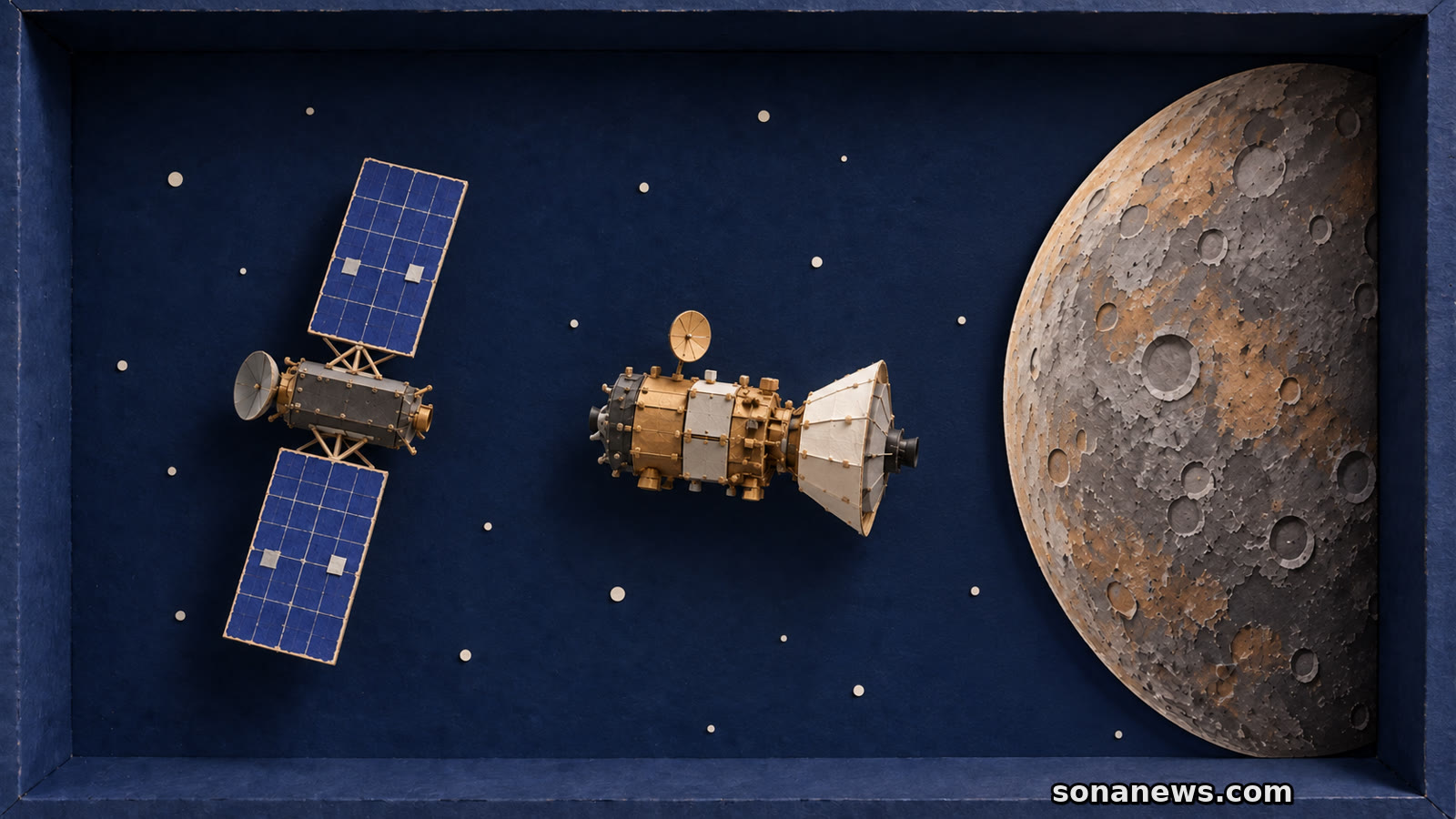
The image above is a conceptual model of that handover, not a photograph or engineering diagram. It uses the newly opened gap between the cruise module and the joined orbiters as the visual fact. It does not show orbit capture as complete.
ESA currently plans for the joined MPO and Mio spacecraft to be captured into a highly elongated orbit around Mercury on 21 November. The agency's media kit gives that initial orbit as roughly 674 by 178,000 kilometres above the planet. These dates can change for operational reasons, a caveat printed directly on the official arrival timeline.
The two orbiters are then due to separate on 9 or 10 December. Mio will be released into an elliptical polar orbit ranging from about 590 to 11,640 kilometres above Mercury. Once free, it can extend its long antennas and magnetometer masts and begin preparing to spin at 15 rotations per minute, its normal operating configuration.
MPO still has more work after that. ESA plans to eject Mio's protective sunshield structure on 16 December, then manoeuvre MPO towards a much tighter polar orbit. The current target is to reach an orbit of about 480 by 1,500 kilometres on 10 March 2027.
The main science phase is scheduled to begin on 6 April 2027. That gap is not dead time. Controllers must commission two spacecraft, deploy hardware, refine orbits and check instruments in an environment where sunlight can be more than ten times as intense as it is near Earth.
A headline about “arrival” can therefore refer to several different events: the cruise module leaving, gravitational capture, the two science spacecraft parting, the final orbit being reached or routine observations beginning. The mission has completed the first of those steps, not the last.
BepiColombo is a joint ESA and JAXA mission because Mercury is not one simple target. The planet has a heavily cratered surface, an unusually large core, a thin exosphere and a magnetic environment squeezed by the solar wind.
MPO will fly close to the surface with 11 science experiments. Its work includes mapping terrain and composition, measuring the gravity field and magnetic field, studying the exosphere and testing aspects of general relativity through precise radio tracking.
Mio carries five instrument packages focused on the space around Mercury. They will measure magnetic fields, plasma, particles, radio and plasma waves, sodium in the exosphere and dust. Its much wider orbit lets it sample the magnetosphere and its interaction with the solar wind.
The value lies partly in simultaneity. A surface-orientated orbiter and a magnetosphere-orientated orbiter can observe connected processes from different locations. They can ask how changes in the solar wind relate to particles and fields around the planet, and how Mercury's surface and sparse atmosphere feed material into that environment.
That complementary observing geometry does not exist yet. Mio remains enclosed, the two craft remain joined and neither is in its final science orbit.
The successful separation confirms that a major mechanical event worked more than 200 million kilometres from Earth. The mission team could not watch it directly or intervene in real time. It inferred the initial separation from a Doppler shift in the radio signal, then waited for the remaining spacecraft to contact Earth and report its condition.
That method is less cinematic than a close-up camera view, but more informative. A change in radio frequency reveals a change in velocity. Subsequent telemetry can show whether power, attitude and other systems are behaving as expected.
BepiColombo is now lighter, differently powered and committed to the next part of its arrival plan. The careful reading is neither “mission accomplished” nor “nothing happened”. Its interplanetary cruise stage has done its work and departed. Mercury orbit, two independent spacecraft and the science campaign are still ahead.
Sources
- ESA, “Latest updates: BepiColombo's arrival at Mercury”. Updated 3 September 2026 and extracted 13 September 2026. Verified successful MTM separation, Doppler and acquisition-of-signal confirmation, nominal systems, the more-than-200-million-kilometre operating distance, MPO power handover and current milestone dates
- ESA, “BepiColombo arrival media kit”. Extracted 13 September 2026. Verified the 10.2-billion-kilometre route, 22 solar orbits, gravity-assist sequence, initial capture and final-orbit geometry, commissioning timeline, date-change caveat, spacecraft configuration and Mercury environment
- JAXA Institute of Space and Astronautical Science, “Mercury Magnetospheric Orbiter MIO / BepiColombo”. Extracted 13 September 2026. Verified Mio's mission role, spacecraft form, planned orbital period and altitude, post-separation antenna and mast deployment, and five science instrument groups
- ESA, “Mercury Planetary Orbiter”. Extracted 13 September 2026. Verified MPO's planned 480 by 1,500 kilometre polar orbit, spacecraft dimensions and 11 science experiments covering Mercury's surface, interior, exosphere, magnetic field and radio science
- ESA, “Why does it take so long to get to Mercury?”. Extracted 13 September 2026. Verified why a spacecraft falls faster towards the Sun, why orbiters must shed energy to avoid flying past Mercury and how repeated gravity assists reduce fuel requirements
Help us improve
Was this article useful?
One anonymous tap helps Sona improve future reporting, headlines and source context.
Up next
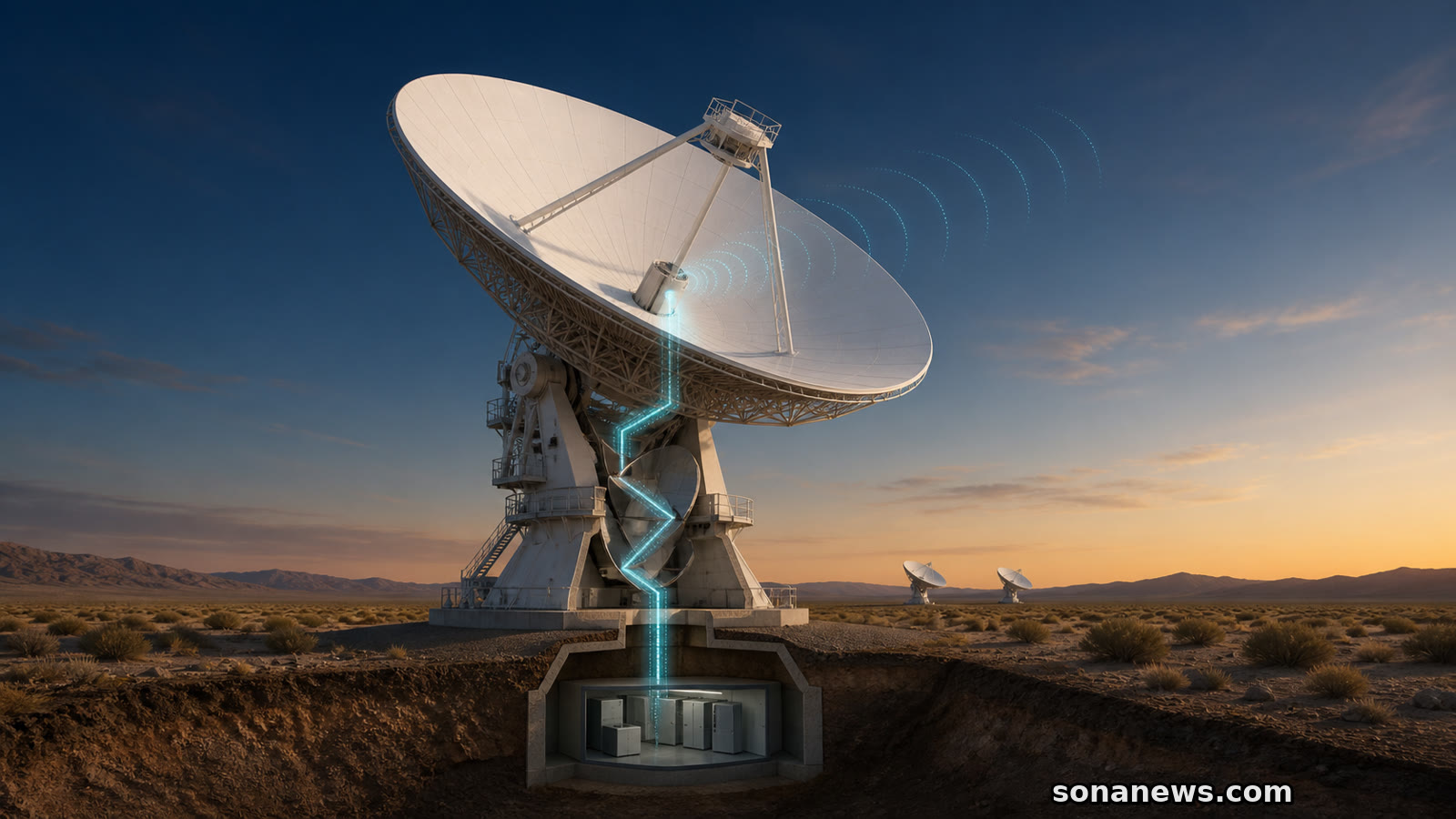
DSS-23 is already tracking spacecraft from California. Its beam-waveguide design adds capacity while moving delicate electronics off the moving antenna.
Continue readingMore in Space