The Moon's tiny laser reflectors are markers, not a GPS network
Passive prisms can help locate lunar landers without using power. The difficult work happens on the spacecraft trying to find them.
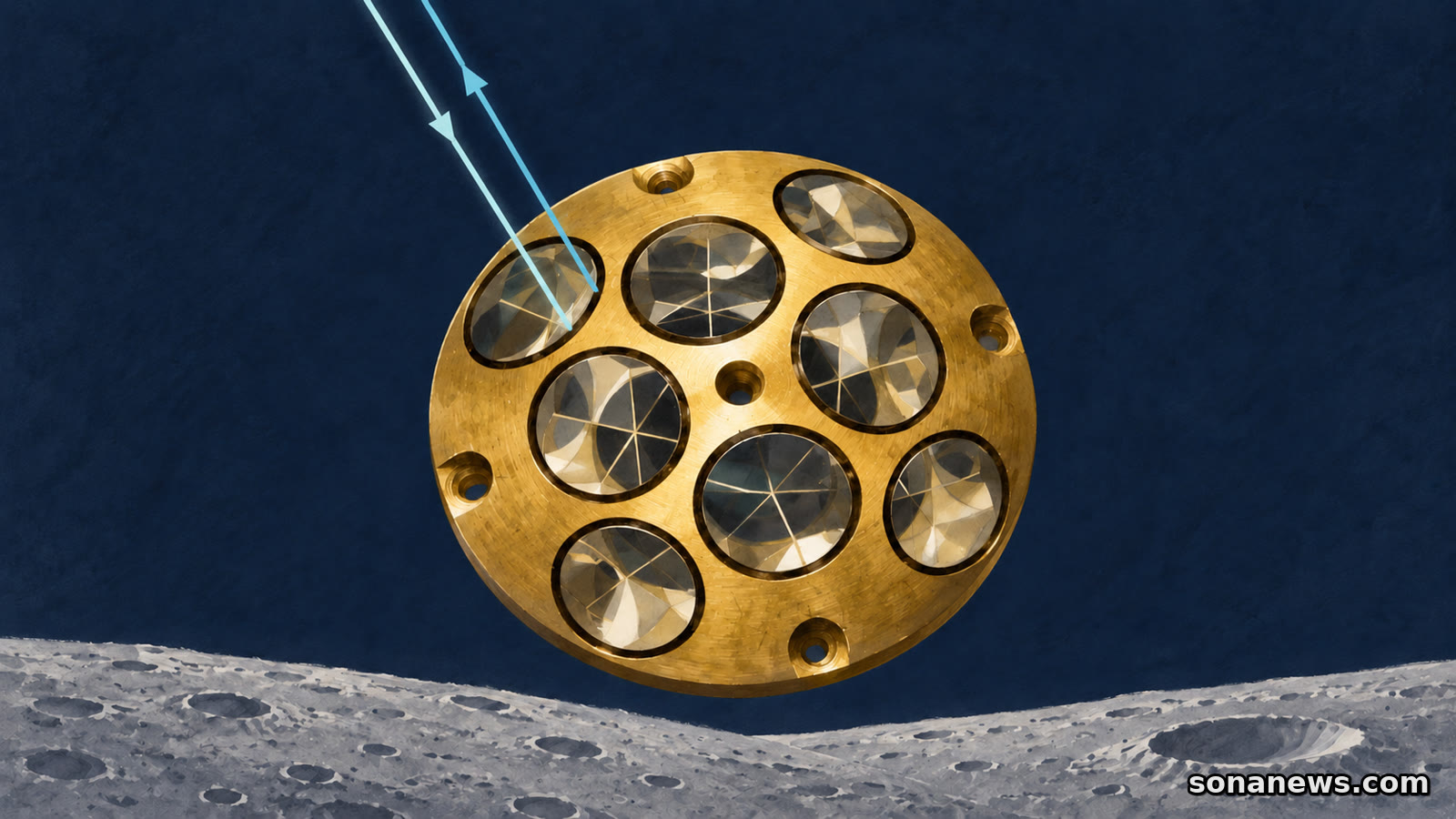

A lunar lander does not have to keep its electronics running to remain useful as a marker. A small assembly of glass prisms can return laser light to an orbiting spacecraft without a battery, a radio message or a command from Earth.
That is the appeal of the miniature laser retroreflectors NASA has supplied for lunar missions. Their simplicity is also easy to misread. A reflector is not a transmitter, and a collection of reflectors is not, by itself, a working lunar equivalent of GPS. Someone still has to illuminate the right target, catch the returning light and turn the timing into a reliable position.
The distinction matters when reading about navigation around the Moon. The demonstrated achievement is a way to measure distances to identifiable surface markers. A routine navigation service is a larger undertaking. The published experiments show both why these tiny objects are useful and why the rest of the system cannot be taken for granted.
NASA's miniature Laser Retroreflector Array is about five centimetres across. Its aluminium dome holds eight corner-cube prisms, arranged to return incoming light towards its source over a range of directions. An ordinary flat mirror would need a much more particular alignment to send the light back to the observer.
NASA describes the assembly as requiring neither power nor maintenance and capable of lasting for decades. Those are properties of the reflector, not a promise that every spacecraft carrying one will remain operational for that long. The laser, receiver, clock and pointing system belong to the spacecraft or observatory doing the measuring.
The basic measurement is a round trip. A laser pulse leaves the instrument, reaches the reflector and returns. The elapsed time provides a distance. Establishing positions then involves the observing spacecraft's trajectory and the geometry of the observation, rather than simply reading coordinates out of the prism.
The illustration above makes that passive optical idea visible. The reflector is enlarged, and the drawn light path is explanatory. It does not depict a photographed beam crossing lunar space or reconstruct a particular spacecraft encounter.
A useful example comes from NASA's Lunar Reconnaissance Orbiter, or LRO, and India's Chandrayaan-3 Vikram lander. On 12 December 2023, LRO sent laser pulses towards the lander from about 100 kilometres away and detected light returned by the small NASA reflector attached to it.
NASA reported the result in January 2024. Its account says the laser altimeter took eight attempts to contact Vikram's reflector. This was a successful demonstration, not evidence that hitting such a target had become routine.
LRO's Lunar Orbiter Laser Altimeter, known as LOLA, was designed to map terrain. NASA explains that it sends five laser beams towards the surface. At an altitude of 100 kilometres, each beam covers an area about 10 metres wide, with substantial gaps between the beams. That arrangement is useful for measuring topography but awkward for finding a target only centimetres across.
The lesson is not that a passive reflector is unreliable. It is that a small, durable target and an instrument optimised for terrain mapping are different pieces of engineering. The quality of the pointing and the chance of actually illuminating the target matter as much as the target's ability to return light.
The story does not end with one ping. NASA Goddard's Planetary Geodesy Data Archive describes a study using LRO measurements collected between February 2023 and December 2024. It includes observations of the Apollo 11 and Apollo 14 arrays, alongside miniature reflectors carried by Chandrayaan-3 and Chang'E-6.
The archive reports measurements across 42 orbital arcs, or portions of the spacecraft's orbit used in the analysis. The researchers combined reflector observations with conventional Doppler tracking data and solved for both LRO's trajectory and the reflector coordinates. Their resulting surface positions agreed with independent estimates within the expected uncertainties.
The reported range accuracy was approximately 1.7 metres. That figure describes the spacecraft-based measurements in this study. It is not a guaranteed landing accuracy, a specification for every reflector, or a claim that a future lunar navigation service has already met a particular performance standard.
There is another important boundary in the archive description: the downloadable table contains successful reflector returns. It is not a record of every unsuccessful targeting attempt. Counting rows in it would not establish how often an arbitrary pass over a reflector will succeed.
Earth-based lunar laser ranging has a much longer history. Observatories send pulses to reflectors placed on the Moon during Apollo and Soviet lunar missions, with newer hardware adding to that record. The International Laser Ranging Service describes measurements used to study lunar motion, the Moon's interior and gravitational physics.
That Earth-to-Moon work and the orbiter-to-surface experiments use the same broad principle: time the light's return. They do not automatically have the same instruments, distances, observing geometry or measurement performance. Quoting the precision of one as though it applies to the other would conceal the engineering question the newer experiments are testing.
NASA has described future uses for miniature reflectors, including helping spacecraft locate surface targets and supporting approaches in darkness. Those are reasons to develop the technique. They should not be read as confirmation that an autonomous lunar landing network is already available.
For the reader, the useful test is to ask what has actually been demonstrated: a detected return, a distance measurement, a position estimate or a complete navigation operation. The little prism assembly can contribute to each stage, but it does not perform them all. Its strength is precisely that it does so little: it provides a durable optical reference while the more complicated equipment does the work.
Sources
- NASA, How NASA Uses Simple Technology to Track Lunar Missions: - Published 13 February 2024, updated 19 March 2025. Verifies the five-centimetre dome, eight fused-silica corner cubes, passive operation, round-trip measurement and prospective navigation applications. Forward-looking mission schedules are not treated as current facts
- NASA, Laser Instrument on NASA's LRO Successfully Pings Indian Moon Lander: - Published 18 January 2024. Verifies the 12 December 2023 experiment, approximately 100-kilometre distance, eight attempts, LOLA's five-beam design and approximately 10-metre footprints at that altitude. Historical operational exclusivity and launch predictions are not repeated as present-day claims
- NASA Goddard Planetary Geodesy Data Archive, First use of laser ranging to surface retroreflectors for orbit determination: LRO at the Moon: - Primary dataset description accompanying Cascioli et al. (2025), The Planetary Science Journal, DOI 10.3847/psj/ae0e0b. Verifies observation period, four targets, 42 arcs, approximately 1.7-metre range accuracy, Doppler combination and successful-return-only selection. The linked full paper has not been independently audited; numerical statements here come from the inspected archive description
- International Laser Ranging Service, Lunar Laser Ranging: - Verifies the separate Earth-based programme, Apollo and Soviet reflectors and scientific uses. Used as context, not as a performance specification for LRO
Help us improve
Was this article useful?
One anonymous tap helps Sona improve future reporting, headlines and source context.
Up next

The meteor shower peaks on 21-22 October, but a bright Moon will hide fainter streaks. A local window after moonset matters more than a universal start time.
Continue readingMore in Space